
Getty
DAYTONA BEACH, FL – 1979: Richard Petty rallied late in the season to gain the advantage and win an unprecedented seventh national title in NASCAR’s Cup Series. (Photo by ISC Archives/CQ-Roll Call Group via Getty Images)
Getty
DAYTONA BEACH, FL – 1979: Richard Petty rallied late in the season to gain the advantage and win an unprecedented seventh national title in NASCAR’s Cup Series. (Photo by ISC Archives/CQ-Roll Call Group via Getty Images)
A seven-time champion racing for his eighth world title. Everything goes well, and he nearly wins the race, when a controversial rule change completely decimates their championship hopes. No, we are not talking about the 2021 Formula 1 season. NASCAR did it long ago, and on a much more complex and technically legitimate scale. Such was the rule that no protests could be staged against it.


In a rather poetic fashion, Richard Petty was racing for his fifth NASCAR Cup Series title (then known as the Winston Cup Series). Everything looked in order–Petty had six wins during the season–quite enough to secure the title, even by today’s standards. But to everyone’s surprise, and Richard Petty’s disappointment, the 1973 Winston Cup Series champion was Benny Parsons.
Watch What’s Trending Now!
You might be wondering, how can this happen?! One probable answer might be that Petty was inconsistent and could not win the championship because of subpar results outside of his six victories. But no, he had 15 Top-5 finishes in 28 races throughout the season. As a matter of fact, Petty was actually only P5 in the drivers’ championship. So, what’s the catch here?
The NASCAR championship system that changed everything for Petty
Yes, NASCAR only adopted the Chase and Playoffs system in the 21st century. But prepare yourself, their points system during the 70s was even stranger than today. It was an era where the reliability of the cars was a much bigger issue. Hence, the sport awarded points to drivers on the basis of the miles they had completed during the race.
The points system awarded drivers bonus points for every lap raced. According to the length of the NASCAR track, each additional lap added the following points to the driver’s tally:
- Under 1 mile – 0.25
- 1 mile – 0.5
- 1.3 mile – 0.7
- 1.5 mile – 0.75
- 2 miles – 1
- 2.5 miles – 1.25
During the 70s, NASCAR was all about survival during the race. Winning did not matter more than going the distance. If you completed a long race without your car breaking down, you were considered a talented driver. Winning at all costs would often lead to breakdowns. Instead, a driver had to be smart and keep the vehicle for as long as possible.
In a way, NASCAR mirrored the endurance racing system. The only difference was that the races were much shorter. Now, Benny Parsons, who was the 1973 Cup Series champion, was able to utilize this system very effectively.
October 21, 1973: Another championship that broke the system. Bonus points were paid based on miles run
Benny Parsons had one win and one lead lap finish but won the title because Richard Petty (who had 6 wins) completed 800 less miles. The system was changed for 1974 pic.twitter.com/2G2jQarQW5
— nascarman (@nascarman_rr) October 21, 2023
He finished out of the Top-10 in only eight out of the 28 races that season. In that manner, he was able to claim the points, as well as the bonus for completing the laps and clocking in more miles than other drivers. Petty’s P5 was nothing compared to one of the other legendary drivers that season.
David Pearson was able to win 11 out of the 18 races he participated in 1973. Yet, he could manage a meager P13 in the drivers’ championship. In the end, Richard Petty lost out to Benny Parsons by 800 miles. The biggest factor that led to his loss was the 10 DNFs he encountered during the season, leading to a massive point deficit.
But such was the dominance of Richard Petty in those years that even a P5 was his ‘lowest’ ranking in the driver standings since 1965. Nevertheless, NASCAR saw the error of its ways and immediately changed its rules to a full-season championship format in 1975. As a result, Richard Petty won the championship once again, finishing his sixth successful NASCAR campaign.
Imagine how the NASCAR fans of that era felt when they saw their favorites winning races but losing championships without any apparent reason.
On that note, it would be a crime to forget the final race of the 1973 Cup Series season…
The ‘rebuild’ that rebuilt Benny Parsons’ championship
Going into the final race of the season, the American 500 at North Carolina Motor Speedway, Benny Parsons was only inches ahead of the competition. He ran out of luck quite soon, ending up in a disastrous accident during lap-13, but somehow kept his Chevy moving forward.
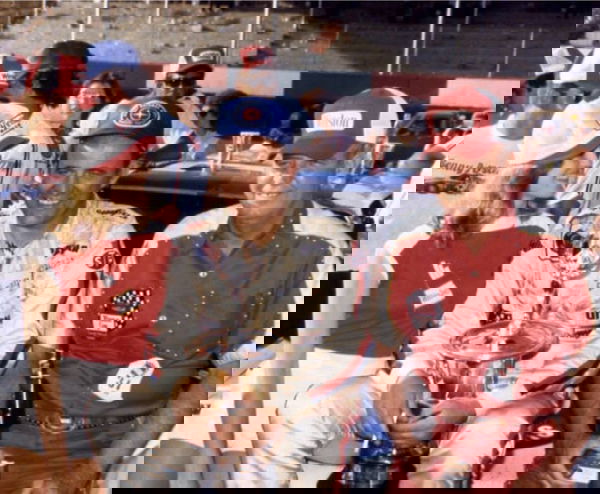
The impact, however, took more out of the car than he would have imagined. The entire right-side sheet metal of his car was torn off, and his roll-cage were severely damaged. When all hope seemed lost, L.G. DeWitt’s crew and volunteers from other teams took on the impossible task of performing CPR on his dying Chevrolet.
Imago
via X (@CBird73936300)
As a result, Parsons was at least able to complete 308 out of 492 laps. It earned him a P28 finish in the race. Paired with Richard Petty’s engine failure, his efforts were enough to secure the crown of the 1973 Cup Series season.
Do you think NASCAR’s old championship systems were unfair? Let us know in the comments.
Written by

Edited by

Suyashdeep Sason