
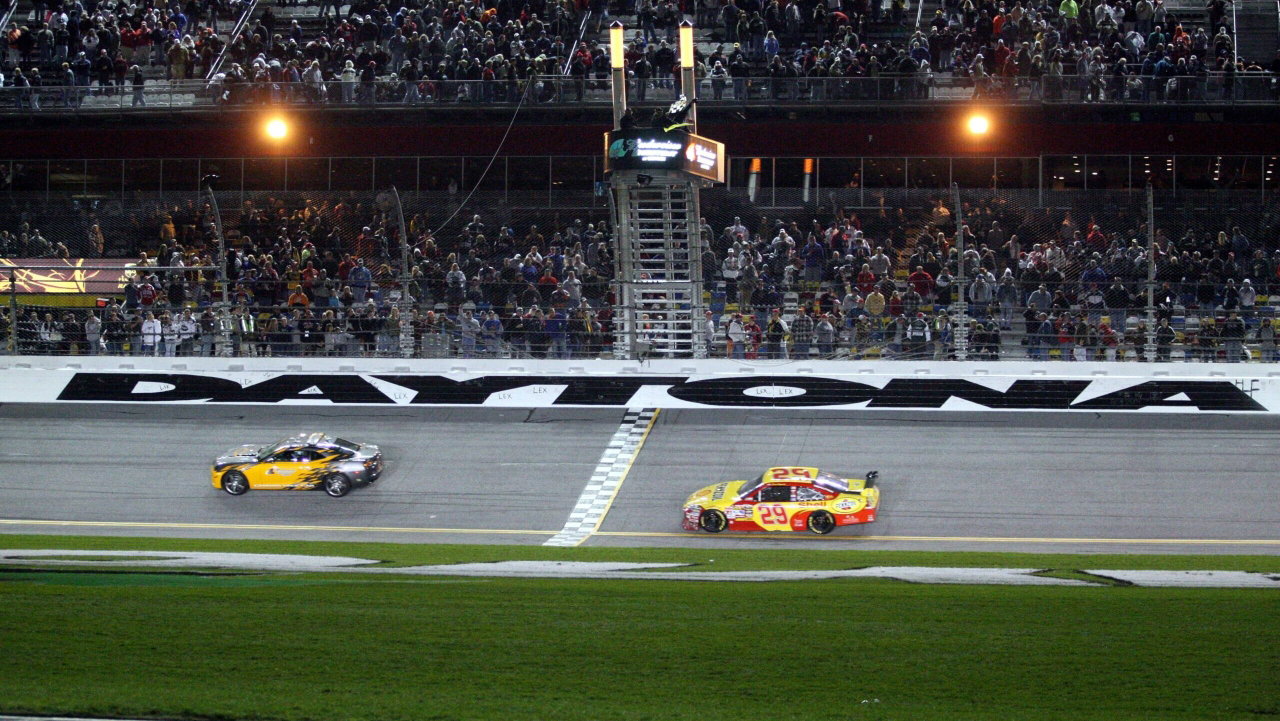
Few years ago, the Clash left Daytona for Los Angeles in an attempt to revive its declining viewership and audience interest. Now, as it prepares for a homecoming next year, NASCAR has answered the fans’ call for a return to tradition. But has it done enough to ensure the racing itself is worth coming back for? For Freddie Kraft, the venue was never the real problem. The bigger question is whether NASCAR has got the racing right.
Watch What’s Trending Now!
Freddie Kraft has been actively following the conversation around the new Clash format for 2027 and has backed the exhibition race’s return to Daytona along with its ‘select drivers only’ participation criteria. And though his driver, Bubba Wallace, has not made the cut, he still believes the new preseason race might deliver now that it has returned to its traditional grounds. But his reservation stems from the format NASCAR is relying on to revive the racing spectacle at the Clash, and he believes it might fall flat on its face if the field decides to save the racing part for the second half of the 70-lap race.
“I don’t think, unless there’s something else they’re going to add to it where they’re going to get points or money or whatever it is for those first 30,” he elaborated. “I think you’re going to see guys just kind of ride around, save fuel, to make that mandatory pit stop at lap as short as they possibly can. Now the last 40 laps are going to be exciting.”
Instead, Kraft had his version of what an ideal Clash race would look like, had NASCAR considered a shorter format.
“The race only needs to be 40 laps. I mean, if you have that field shortened down to those pole winners and the Daytona 500 pole winners, and it’s a 15-car field for 40-45 laps, you can run hard the whole time. There’s no saving fuel. I just feel like we’re missing the boat on this race.”
Kraft’s argument builds on a season in which drivers relied on a fuel-saving strategy for long stages, which only paid off in the final few laps of the race, so his theory isn’t entirely dismissible.
While NASCAR has revised the format from a 200-lap race to a 70-lap run, the 23XI Racing’s spotter’s argument is: if the Clash is supposed to be a short, high-intensity showcase, why introduce a format that gives drivers a reason to conserve their resources for the first half of the race?
The new format doesn’t just shorten the laps but also significantly changes how drivers qualify for the event, who gets to participate, and how the race itself unfolds.
For starters, drivers must meet the eligibility criteria as NASCAR returned to its much-adored invitation-only criteria for the upcoming race. Drivers must have won a 2026 Cup Series race or pole, or be a previous Daytona 500 winner or Cup champion who competed full-time in 2026.
This eliminates the complicated 2026 qualifying sessions and a Last Chance Qualifier to decide the field. The challenge is no longer about who makes it to the final race, but about who wins when the field has pole sitters, race winners, and champions fighting for the win, which certainly helps revive the high stakes the Clash had in its golden era.
The 2027 Clash race will feature 22 racers, including Brad Keselowski (2027 season seat to be confirmed) and a Dodge driver (yet to be confirmed between Ty Dillon and AJ Allmendinger), who will participate in the preseason exhibition race.
Qualifying also changes, as 2027 will rely on a more All-Star-style qualifying for the Clash. Drivers will complete one full green-flag lap, followed by a mandatory four-tire pit stop and a second timed lap to set the pecking order.
In 2026, drivers had four minutes in their groups to set their fastest times, with the top 20 advancing directly to the main event. The remaining places were decided through the Last Chance Qualifier and the provisional spot.
NASCAR will also allow teams to run a special qualifying setup and will introduce a mandatory four-tire pit stop on a lap 30 caution during the race.
While these revisions might improve the product for fans who have been wanting the Clash’s return to Daytona, Kraft’s suggestion leans more towards the old-school golden era of the Busch Clash and the Bud/Budweiser shootouts.
Kraft’s ideal Daytona Clash shares its racing philosophy all the way back with its inaugural edition in 1979, where only nine drivers qualified for the race, and all nine were pole sitters in the previous season. Not only was the race a high-stakes, short-run spectacle with just 20 laps, it also had a $50,000 prize money for the winner.
Over the years, the 20-lap race transitioned into two ten-lap halves, then two 25-lap halves, eventually reaching the closest lap number to the 2027 format in the 2000s where NASCAR made the Clash races run for 70-75 laps.
What worked for these eras was how the races moved from an afternoon run to an under-the-floodlights run on a Saturday night while expanding the field from just pole sitters to winners and champions. The 2027 format is perhaps the closest NASCAR could get to reviving the early 2000s Clash races in the modern era.
But this expansion did not necessarily deliver the same effect as the years went by. 2017 to 2020, saw a dip in the format’s viewership and audience interest as teams started treating the exhibition race more like a practice session when NASCAR got rid of the preseason January testing at Daytona.
With the older package making passing difficult, drivers used the same pack-running and fuel-saving strategies to fight it out in the final few laps of the 70- 75-lap race. By the time the Clash entered the 2020s, multi-car pileups and stackups made it difficult for drivers to survive, as the field charged for the lead at the end. Many fans and veterans were also unhappy that the entry criteria had been diluted over the years to allow more drivers to participate.
Eventually, NASCAR moved the Clash away from Daytona after the 2020 oval race because of declining fan attendance and interest, high crash-damage costs, and pandemic-related scheduling and car-rollout disruptions. Starting in 2022, NASCAR shifted to venues like the Los Angeles Memorial Coliseum (2022–2024) and Bowman Gray Stadium (2025–2026) to reach new audiences, add short-track variety, and revitalize the event. However, while the format initially drew a new crowd, it did not sustain that interest in the long run, as weather and other challenges made it difficult for NASCAR to race as planned.
As it prepares to return to Daytona to race on the oval for the first time since 2020 in 2027, the sanctioning body is hoping to restore its traditional significance in the NASCAR circuit while also trying to re-engage core fans with a revamped, exclusive format.
While Kraft is a part of the larger lot of fans and veterans who have long rooted for the Clash’s return to Daytona, he believes returning to its roots might be the only real fix to the fatal flaw of the format. His solution? Shorter races, a tighter field, and flag-to-flag racing with real consequences and rewards.
Multiple NASCAR insiders have also made a similar argument about the Clash’s future. Dale Earnhardt Jr. has sided with Kraft’s shorter-race camp by saying, “Less is More.” Meanwhile, other figures like journalist Jordan Bianchi and President of Daytona International Speedway, Frank Kelleher, have also welcomed the shorter race and Daytona return, respectively.
While the Clash has never been a points race, it has been an integral exhibition race with a legacy of bringing together the sport’s finest drivers to see who wins when mediocrity is not an option. Its longstanding heritage thrived on its exclusive, invitation-only driver lineup and on being the season-opening spectacle set right before the Daytona 500. NASCAR’s ‘Intimidator,’ Dale Earnhardt, has six wins (the most in the Clash’s history) at the fastest-of-the-fast deciding event, followed by Denny Hamlin, who has four wins, Jeff Gordon and Dale Jarrett, each with three victories, and Tony Stewart, who has two wins.