
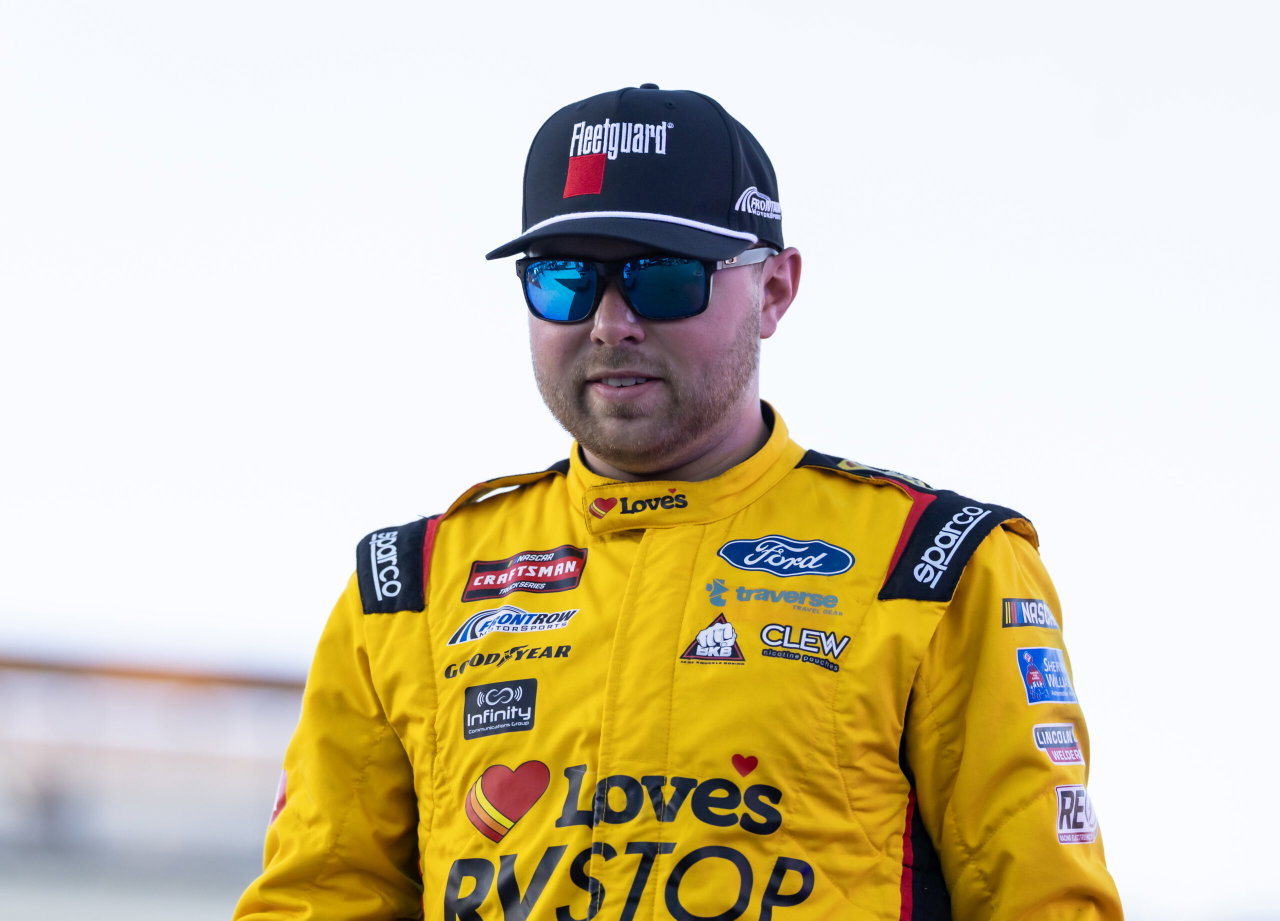
Layne Riggs had barely finished processing a championship that slipped away at Homestead-Miami Speedway when attention turned to what comes next. Seven victories had made 2026 his best NASCAR Craftsman Truck Series season yet. However, his 32nd-place finish in the finale left him 83 points short of Kaden Honeycutt’s championship. Riggs will return to Front Row Motorsports in 2027, but another opportunity is already on his mind. This time, he wants to see how far he can go in the Cup Series without walking away from the Trucks.
Watch What’s Trending Now!
Speaking with Bob Pockrass, Riggs put a number on what he considers an ideal Cup schedule.
“If I could run the truck again full-time, which we are doing, run the truck again full-time for Front Row Motorsports, I think 15 Cup races would be the max. And I look at the max as ideal. You want as many as possible. But I feel like if you get more than that with my experience level, it would start to get muddy and it would become a little bit too much.”
There is a reason Layne Riggs wants to keep his Truck program intact. His development at Front Row has taken time, and the results have finally started showing. He won three races in 2025 before taking seven victories in 2026. He also led 988 laps, earned 13 top-five finishes and secured five poles. His championship defeat did little to change the progress he made.
However, moving into Cup presents a different challenge. Riggs is not talking about replacing his Truck seat with a Cup ride. He wants both programs, much like Corey Heim managed while racing full-time in Trucks and making selected Cup appearances with 23XI Racing. That route offers experience without immediately abandoning a proven environment.
The problem is finding someone willing to finance it.
“I don’t know if that’s going to happen logistically. Obviously, it being an open car, open cars are not cheap for anybody and not really financially the best, I guess, idea to do for everybody. They would kind of be, whoever does that would be investing money into helping me get better.”
The reference to an open car is particularly important. NASCAR’s Cup Series has 36 chartered entries, which receive guaranteed starting positions and a larger share of the sport’s revenue. The remaining four positions in a 40-car field are available to non-chartered teams. Those entries must qualify on speed and do not receive the same financial guarantees.
The financial difference is substantial. Documents released during the 23XI Racing and Front Row Motorsports antitrust dispute revealed that an open team finishing around 20th across a full season could collect approximately $2.9 million in purse money.
A chartered team in the same position could receive $11 million to $12 million. Meanwhile, participating teams reported average operating losses of approximately $2.2 million per car in 2024. Only three organizations reported profits.
Those figures explain why Riggs cannot simply arrange 15 appearances and expect a team to make them happen. Even a part-time program needs equipment, personnel, preparation, and travel. Sponsorship must cover a significant portion of the expense. The investor would also be funding experience rather than purchasing an established Cup contender.
Front Row’s own situation adds another complication. Its three Cup seats are occupied by Noah Gragson, Todd Gilliland and Zane Smith for 2027. General manager Jerry Freeze previously acknowledged the difficulty of accommodating both Layne Riggs and teammate Chandler Smith. He explained that sponsorship and the other pieces must come together before a driver can move up.
“We’d love to see Layne get a chance, and he will get a chance,” Freeze told NASCAR.com in July.
Layne Riggs has also thought carefully about where those 15 starts should happen. He does not want to spend the entire schedule racing on familiar tracks. Instead, he wants exposure to all four major track types.