
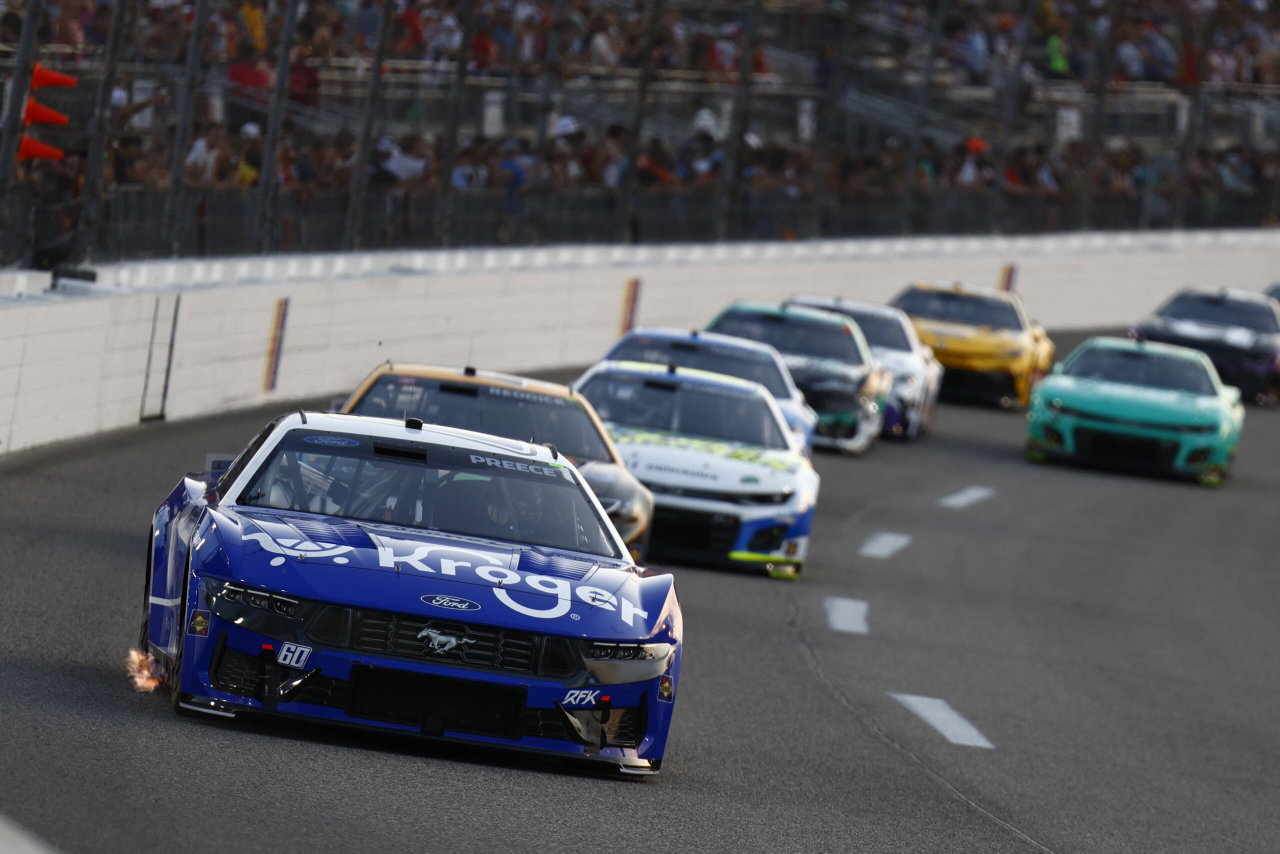
NASCAR introduced stage racing in 2017, dividing races into segments and awarding championship points to the top 10 drivers at the end of the opening two stages. The system was designed to reward performance throughout an event and keep the competition meaningful long before the finish. Nearly a decade and many debates later, Preece believes NASCAR may have gone too far with those rewards.
Watch What’s Trending Now!
Preece argues that finishing the race should matter more than collecting points for partial success. He believes the final outcome is what should ultimately matter.
“What happens if you win two stages so you get 20 points, and then in stage three, a caution comes out after three laps, you make a dumb move, you wreck. Now you finish 36th, but you still get 16th-place points. So you didn’t finish the race, but you still get the reward of that. Like, that doesn’t make sense to me because the whole point of racing is to be there at the end and finish the race, right?” Preece said on the Door Bumper Clear podcast.
The RFK Racing driver’s argument becomes easier to understand when looking at what happened to Ryan Blaney at Bristol last Saturday. Blaney had one of the strongest cars in the field, leading a race-high 202 laps and winning Stage 2. Yet his night ended before the checkered flag after a late-race incident with Carson Hocevar sent him into the wall, leaving him with a 33rd-place finish.
Under NASCAR’s current points structure, however, the DNF did not erase everything Blaney had accomplished earlier in the night. He collected five points for finishing sixth in Stage 1 and another 10 for winning Stage 2. His 33rd-place finish added four more points, giving him 19 points overall.
That means most of Blaney’s points came from what he had accomplished before the race-ending crash. In fact, his 19-point haul was higher than the total earned by some Chase contenders who finished considerably higher than him at Bristol, which is precisely the situation Preece believes exposes a weakness in the current system. A driver can fail to finish the race yet still leave with a meaningful points reward because of how well he performed during the earlier stages.
Not everyone in the garage agrees with the No. 60 Ford driver, however. Joe Gibbs Racing’s Denny Hamlin began the Chase as the points leader and managed to retain the position through Darlington and Gateway. That was despite finishing 18th at Darlington and ninth at Gateway, with the 16 stage points he collected at Darlington playing a significant role in keeping him atop the standings.
Hamlin eventually surrendered the lead to Kyle Larson after Bristol, but his run at the top showed how heavily stage performance can influence the championship picture. For Hamlin, this is exactly what NASCAR intended when the format was created, as he admitted in his interview after the race in Gateway.
Blaney himself has also previously defended the concept, particularly because stage points can protect drivers from losing everything after an unfortunate problem late in a race. At Gateway, the Team Penske driver appeared to have a race-winning car before a brake failure ended his night. Despite the setback, he still collected 14 stage points that Sunday.
“When stage racing was introduced, the idea that when I learned that we were doing this was, ‘oh good, you’re going to get rewarded a little bit if you’re running up towards the front throughout the race and you have a problem at the end and you don’t finish good’, like if you blow up or get in a wreck,” Blaney said.
That is the central argument in favor of stage points. NASCAR does not want the middle part of a race to become an afterthought, especially during long green-flag runs. Awarding points throughout the race gives drivers a reason to race hard before the final laps and rewards consistent performance instead of making the entire race depend on the final restart.
More importantly, a late mechanical failure, crash, or incident caused by another driver can ruin an otherwise strong race. Stage points provide some protection against that, ensuring one bad moment does not completely erase several hundred miles of good racing.
Preece, however, believes the balance has shifted too far toward those interim rewards. He is not arguing that stage performance should be meaningless. Instead, he wants the points attached to those stages to carry less weight compared with finishing the race.
“Like, to me, I feel like we do overvalue stage points, in my opinion. And they are they reward stage points too much. Like, I wish they were less, but that’s just my opinion,” the RFK driver, who finished 10th in Bristol, said in the same episode of the Door Bumper Clear podcast.
What Preece claimed might be unpopular among drivers in the garage, but it is thought-provoking. Should a race be decided more by what happens at the finish or by performance throughout the event?
Most will be in favor of stage points for now, especially because of the protection they offer when a late-race incident wipes out an otherwise strong performance.