
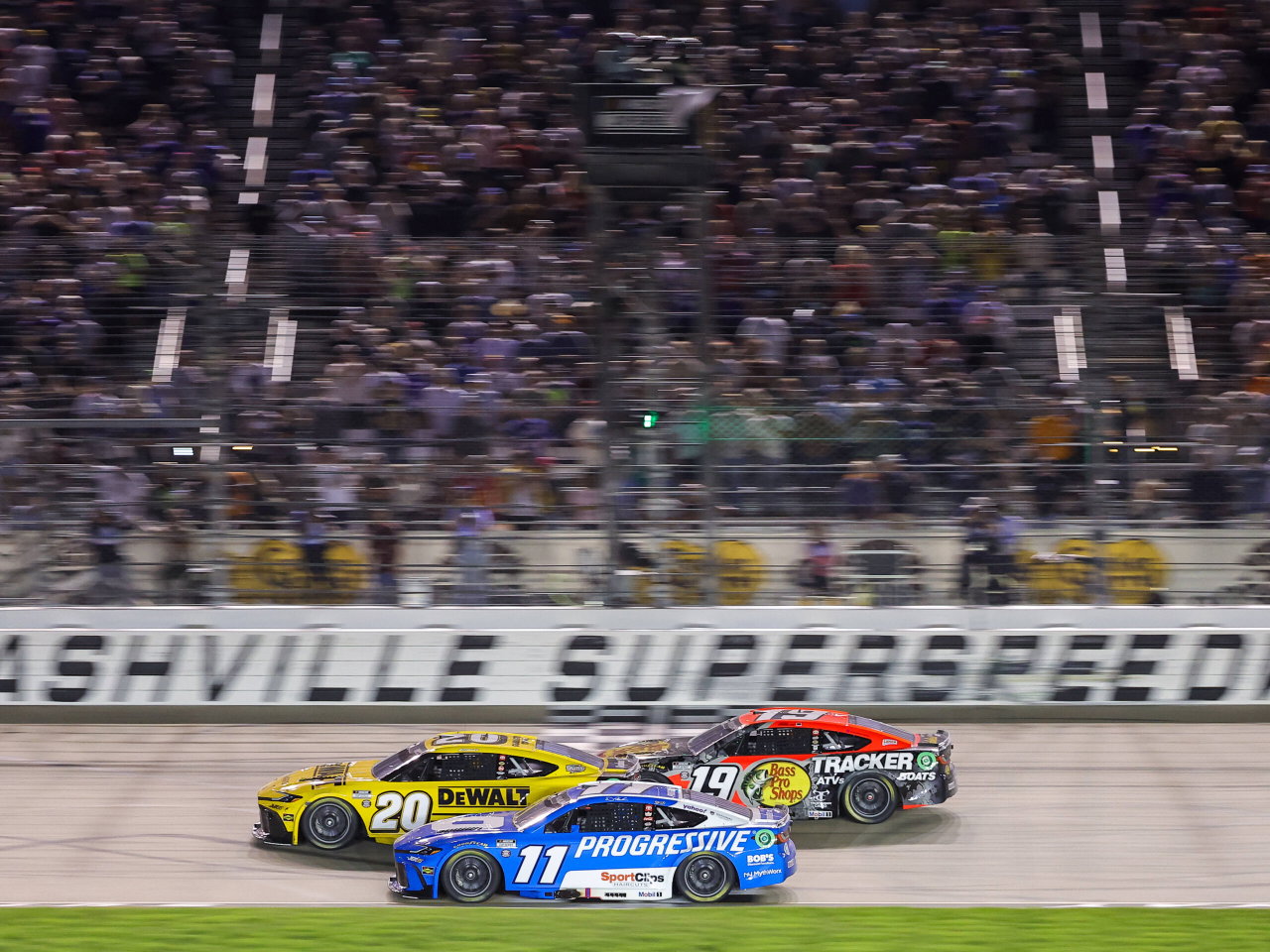
At Homestead in 2019, Joe Gibbs Racing had three drivers fighting for the NASCAR Cup Series championship. Kyle Busch emerged with the trophy, while Denny Hamlin and Martin Truex Jr. went home empty-handed. Having multiple shots at the title was a luxury, but only one driver could finish the job. Seven years later, JGR faces a similar opportunity, except this time Kyle Larson stands in the way. Hamlin, Christopher Bell, and Chase Briscoe occupy second, third, and fourth in the 2026 Chase standings, giving JGR three chances to catch the Hendrick Motorsports driver. The catch? They have to get past Larson without losing ground to one another.
Watch What’s Trending Now!
JGR president Dave Alpern knows what it means to have several cars capable of winning, but the closing stretch of a championship fight brings its own headaches. With four races left, every stage point and every position matters. And when three teammates are chasing the same driver, even a battle for the lead can carry consequences far beyond the checkered flag.
“With four teams: you want as many chances as you can because you want it for all of them, and they all work really hard,” Alpern said on SiriusXM NASCAR radio. “But yeah. With the points, I think the hard part is you’re trying to catch the five, but you got three teammates that are all taking points from each other by racing for stage wins and racing for the championship. But look. I think that’s the way it’s supposed to be.”
“We got 36 cars out there every week. Four of them belong to us. And even though we’re one team six days a week, on Sunday, you’re racing for that door number. You’re racing for that sponsor that invests in you, and that individual crew and those fans. And so I do think it makes it more complicated. I think it makes it way more nerve-wracking. But again, this is what we raced all year for. On the flip side, if you only have one, that’s in contention. Yeah, can you focus all your efforts on that car and on those stage points and on those wins? You can. But that’s not the position we’re in.”
Larson has made that dilemma harder to solve. At Kansas, he scored 76 points by winning the race, sweeping both stages and collecting the fastest-lap bonus. At Las Vegas, he recovered from going a lap down to finish second. Then, at Charlotte, contact with Hamlin knocked him out of the fight for the win. Larson still finished sixth and extended his lead over Hamlin by nine points. Even when the No. 5 Chevrolet loses its grip on a race, Larson has found ways to protect his championship position.
Hamlin trails by 49 points and remains JGR’s closest challenger, but the intermediate-track stretch that offered him a chance to close the gap has instead widened it. After finishing third at Kansas, he endured a 16th-place run at Las Vegas following a spin and fuel-pressure trouble. Charlotte brought a fifth-place finish, but Hamlin also lost ground during the race when a pit-road safety violation cost him the chance to score Stage 1 points. His contact with Larson changed the leader’s afternoon, yet it did not produce the points swing Hamlin needed.
Bell is just two points behind Hamlin, but Charlotte left him wondering what might have been. He led 93 laps and won Stage 2, then nearly stole the race from Briscoe on the final lap. The two Toyotas banged fenders before Briscoe held on by 0.029 seconds. Had Bell made the pass stick, he would have left Charlotte only 31 points behind Larson instead of 51. The difference between a win and a runner-up finish was measured in inches, but its championship cost was considerable.
Briscoe, meanwhile, has become JGR’s hottest contender. He won at Las Vegas after sweeping both stages, then backed it up at Charlotte with another victory. The Charlotte win came despite Bell’s late charge, and Briscoe’s consecutive victories have cut 58 points from his deficit to Larson across the two races. He now sits 65 points behind the leader. Yet the same finish that strengthened Briscoe’s title hopes showed how close Bell came to taking those valuable points for himself.
Alpern sees the crowded championship fight as evidence that the organization has achieved what it set out to do, even if the situation makes Sundays more complicated.
“This is what we set out to do at the beginning of the year: to get as many cars in contention to win,” Alpern said. “And Ty’s had an unbelievable year, and it’s been exciting with him having a couple of wins. And now then we got our other three cars that are two, three, and four racing for the championship. But yes, it is a little complicated and a little nerve-wracking for sure.”
The next four races will decide whether JGR’s depth becomes its greatest weapon or a costly distraction. Phoenix comes first, followed by Talladega, Martinsville, and the finale at Homestead-Miami. Hamlin needs a sustained points recovery, Bell must turn speed into wins, and Briscoe has to keep his momentum rolling. All three remain close enough to make Larson sweat, but none can afford to let a teammate take away another opportunity.
Larson has the lead, and JGR has the numbers. In 2019, the organization brought three drivers to the finale, and Busch delivered the title. This time, it must first get through four more races in which its contenders will be fighting Larson and each other. The question is whether one of them can finish the job before the teammates’ battle gives the No. 5 Chevrolet too much breathing room.