
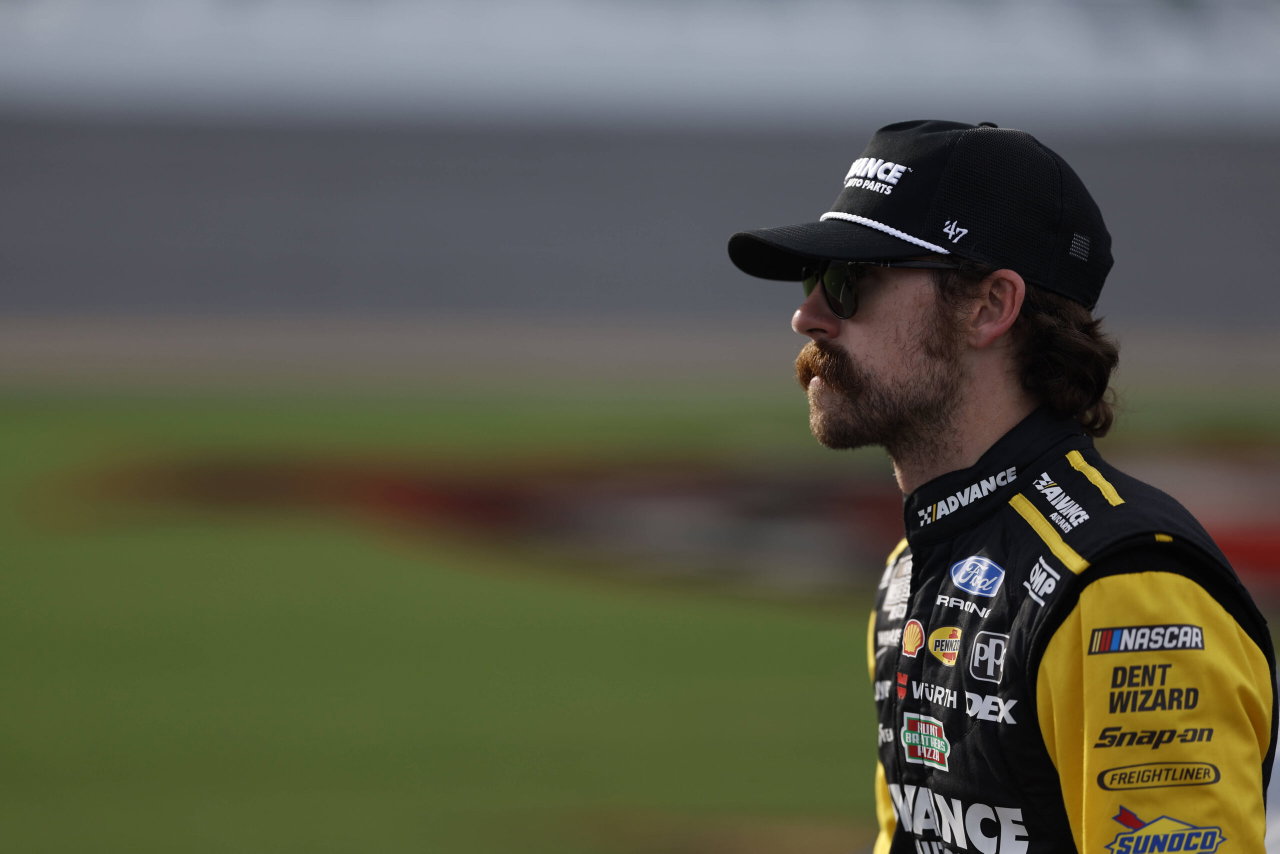
Cup qualifying was cancelled in Kansas, making it three out of four races in the Chase where the starting grid is dictated by the metric, which is 70 percent based on the car owner’s finishing place in the last race and 30 percent based on the team’s championship points standing. While the grid for tomorrow’s race will be decided under this metric, few drivers have it worse than others. And Team Penske’s Ryan Blaney is pretty high up on that list.
Watch What’s Trending Now!
Blaney DNFed in Bristol after contact with Carson Hocevar on Lap 457, and he’s dropped to 6th in the standings after being a top-three contender all season long.
“I just got done saying last week the metric is what it is,” said Blaney on his thoughts about the metrics at Bristol before adding, “Now I’m starting to slowly hate it from what’s been happening to us.”
Blaney’s response came to a question by Tim Moore of Motorsports Today, and the No. 12 Penske Ford driver laughed at his own luck ever since the Chase began.
After blowing brake rotors at Gateway (35th-place finish), Blaney started 29th in Bristol. There, qualifying was cancelled due to lightning, forcing him to the back of the pack.
After the Bristol DNF, Blaney’s 33rd-place result will lead to him starting from 25th in Kansas, the lowest amongst those in the Chase. But this is the third time that Blaney will need to start further back in the pack. His Chase began at Darlington, where he had to start 24th after qualifying was cancelled, based on the fact that he DNFed at Daytona during the last regular-season race.
While the initial phase of the Chase and qualifying metric felt like an unlucky break, it’s growing influence has left Blaney worried.
The driver of the No. 12 Penske Ford finished 4th in Darlington, and so far, it’s been the only race he’s finished in the Chase. And now that they are heading into intermediate tracks, tracks where Toyota has shown early-season dominance. Blaney was desperately hoping that rain wouldn’t add to his sorrows again. But once again, he’s found himself on the bitter end of the stick.
For Blaney, who is now 52 points behind championship leader Kyle Larson, it is essential he gets a major points haul from the next three mile-and-a-half tracks, Kansas, Las Vegas, and Charlotte. Because if that gap increases with four races to go, Blaney would effectively be out of title contention.
While Blaney is suffering the effects of the metrics, the first three Chase race winners will be taking the top three grid spots in Kansas. Darlington winner Christopher Bell starts third for Joe Gibbs Racing, Blaney’s teammate Joey Logano starts on the pole on the back of his Bristol victory. And championship leader and Gateway race winner Larson shares the front row in second place with Logano.
What should happen with the metric?
NASCAR introduced the qualifying metric in 2020 when qualifying and practice were cancelled to limit on-track time during COVID. The initial system was 35 percent for owner points position, 25 percent for driver finishing position, 25 percent based on finishing position, and 15 percent for fastest lap position.
That system lasted till 2024, before the 70-30 split came into play in 2025. And very few have ever voiced their support for the metric.
As recently as after the Darlington race, Kevin Harvick was critical of the system and went as far as saying he hates it. Harvick suggested the system be changed to a lucky draw of sorts to provide an interesting mix-up of race starts.
Kyle Larson, who has 12 top-five finishes this year, has profited many times based on this metric. 2nd at Bristol earned him a front-row spot for the upcoming race. And yet Larson was critical of the system at Gateway after being on the wrong end of the same metric in Darlington, where he started 25th because he finished 31st at Daytona.
“I mean, selfishly, after a weekend like last, I wish we would just go back to lining up off points because we don’t see the metric kind of come into play,” Larson said at Gateway. “I mean, you can have the metric to set the qualifying order, but I think, you know, just lining up the field based off points would be good, especially with the Chase, this point format and every point being so important. It was kind of crappy to feel like we were starting off at a disadvantage last week, and we raced our butts off to just miss stage one points.”
Two suggestions from two Cup champions, and NASCAR is already looking at what could be the metric for next year. Brad Moran, NASCAR Cup Series MD, spoke about a possible change while speaking to SiriusXM NASCAR Radio.
“We’re certainly going to let the industry have a say in it like we did when we brought it out. Maybe it’s time to change the percentages a little bit or change it completely,” said Moran before adding, “It’ll be an off-season thing.”
Moran cleared up that it’s based on performance and driver points, and he doesn’t believe there is a problem with it to the point that it needs to be rectified as the Chase continues.