
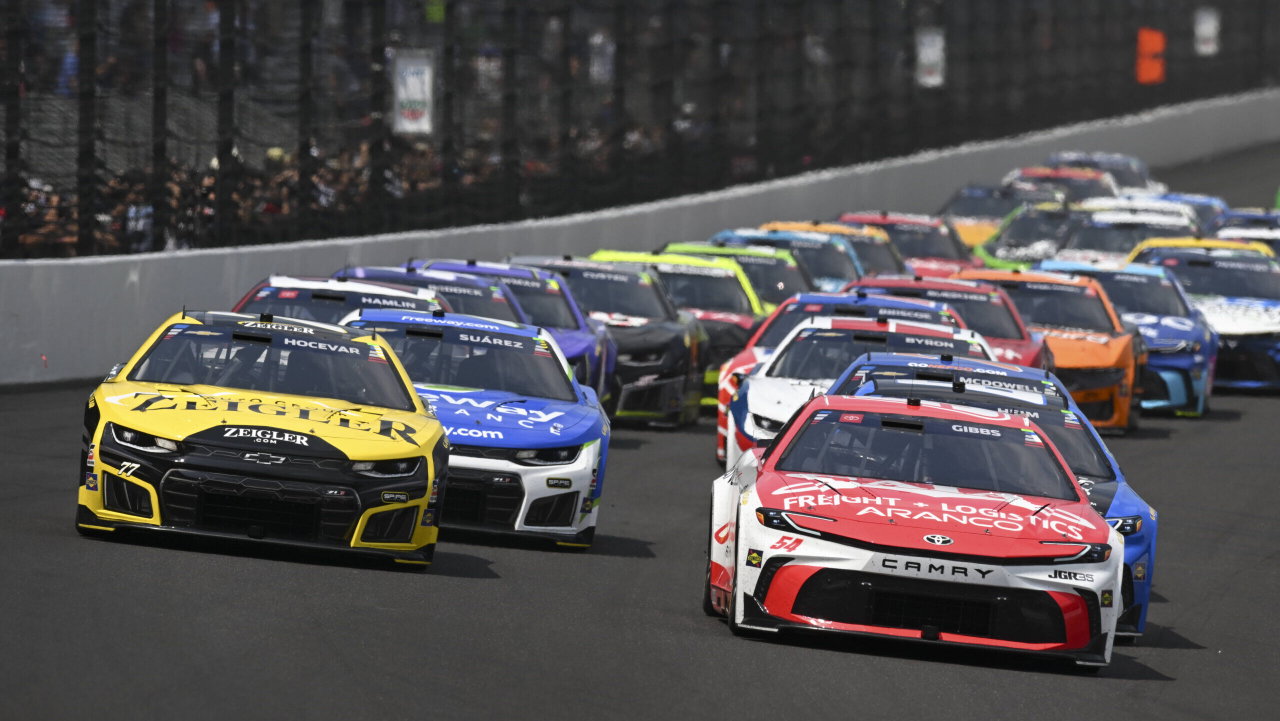
NASCAR let the field get away with exactly what a new rule was written to stop. The YellaWood 500 ended with fuel-saving improvisation that defied the rulebook, and fans, drivers and critics have spent the days since calling it out. Mike Forde, NASCAR’s vice president of racing communication, weighed in and revealed something important: repercussions were waiting for the field if they had not changed strategy.
Watch What’s Trending Now!
On the latest episode of the Hauler podcast, Forde explained how NASCAR monitors minimum speed and approaches serious consequences against the field in situations like stage one at Talladega.
“I believe like 75% of the field at one point, I think it was only for a lap, maybe two, were all under minimum speed, so they were breaking the rules there. And I think there was a conversation also in the extended NASCAR podcast universe- uh, we should have just black-flagged everyone.”
The field slowed to roughly 59-second laps at Talladega as drivers prioritized fuel saving, staying just above the 57.1-second minimum-speed threshold.
“So how that works in this case, and in most other cases, is we’ll give a team a couple of laps to get it,” he continued. “So what we’ll say over the radio typically is, Car number X, you ran a minimum speed; you’re at a minimum speed. We’ll give you a lap and if he doesn’t do it alright you gotta take it in.”
Under typical circumstances, race control warns a struggling car over the radio and gives it a lap or two to regain the minimum speed before ordering it to pit road.
“So that’s what we do, we’ll do it over the radio, talking about that IM System it’s a simple Microsoft teams, but we can IM individual teams or the entire all of pit road,” he added. “And so, we IM’d all of pit road and said- Hey there are X amount of cars that just, that have not reached minimum speed. If you guys don’t pick it up, then we’re going to have to step in, and soon after they picked it up, so that message was delivered and so that’s why we did not black flag anybody.”
Forde’s comments came after massive fan and driver outrage erupted over the field driving at 25% throttle for the longest stage of the race. And while the fraternity was awaiting an official statement on the fuel-saving game plan, Forde’s comments did not deliver a strong counterargument.
The field ran the fuel-saving parade for over 14 laps (contrary to Forde’s comments suggesting one or two laps) until the RFK Racing trio decided to break away and race at full throttle, almost lapping the entire field.
Forde also discussed how the minimum speed at Talladega was 12.5% of the pole-winning speed (approximately 186.065 mph), but the drivers were running below the required throttle. Fans who arrived at Talladega expecting high-octane action and a championship-altering run right from stage one had to bear the longest stage of the race watching a fuel-saving parade instead.
Drivers who had no choice but to follow the strategy expressed their frustration over the radio and during post-race interactions. Veteran driver Denny Hamlin and Team Penske driver Ryan Blaney were quick to call out the snoozefest over their radios.
“This is like it’s the Richard Petty Driver’s Experience at a race,” Hamlin said.
Meanwhile, Blaney stated, “We’re going to be running a minute lap time before too long here.”
Another driver who was stuck in the mix was Front Row Motorsports’ Zane Smith, who explained how he could not capitalise on the fuel-saving strategy as a right-rear flat tire ended his hopes to fight at the front of the field in the final few laps of stage one.
Smith, in conversation with Steven Taranto, expressed his frustration.
“It was a frustrating day, to say the least, for myself. I mean, I was in the fuel-saving game for the majority of the day, and then once we pitted, I felt like I had a smooth pit stop, rolled out, and there was like a group of about like four or five cars, then there was a group of about maybe ten, and I was leading that group of ten. And maybe raced for like five laps, if that, and blew a right rear tire out of nowhere playing into Turn 1. And fortunately, I saved it, but with that, obviously, I had to roll back pretty slow,” he said.
With just two races to go until the Cup Series crowns its 2026 champion, the focus has shifted to an important conversation about how NASCAR wants to go racing and where it draws a line when the paddock adapts and adjusts to find loopholes in crucial rules to modify and alter racing at iconic venues like Superspeedways.
With a rather on-the-fence clarification coming off a weekend that encouraged debates around driving down the yellow line, manipulating races by playing the team game, and a post-race introspection letting the Chevrolet army keep its unprecedented top-six cars finish at Talladega, NASCAR has a lot to figure out heading into the penultimate round of the season in Martinsville.