
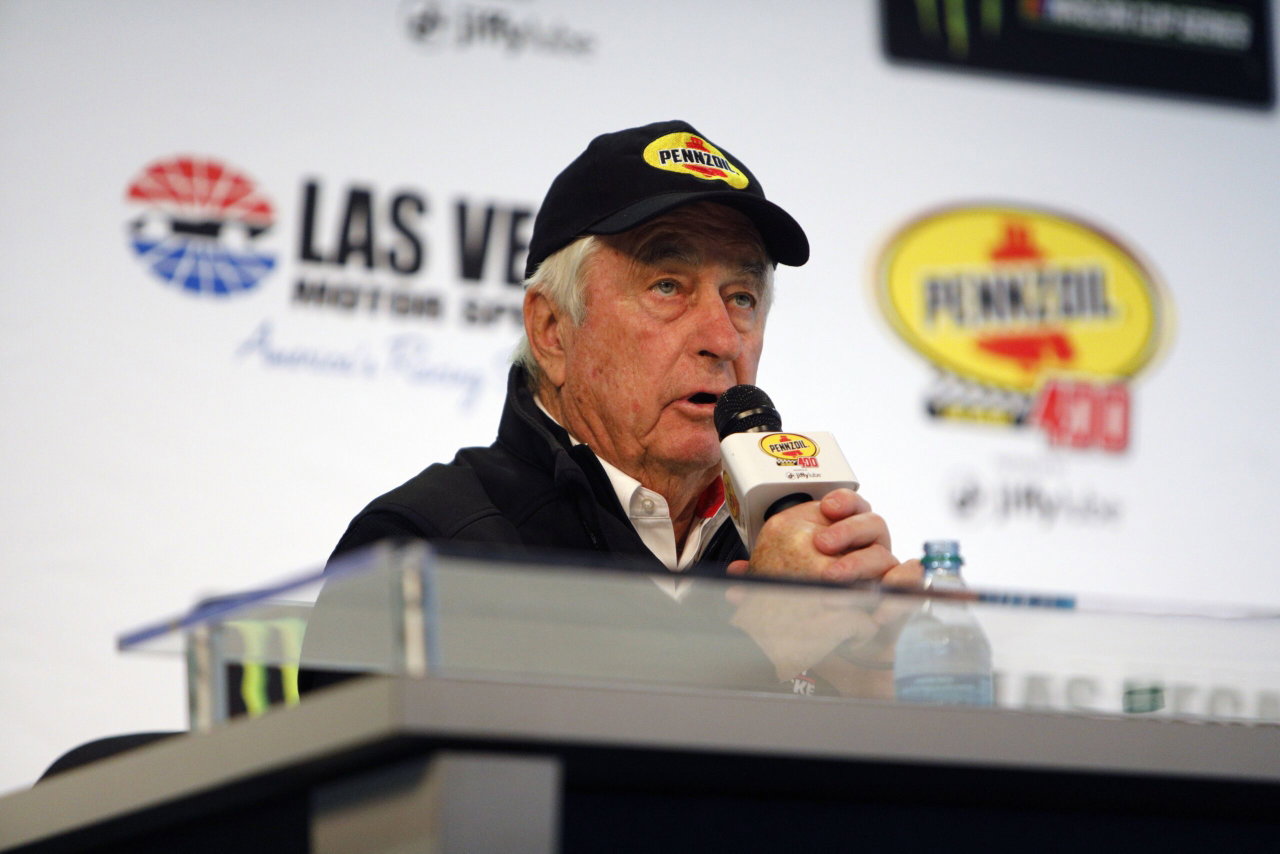
Ask a NASCAR fan what he or she remembers about Team Penske, and the answer might not begin with a championship. It could be Rusty Wallace’s Miller Lite colors, the sight of his No. 2 battling Dale Earnhardt, or the unforgettable 2008 Daytona 500, when Kurt Busch helped push Ryan Newman toward a victory Roger Penske had spent more than two decades chasing. It could just as easily be the less celebratory moments: the crashes, the heartbreaks, the races that didn’t go to plan. Six decades of racing cannot be measured by victories alone. They live on in the people, rivalries and moments that made a team part of the sport’s history. For Roger Penske, the philosophy behind it all can be summed up in three words.
Watch What’s Trending Now!
As Team Penske marks its 60th anniversary, founder and team owner Roger Penske has shared the motto that has guided the organization through the highs and lows.
“We have a motto at Team Penske. It’s simple, three-word phrase that conveys the key to much of our success from the last 60 years. Effort equals results,” the team owner said.
“My father taught me that many years ago, and it still rings true today: these words tie together all the men and women who have made us successful over the years and put in all the effort to keep us a championship-winning organization. I prefer to call them our human capital. It’s a formula that has served us well, and the numbers prove it.”
The words were passed down by his father, Julius, who spent three decades working in the metal distribution business in Cleveland, Ohio. Growing up, Roger Penske was taught that hard work was not simply a route to success, but something to be valued in itself. His parents encouraged him to earn his way toward the things he wanted, with his father often matching what he managed to save.
It was a lesson in effort, patience and personal responsibility that stayed with him long after he stepped away from driving. Today, the phrase is more than a reminder of his upbringing. Team Penske carries it on a coin, and it has become a guiding principle across his businesses and racing teams.
Building that human capital, however, was anything but easy. When Team Penske was founded in 1966, its headquarters was a tiny, one-car garage in Newtown Square, Pennsylvania, and its operation had just six people. The racing team grew to 10–12 people over the following years. When Walt Czarnecki joined in 1970, the wider Penske business had around 200 employees, one car dealership and four truck-leasing locations. Six decades later, the enterprise employs more than 73,000 people around the world.
Roger Penske’s move into team ownership came after several years behind the wheel. He began competing in SCCA sports car events in 1958 and won across different categories, including a NASCAR Pacific Coast Late Model race at Riverside in 1963. He retired from driving in 1965 to focus on his business interests, but his connection to racing was only beginning a new chapter. A year later, he established Roger Penske Racing.
The team’s first outing came in sports car competition at the 1966 24 Hours of Daytona. NASCAR followed in 1972, when Mark Donohue drove an AMC Matador for Penske in the Cup Series at Riverside.
That move brought Team Penske into a very different racing culture. NASCAR had been shaped by family-run outfits such as Petty Enterprises and the Wood Brothers, whose roots reached back to the sport’s earliest years. Their stock-car experience had been built over generations. Penske arrived with resources, ambition and racing credentials, but success in other disciplines did not guarantee a place among NASCAR’s established names. The team would have to earn it.
The Years That Built Team Penske
The first breakthrough came after a difficult debut season. Returning to Riverside in 1973, Donohue gave Team Penske its first NASCAR Cup Series victory. It was an important result for an organization still learning the demands of stock-car racing.
Bobby Allison carried that progress forward. Driving Penske’s No. 16, he scored four Cup victories between 1974 and 1976, including two wins at Darlington in 1975. One was the Southern 500, a triumph at one of NASCAR’s most demanding and prestigious tracks. Allison’s success gave the young team another reason to be taken seriously.
Penske’s initial NASCAR program wound down before the organization returned with a full-time Cup effort in 1991. The arrival was marked by the signing of 1989 champion Rusty Wallace, who found his footing almost immediately, winning at Bristol in just his sixth race with the team. Over the next 15 seasons, Wallace added 37 victories, becoming Penske’s most successful Cup driver to that point. His No. 2 Pontiac became one of the defining sights of the era.
His battles with Dale Earnhardt made those years all the more memorable. Wallace won 10 races in 1993 and mounted a serious championship challenge, but Earnhardt held him off to claim his sixth Cup title. Their rivalry captured the competitive edge of the period, with Wallace among the few drivers able to regularly take the fight to NASCAR’s most formidable champion.
When Wallace stepped away from full-time competition after the 2005 season, he closed a 15-year chapter that had become central to Penske’s NASCAR identity. His departure marked the end of a defining driver-team partnership, even as the organization prepared for its next chapter.
Three years later came a milestone that had eluded Penske for decades. Ryan Newman won the 2008 Daytona 500, with teammate Kurt Busch finishing second after helping push Newman toward the lead. On the race’s 50th anniversary, Penske claimed its first victory in NASCAR’s biggest event — and finished one-two.
One major achievement remained. In 2012, Brad Keselowski delivered Penske its first NASCAR Cup Series championship. Driving the No. 2 Dodge, he won five races and held off Jimmie Johnson to secure the title at Homestead. It was the payoff from a pursuit that had begun with the team’s arrival in NASCAR 40 years earlier.
More Than A Racing Team
Team Penske’s identity, though, has never been defined by results alone. It has also been a home for drivers whose stories are woven into the sport’s family traditions. Bobby Allison belonged to the famous Allison racing family, while Rusty Wallace followed his father, Russ, and brothers Mike and Kenny into racing. Both arrived at Penske with reputations of their own, and their time with the team became an important part of their careers.
Manufacturers, too, have left their mark on the organization: from the AMC Matadors of its early years and the Pontiacs of the Wallace era to Dodge and Ford, which Penske returned to in 2013. Across generations, drivers, engineers, crew members and manufacturers all helped shape the team. Its legacy is not only about the place it earned for itself in NASCAR, but also about the people and partners who helped build it.
The Modern Era
The organization that once had to prove itself in NASCAR is now one of the benchmarks of the modern Cup Series. A new generation of drivers has carried its championship ambitions forward, adding another remarkable chapter to the team’s history.
Joey Logano joined Penske in 2013 and delivered its second Cup Series title in 2018, five years after Keselowski claimed its first. He added championships in 2022 and 2024, while Ryan Blaney won in 2023. Three consecutive titles across three seasons marked an extraordinary run, making Penske the first team to win the Cup championship in three successive years under the elimination-style Playoff format.
Today, Austin Cindric, Blaney and Logano represent Penske’s three full-time Cup Series entries, driving the No. 2, No. 12 and No. 22 Fords.
The team’s record now stands at more than 160 Cup Series victories, five drivers’ championships and three Daytona 500 wins, with 10 different drivers contributing to its victory tally. From Donohue’s breakthrough at Riverside to the championship success of Keselowski, Logano and Blaney, Penske’s story has been carried forward by generations of drivers.
In 2026, all three drivers finished inside the top 10 in the final standings. Blaney led the way in fourth, with four wins, including the season finale at Homestead-Miami. Logano finished seventh with three victories, while Cindric recorded the best full-time Cup season of his career, ending the year 10th. It was another strong showing for the organization’s three-car operation.
And the next chapter is already taking shape. Ford Racing has announced that its Mustang Dark Horse SC will make its NASCAR Cup Series debut in 2027, with its first competitive outing set for the Daytona 500. Penske will be among the Ford organizations campaigning the car, with Blaney, Logano and Cindric continuing to represent the team. After decades of adapting to new eras, manufacturers and competition, the organization is preparing for another change.
From its arrival in NASCAR in 1972 to its place among the sport’s most enduring championship organizations, Team Penske’s story has been shaped by the collective effort of its drivers, crew members, engineers and partners. That may be the clearest reflection of the lesson Roger Penske carried from his father: effort equals results.