
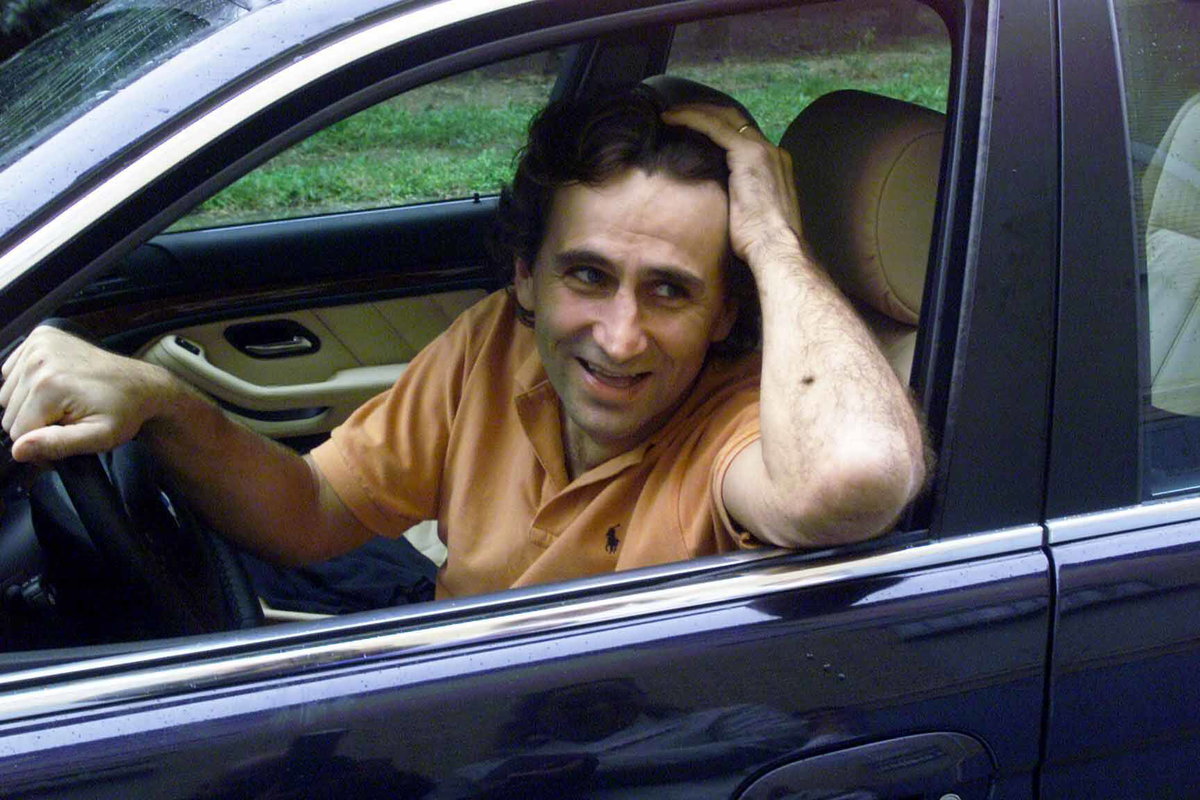
Alessandro Leone “Alex” Zanardi – 23 October 1966 – 1 May 2026
Watch What’s Trending Now!
Racing driver. Paralympic champion. The man who taught the world that loss can be a starting line.
Alex Zanardi died on a spring evening in Bologna, the same ancient city of red-brick arcades and fast cars that had always claimed him as its own son. He was 59. Outside, somewhere in Italy, several engines must have been running. But that evening, they were all running just for him.
“Alex passed away peacefully,” his family confirmed the news, “surrounded by the affection of those closest to him.”
Zanardi was born on the 23rd of October, 1966, the son of Anna and Dino Zanardi, in a modest apartment in Bologna. When Alex was four, the family moved to the small, plain, flat town of Castel Maggiore on the city’s outskirts. It was the kind of provincial Italian town where nothing extraordinary was supposed to happen. Yet, as one Italian journalist wrote upon his death this week, “in places like this, great things often occur.”
As a small child in the 1970s, Zanardi would often sit beside his father, Dino, to watch Formula One on the family television. In a matter of minutes, he would be completely transfixed. Then, unable to simply watch, he built himself a car out of a box cart atop roller skates, with no engine and no brakes, and powered by the family dog. It was not very fast, but that didn’t matter.
Watching his little one, elder Zanardi realized how a boy burning with speed cannot be brought to a standstill. So he gave him a go-kart to channel that energy.
“It all started back in 1980 when my father bought me a go-kart,” Zanardi recalled years later. “I got addicted immediately. And as funny as it could sound, the first lap I took around the local circuit I said: This is what I’m going to do in my life.”
He was thirteen when he first sat behind the wheel of a kart. And he even built one himself, scrounging wheels from a dustbin and pipes from his father’s workshop. The resulting machine was improbable, and so was the talent inside it. But within a few years, he sought this way to the top class of the CIK-FIA European Karting Championship, winning back-to-back titles by 1986.
He entered Italian Formula 3, graduating to Formula 3000 by 1991 with the Il Barone Rampante team, donning a newcomer outfit that, like him, had everything to prove. He won on his debut and went on to win two more times that season, finishing runner-up in the championship. Of course, the world of Formula One had to take notice.
He entered F1 that same year and raced for teams like Jordan, Minardi, and Lotus. But with equipment never being worthy of him, and Lotus folding at the end of 1994, he made a decision that would change everything. He crossed the Atlantic.
He arrived in the CART Championship (the American open-wheel series that would one day become IndyCar) with a test at Homestead for Chip Ganassi Racing. The team’s engineer, Mo Nunn, was skeptical, telling Ganassi that Italian drivers were too prone to mistakes. And Zanardi spent the next three years proving him spectacularly wrong.
He signed his contract with Ganassi on October 23rd, 1995, his 29th birthday, and was an immediate sensation. He took the pole position in only his second race and won at Long Beach, where he celebrated by spinning the car in frantic, rubber-burning circles at Turn 1. That spontaneous act of joy is now believed to be the first “donut” celebration.
The crowd erupted. His nickname, almost immediately, was the Donut King. It suited a man who treated racing wholeheartedly with love, as a playground.
Chip Ganassi, hence, took to X to honor his ex-star driver. “No words can express my feelings about this guy,” he wrote.
In his first full season, he won three times and was named Rookie of the Year. Then, on the final race of the year at Laguna Seca, he produced what many consider one of the most audacious overtaking manoeuvres in American racing history.
Running in second place, he dived around Bryan Herta through the terrifying downhill left-right flick of the Corkscrew corner, a place where no one passes, and stole the win. The move is still known, simply, as “The Pass.” Race footage shows the crowd losing its minds while Zanardi just grinned.
In 1997, he was champion. In 1998, he was champion again. Honda, in a gesture of remarkable esteem, released a limited-edition “Alex Zanardi Edition” Acura NSX, and only 51 were made, all in New Formula Red, the colour of his Ganassi car.
For such a man, even the Italian Prime Minister, Giorgia Meloni, had to pay her tributes.
“Italy loses a great champion and an extraordinary man, capable of turning every challenge of life into a lesson in courage, strength, and dignity,” Meloni wrote.
“Alex Zanardi knew how to bounce back every time, facing even the toughest challenges with determination, clarity, and a strength of spirit that was truly exceptional,” Meloni added. “He gave all of us much more than a victory: he gave hope, pride, and the strength to never give up. … Thank you for everything, Alex.”
IndyCar, a subsidiary of Penske Corporation, owned by Roger Penske, also wrote on Instagram:
“The INDYCAR community mourns the passing of Alex Zanardi. A two-time series champion, 15-time race winner and one of the sport’s most inspiring figures, his legacy on track was matched only by the strength of his character.”
The INDYCAR community mourns the passing of Alex Zanardi.
A two-time series champion, 15-time race winner and one of the sport’s most inspiring figures, his legacy on track was matched only by the strength of his character. pic.twitter.com/NtiTQwCXok
— NTT INDYCAR SERIES (@IndyCar) May 2, 2026
There is a moment in the story of Alex Zanardi that the world cannot look away from, even now. It happened on a Saturday in Germany, at the EuroSpeedway Lausitz, with thirteen laps remaining in the American Memorial race.
Coming out of the pits on a late stop, he accelerated, caught a patch of fluid on the track, and his car spun sideways across the racing line. What happened next took place in a fraction of a second that would define the rest of his life.
The following car, driven by Alex Tagliani, had nowhere to go. The impact severed the nose of Zanardi’s car. In doing so, it severed both his legs, one at the knee, one above it. However, he never gave up. In fact, dissatisfied with commercially available prosthetics, he designed his own after testing different weights, different degrees of stiffness, and building exactly the legs a racing driver would want.
Just weeks after the accident, barely out of his wheelchair, Zanardi appeared at the Autosprint Golden Helmets awards ceremony in Italy, looking elegant in a grey suit, eyes shining. When the applause began, he rose slowly to his feet, paused, and said into the microphone: “It has been a long time since I’ve been this emotional. I am so emotional, my legs are shaking.”
There is no better summary of the man.
Then, in 2003, before the German 500 race began at the Lausitzring, Zanardi drove a specially modified car around the same circuit where his life had been rearranged and completed the thirteen laps he had never been able to finish. His fastest lap time would have qualified him fifth for the actual race.
“I drove out,” he said, “and it was as if I was in the car the day before the accident.”
He had, of course, already returned to racing. In touring cars, in endurance events, and at the 2006 BMW Sauber test at Valencia, he wedged himself into an F1 cockpit again, using hand controls fitted to the steering wheel. When the team’s manager moved to adjust the pedals for him, Zanardi simply laughed and waved him away. He didn’t need the pedals.
In 2007, with virtually no training, he placed fourth in his class at the New York City Marathon after competing on a handcycle he had largely designed himself. He prepared for only four weeks. Naturally, his competitors, who had been training for years, were baffled.
He then set his sights on the 2012 London Paralympics, taking up competitive handcycling. At the London Games, on a circuit at Brands Hatch, he won two gold medals and a silver medal. After crossing the finish line in the H4 road race, he sat on the track, lifted his bike above his head with one arm, and held it there.
At the 2016 Rio de Janeiro Paralympics, he won two more golds and a silver. In 2018, he broke the Ironman world record in the disabled category.
In 2019, he returned to Daytona for the 24-hour race, driving a specially adapted BMW M8 GTE with hand controls for throttle and brake, as part of a factory team. Formula One champions sought him out for photographs. Drivers from around the world stood and listened as he told elaborate, hilarious, unput-downable stories about the years they had missed.
Zanardi also founded a charity, the Associazione Alex Zanardi Bimbingamba, dedicated to rehabilitating children who had lost limbs but lacked access to healthcare, providing prosthetics to young people who could not otherwise afford them. He visited rehabilitation wards not as a celebrity making an appearance but as someone who understood the particular loneliness of lying in a hospital bed, trying to imagine a future.
He was married to Daniela, whom he credited as the cornerstone of everything, and was the father of a son, Niccolò, a young man who inherited, by all accounts, his father’s passion for sport and his father’s sense of humour about life. And he leaves behind a world that is measurably braver for having watched him live in it.
“RIP Alex. You were an absolute inspiration to many, including myself, by teaching me to never give up, even when the chips weren’t in your favor,” one tribute read.
Retired IndyCar driver, Marco Andretti, also paid his respects, writing, “The man 🙏🏻.”
“Rest in Peace Alex,” Fellow IndyCar rival Felix Rosenqvist wrote, joining a wave of drivers who paused to honour one of the sport’s most admired figures.