
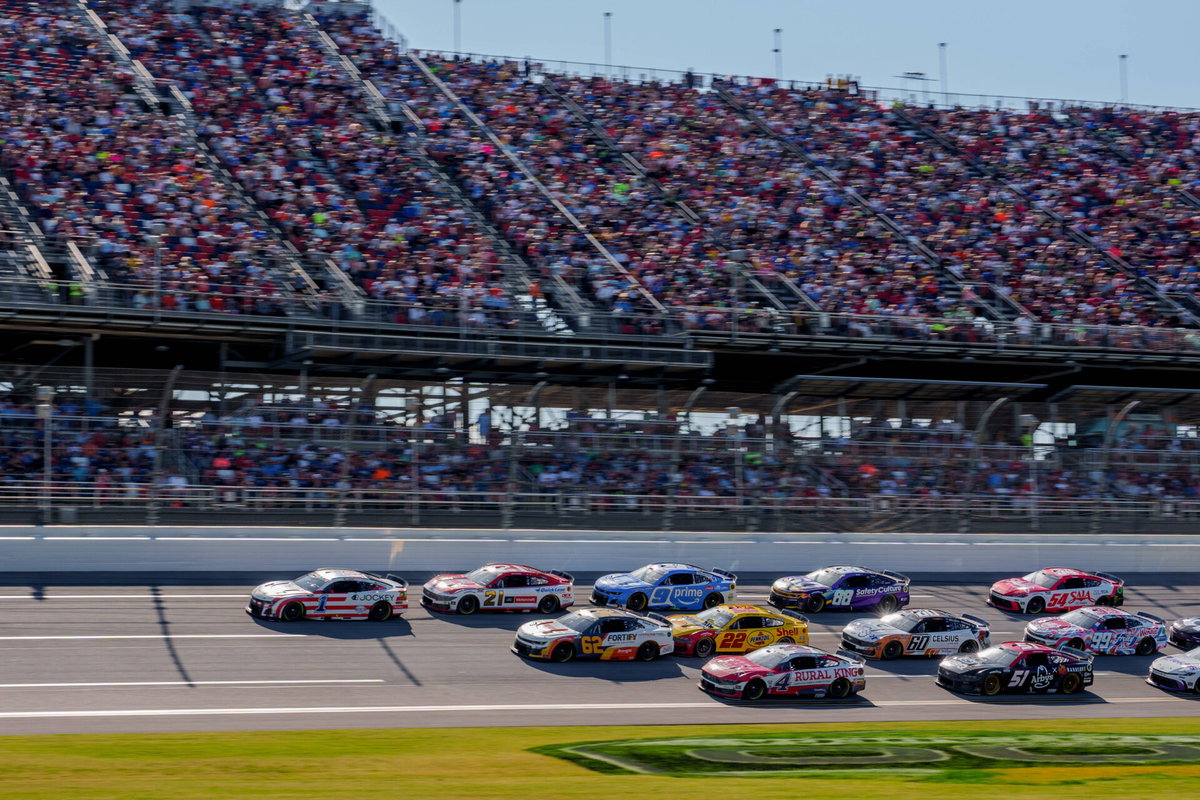
Talladega Superspeedway is known for its three-wide battles, aggressive overtakes, and last-lap drama. But at the 2026 YellaWood 500, fans got anything but that during the opening stage, as drivers spent long stretches saving fuel instead of racing at full speed. It was a frustrating sight, and one NASCAR has struggled to prevent throughout the season. Now, after yet another fuel-saving spectacle, the governing body appears ready to take matters into its own hands.
Watch What’s Trending Now!
NASCAR Cup Series managing director Brad Moran has admitted that fixing fuel-saving tactics at superspeedways will be the organization’s top offseason priority, with several possible changes already being considered.
“We want to correct that. It’s all got to do with strategy, fuel mileage, one can. You know there’s so much engineering in the sport now, which you know has made some great improvements, but there’s some downsides to it. This would be one of them,” Brad Moran said at SiriusXM NASCAR Radio.
The problem was particularly visible at Talladega. While much of the field spent the opening stage conserving fuel, RFK Racing took a completely different approach. Chris Buescher, Ryan Preece and Brad Keselowski stayed at full speed, broke away from the pack and built a lead of more than 40 seconds. They eventually finished the stage in the top three.
NASCAR even used its messaging system to warn teams running below the minimum speed that they risked being black-flagged if they did not pick up the pace. But the warnings did little to change the bigger issue, as the teams were still finding fuel conservation more beneficial than fighting for positions on the track.
Talladega still delivered a dramatic finish, with Kyle Larson charging from 11th on the final lap to beat William Byron by just 0.041 seconds. But the fact is that one spectacular finish could not erase the frustration surrounding the opening stage. And this is not really a new problem that needs to be fixed.
NASCAR Has Tried Fixing the Problem Before
The fuel-saving approach had already frustrated fans at the Daytona 500 in February, when drivers spent long stretches lifting off the throttle and running in closely packed lines.
NASCAR responded by changing the stage lengths in the spring, making the opening stage longer in an attempt to prevent fuel-saving strategies from dominating the second half of races.
“So, we’re going to go back; we changed the stages in the spring to make the longer stage the first one, so we didn’t see anything like that in the second half of the race, but we didn’t like it,” Moran explained.
However, the adjustment has not delivered the results. Teams continued to prioritize fuel mileage. Moran admitted that there is honestly little NASCAR could do under the existing 2026 regulations, but made it clear that the issue would not simply carry over into next season.
“So we’re going hard to work at it, and we’re going to talk about a lot of different things and look at different strategies, and we’re going to come up with a fix for it, and that’ll be probably project number one for the off-season.”
What Could NASCAR Fix Next Season?
Moran has already hinted that NASCAR is considering more than one solution. One possibility is introducing a fourth stage, which could change how teams approach fuel mileage and eliminate some of the incentives to conserve fuel during the opening portion of a race.
“First of all, adding another stage, yes, that would be one way to correct it. Whether broadcast partners and the industry would like to go down that direction, it’s a possibility,” Moran said.
Another option Moran said, is changing the size of the fuel cells. Smaller fuel cells could force teams to make more frequent pit stops, potentially reducing the advantage of spending long stretches saving fuel.
The challenge however, is finding a solution that teams cannot simply work around. NASCAR has already reduced the drag through changes to the superspeedway package, including trimming the rear spoiler to 3.5 inches for Talladega. But as long as fuel conservation offers a strategic advantage, teams will continue looking for ways to exploit it.
Cole Pearn and Ryan Preece Have Their Own Ideas
Former championship-winning crew chief Cole Pearn offered a rather old-school suggestion during Sunday’s race, arguing that NASCAR should take some of the engineering out of superspeedway strategy altogether.
“Speedway races should be called with one crew chief with a radio, clipboard and a calculator. No engineers, no internet, cell blockers up. No way the racing won’t be improved. Also saves money and time on this stupid a*** races,” Pearn wrote on X.
Ryan Preece also had a suggestion, and he jokingly said he had texted NASCAR CEO Steve O’Donnell with a solution!
“Pay lap money, pay the leader, whoever leads a lap,” Preece said.
Well, whether he takes any inspiration from these suggestions or not, Moran, though, seems to be certain that things can’t go as they have been going on.