
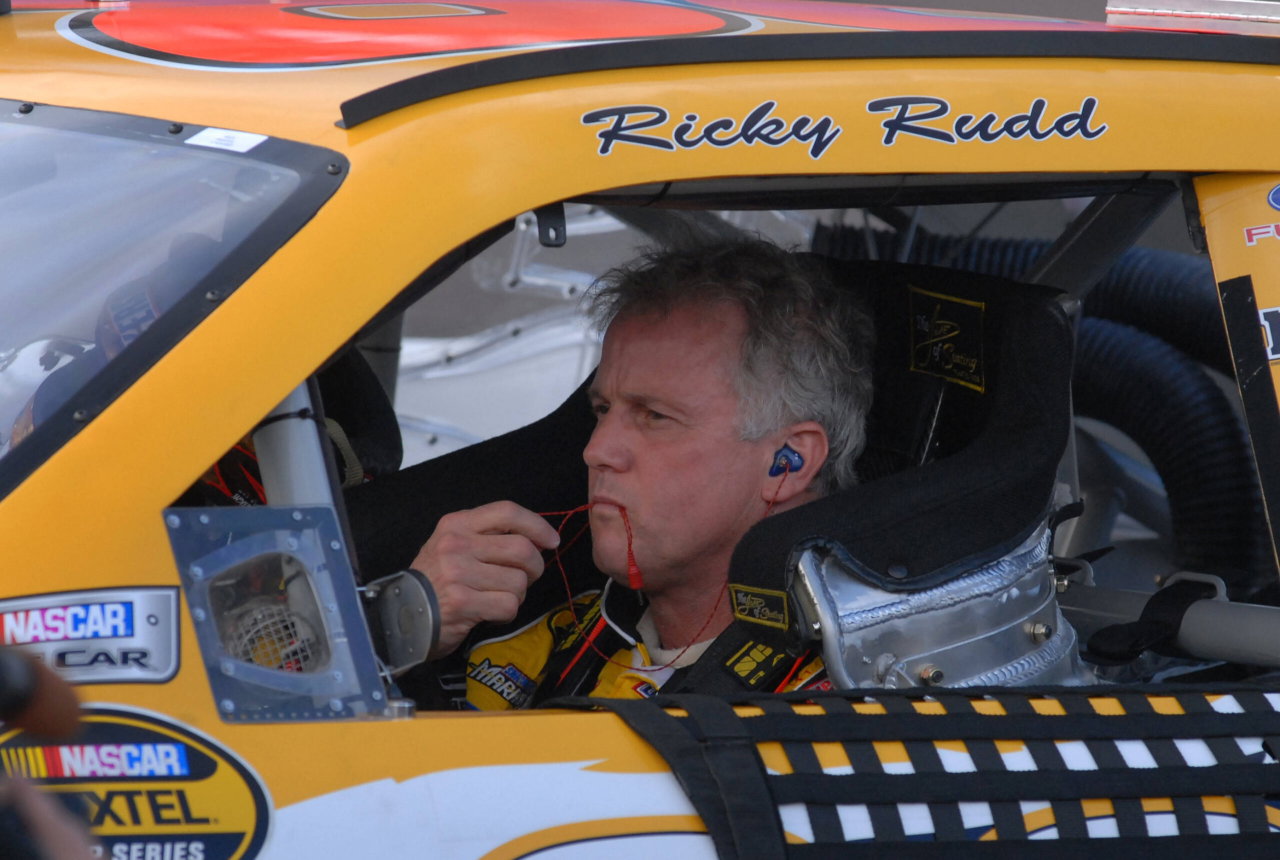
At the age of 18, Ricky Rudd found himself behind the wheel of a stock car, making his NASCAR Cup Series debut alongside some of the sport’s greatest names. His biggest drawback? He had never raced a Cup car before. For a teenager who dreamed of a career in IndyCar and had his roots in karting and dirt-bike racing, a NASCAR debut was far from what he had expected. It didn’t take long for the youngster’s cocky confidence to turn into fear, as he recalls being petrified at the thought of making his Cup Series debut at Rockingham in 1975.
Watch What’s Trending Now!
Rudd’s entry into NASCAR’s premier division came earlier than even he could have anticipated. While other young drivers spent years working their way through the ranks, he found himself with an opportunity to compete at the highest level before he had even found his footing in stock-car racing. It was a leap into the unknown, and one that would leave a lasting impression on the teenager.
“I came in in the mid-70s, and I had just turned 18 and just graduated from high school. And the first race car that I actually sat in was a Cup car, at Rockingham, North Carolina. Prior to that, go-karts, dirt bikes, you know, kind of more like regional neighborhood type stuff,” recalled Rudd during his appearance on The Scene Vault podcast.
“And then all of a sudden, trying to go to a race, and that being Rockingham, North Carolina, and hopping in a car…There was no testing; there was nothing to really compare it to except, you know. Probably one of the scariest things I think I ever did is hopped in that race car. I was usually a pretty cocky kid. You know, I was confident in what I was doing.”
Despite his nerves, Rudd’s first outing in NASCAR’s premier division turned out to be a respectable one. Driving Bill Champion’s No. 10 Ford, the teenager started 26th in a 31-car field and worked his way up to finish 11th in the Carolina 500. He crossed the line 56 laps behind Cale Yarborough, who led David Pearson and Richard Petty to the podium. Rudd had even finished ahead of established names such as Darrell Waltrip, Buddy Baker and Donnie Allison. For his first time competing in a stock car, it was hardly a disappointing result.
But Rudd’s apprehension hadn’t come from nowhere. A few weeks earlier, Bill Champion had entered him in the preliminary 300-mile Sportsman race ahead of the 1975 Daytona 500. It was an enormous leap from his Langley tryout, where he had barely experienced speeds approaching 100 mph, to a Sportsman car capable of reaching 180 mph.
Rudd struggled to come to terms with the power and unfamiliarity of the machine, later describing it as feeling like a school bus with a big steering wheel and ungodly horsepower. He failed to qualify for the race, and, in hindsight, admitted he was relieved. He had no idea how he would have handled the event without embarrassing the people who had given him the opportunity.
“I didn’t know what I was doing,” Rudd admitted. “I remember being scared to death.”
Rudd’s second Cup start at Bristol brought another encouraging result, as he qualified 23rd and finished 10th, just two weeks after his debut. But the learning curve was far from over. At Atlanta the following week, an engine failure sent his car spinning into the inside wall, and the teenager made matters worse by climbing out before the field had slowed. Champion was furious, reminding him of the basic safety rules he had yet to learn. For Rudd, those early races were as much an education as they were a test of his ability behind the wheel.
After two part-time seasons in 1975 and 1976, the NASCAR driver had found the confidence to compete full-time. However, it wasn’t an easy journey, as the driver’s family funded his full-time campaign in 1977, being able to afford 25 out of 30 races. But the Cup Series driver had realized he enjoyed competing in the stock car racing category and took on the challenge head-on.
Out of 25 starts, the NASCAR Cup Series driver secured 10 top-10 finishes, one top-five finish, 17th in the standings, and the Rookie of the Year honor in his first full-time season funded by his family team in 1977.
After earning Rookie of the Year honours in 1977, Rudd continued to build his reputation, eventually joining Junie Donlavey’s team for the 1979 season. But it was a fourth-place finish at Charlotte’s National 500 in 1980 that truly put him on the radar of bigger teams.
Driving an older car from his family’s operation, Rudd qualified on the outside pole and delivered a performance that caught the attention of DiGard Racing. The team soon approached him with a 10-year contract, marking a major turning point in his career and opening the door to a more competitive future in NASCAR.
When Rudd recalled how he landed a seat in the Cup Series, he joked that it was probably only because his brother spun out a lot more than he did when Champion decided to test the two for the opportunity. But the racer may have discovered something far more valuable as Rudd went on to become one of NASCAR’s most prominent names in the early 80s and 90s.
What began as a chance encounter with the sport turned into his career behind the wheel forever, with NASCAR inducting the driver in its Hall of Fame in 2025. And, funnily enough, the very veterans he was once scared to race alongside became his biggest mentors.
“I learned from the best teachers in the world. I learned from the Pettys, the Pearsons, Baker, Yarborough, the list goes on. Those were basically my teachers because when I would screw up they would come find me and say, ‘Ricky, you should have done this or you should have done that.’ So I felt like I had a unique opportunity. I learned from the best in on-the-job training.”
Over a 32-year NASCAR Cup Series career, Rudd made 906 starts, collecting 23 victories, 194 top-five finishes, 374 top-10 finishes and 29 pole positions. Known as NASCAR’s ‘Ironman’, he once held the record for 788 consecutive starts, a testament to his remarkable durability.
From finishing second in the 1991 championship to winning the 1997 Brickyard 400 as a driver-owner, Rudd built a legacy that extended well beyond his 23 victories. The 1977 Rookie of the Year and one of NASCAR’s 75 Greatest Drivers was finally inducted into the NASCAR Hall of Fame in 2025.
Beyond the statistics, Rudd built lasting friendships and fierce rivalries, most notably with Dale Earnhardt, with whom he eventually reconciled after years of on-track clashes. Nicknamed ‘The Rooster’ for his fiery, never-back-down attitude, he earned the respect of a generation of racers. And none of it might have existed had an 18-year-old Rudd not dared to take that first frightening step at Rockingham in 1975.