
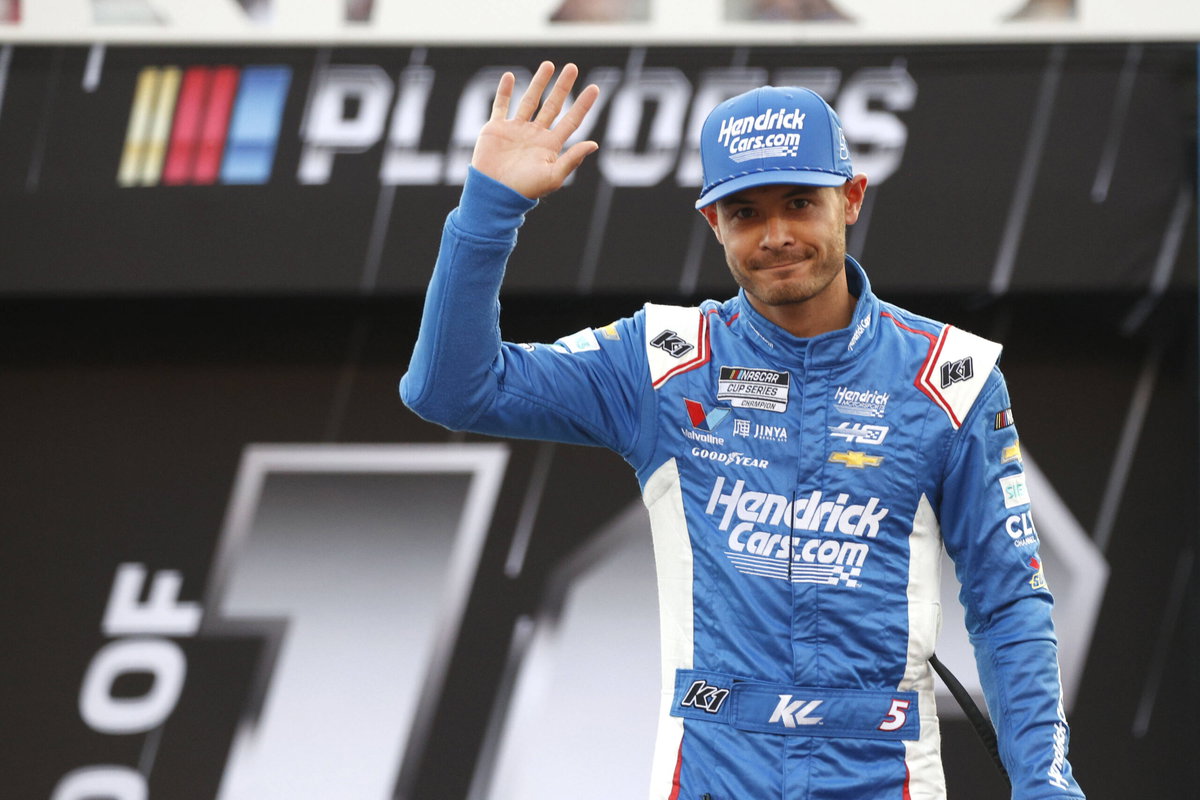
Kyle Larson has a trio of P3 finishes at Phoenix Raceway, and one of those helped him score his second Cup championship. On paper, the numbers suggest that the Hendrick Motorsports driver should feel comfortable returning to the Arizona oval. However, Larson has a very different assessment of the No. 5 Chevrolet’s chances at the track.
Watch What’s Trending Now!
Asked about the team’s performance at the track, Larson delivered a rather blunt verdict as he told SiriusXM NASCAR Radio in a short clip posted on X.
“No, we’re terrible,” he explained.
For Larson, strong finishes at the track have been the product of execution, strategy, and a willingness to fight through difficult situations, rather than having the fastest car in the field.
“I bet, you know, if you looked at average speed, we’re probably an 11th to 13th place car typically. And I feel like if you dropped us in 20th, that’s where we would run,” he added.
Larson has built a significant points advantage through consistent performances, but Phoenix could expose a weakness that his finishing record does not immediately reveal, which is crucial as we head into the final stages of the Chase.
In each of his last four Phoenix starts, Larson has finished inside the top five. Yet, he hasn’t led the most laps across those races. The No. 5 team has repeatedly found ways to secure strong results without consistently having the speed to control the race.
Larson credited that success to the people and decisions behind the car. His crew has been effective on pit road, while the team has made smart strategic calls, including when to take two tires. Restarts, blocking, and the timing of cautions have also helped the Chevrolet move forward when its underlying pace has not been enough.
The importance of that execution was clear in his first championship at Phoenix in November 2021. Larson entered the final round of pit stops in fourth, behind all three of his title rivals, but his crew sent him back out in the lead. He then held off the other championship contenders over the final 24 laps to win the race and the title.
“Without my pit crew on that last stop, we would not be standing right here,” Larson said afterward. That stop helped secure his first championship, even if it offers no guarantee that the team can overcome its current Phoenix concerns.
In other words, the finishes have not been accidental, but neither do they necessarily indicate that Larson is arriving at Phoenix with a race-winning car.
Then there’s also the question of how the track itself feels. Larson revealed that he had a conversation about Phoenix with crew chief Cliff Daniels, where he said he wanted Daniels to experience how it feels on the simulator.
“Phoenix is just such an awkward track,” he said. “I went in the sim a couple of days ago and ran some laps there, and it felt just as horrible as it does in real life. And I wasn’t saying this jokingly, but I was like, ‘Man, Cliff, I really want you to get into the sim just so you can feel how bad it is, and then maybe you will see how desperate that I am for grip.’”
His description of Turn 1 is specific: the car feels normal rolling in, then he cracks the throttle and drifts all the way around the corner with nothing to do about it. He doesn’t know if every car drives that badly and he just does it faster. What he does know is that it doesn’t suit his style or the current cars.
Those frustrations were already evident during the March 8 race at Phoenix. Larson battled loose handling before recovering to finish third, earning his first top-five of the 2026 season. The result was also his third consecutive third-place finish at the track, but his assessment afterward was far less encouraging than that streak suggested.
“It was an awesome finish for how much we struggled today,” Larson said after that race. “All day, I felt like we might not even be a top-15 car.” He credited his team with improving the Chevrolet and gaining track position throughout the afternoon, describing the same gap between pace and results that he highlighted ahead of his return.
The lack of grip also explains why the team cannot rely on outright pace, and has instead shown a heavy reliance on race strategy and execution. A driver can manage a difficult car for stretches of a race, but the challenge becomes much harder when rivals have a clear performance advantage.
Charlotte offered a recent example of how traffic can change the No. 5 team’s prospects. Larson led a race-high 97 laps, but once he dropped into traffic in the final stage, he struggled to challenge the Toyotas and finished sixth. Daniels called it a “good reality check,” acknowledging that the Chevrolet had been less competitive away from the front.
That does not mean Phoenix will follow the same pattern, but it helps explain Larson’s concern about getting buried in the field. His ability to recover positions could become just as important as where he qualifies.
Past results are no source of comfort either. Larson pointed to the team’s performance at St. Louis last year as an example of why recent form provides little reassurance.
“It doesn’t, because we were good in St. Louis last year and we went to Phoenix and we were trashed there too. So no, it doesn’t. And I’m just always honest, but no, it doesn’t give me confidence. But, you know, I know that we’re going to continue to work at it and get better.”
That determination will be important, as Larson’s advantage gives the No. 5 team some breathing room, but it does not eliminate the need to address a recurring weakness before it is too late.
The timing of Larson’s comments is rather interesting too, particularly because of Joe Gibbs Racing narrowing the points gap. Chase Briscoe secured his second consecutive victory while Christopher Bell finished just behind him. Denny Hamlin also collected a top-five result, leaving JGR with three drivers capable of putting pressure on the championship leader.
As detailed in NASCAR.com’s analysis of the title battle, Larson left Charlotte with a sixth-place finish, his worst result of the Chase so far. He nevertheless extended his lead over Hamlin to 49 points, with Bell 51 points behind and Briscoe trailing by 65.
That cushion reflects a significant turnaround for Larson, who began the Chase 55 points behind Hamlin. Through six races, he had turned that deficit into a 49-point advantage, a 104-point swing between the two drivers. Hamlin, meanwhile, had not won since Pocono on June 14, leaving the top seed struggling to keep pace with Larson’s championship run.
Briscoe himself admitted recently that the only way to gain ground is to win, because running second or third while Larson does the same won’t close 65 points in four weeks.
He had already seen an opportunity slip away at Kansas on September 27. Briscoe passed Larson for the lead late in the race, but his car became too loose, allowing Larson to reclaim the position and win. Instead of taking points off the championship leader, Briscoe watched him leave with the victory. His subsequent back-to-back wins made that missed opportunity more significant as he tried to close the gap with time running out.
The margin remains valuable, and JGR’s recent form further makes the next few races extremely important. Briscoe, who had apparently thrown in the towel not long ago, has turned around and shown how quickly a strong run of results can shrink a deficit. Phoenix gives Larson another opportunity to protect his advantage at a track where he openly acknowledges the team’s struggles.
His pursuers also have reasons to welcome the trip to Arizona. Bell won the spring Phoenix races in 2024 and 2025, then led 176 laps before finishing second in March 2026. Briscoe earned his first Cup victory at the track in March 2022. Those results give both drivers a basis for confidence as they look to turn Larson’s discomfort into an opportunity to gain points.
To sum it up, the recent numbers suggest that Phoenix is one of Larson’s best tracks. Larson says it isn’t. The next 312 laps will show which one of them is right.