
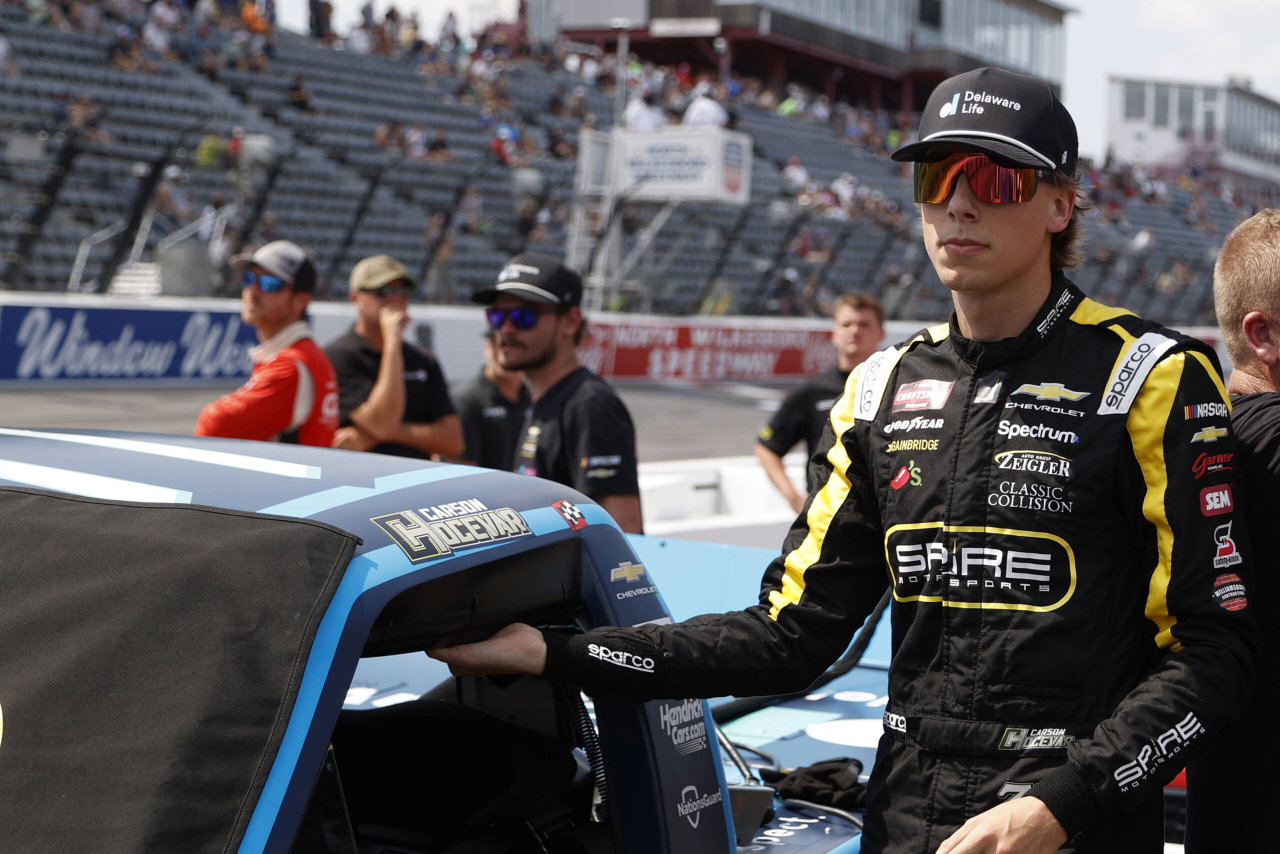
NASCAR has finally handed down its verdict on the Martinsville brake-checking controversy, and the financial consequences are steep for Carson Hocevar and Josh Berry. On Tuesday, NASCAR fined Hocevar $100,000 and docked him 25 driver points, while Berry received a $50,000 fine and the same points deduction. Both penalties followed incidents that damaged rival drivers’ cars and ended their races. But with Hocevar facing twice the financial punishment, NASCAR’s Elton Sawyer has explained why the two cases warranted different consequences.
Watch What’s Trending Now!
“As we reviewed both of those incidents, and you look at the 77, and with Carson being in situations before where we’ve had behavioral situations and penalties, we’ve had discussion with him, we just felt like after reviewing all of the data and the audio, that this one rose to a level that it needed to be more than just the $50,000 that Josh got, and the 25 points for both,” NASCAR Senior Vice President of Competition Elton Sawyer told SiriusXM NASCAR Radio.
His comments revealed that the difference between Carson Hocevar’s $100,000 fine and Josh Berry’s $50,000 penalty was not simply about what happened at Martinsville. NASCAR also considered Hocevar’s previous disciplinary history and its conversations with the Spire Motorsports driver. After reviewing the available evidence, officials decided that his latest actions called for a stronger financial response.
The SMT data played a central role in that decision. Hocevar repeatedly hit the brakes in front of Austin Cindric during the race, with four instances over two laps showing how the No. 77 Chevrolet slowed directly in front of the No. 2 Team Penske Ford. Cindric had little room to avoid the contact, and the damage to his car ended his race. Hocevar’s spotter, Tyler Green, could also be heard repeatedly telling him to stop.
Berry’s incident with Ryan Blaney unfolded differently. After contact exiting Turn 4 left Berry trying to gather his No. 21 Ford, he hit the brakes, damaging the front of Blaney’s No. 12 and contributing to a spin that brought out a caution. Blaney believed Berry had deliberately ended his race, while Berry maintained that he was trying to save his car after getting loose. NASCAR nevertheless penalized both drivers (Hocevar and Berry) under the rule covering actions detrimental to stock car racing.
Brake-checking is considered detrimental to stock car racing because it uses sudden, deliberate deceleration to disrupt another driver’s momentum and can leave them with little time to react. Beyond compromising fair competition, the maneuver creates an avoidable risk of contact, damage and injury. The risk was amplified by NASCAR’s revised short-track bumper package, which removed reinforcement and high-density foam from the front bumper structure.
Hocevar’s history helped distinguish the two cases. In October 2025, NASCAR fined him $50,000 after he spun his tires while attempting to rejoin the field at Kansas Speedway, despite safety personnel being at the scene of his stopped car. Earlier this season, he was involved in a physical altercation with Blaney at Bristol following an on-track clash. NASCAR opted not to penalize either driver for the fight, but the incident added to a season marked by repeated confrontations involving Hocevar.
There was also the incident at Darlington, where Hocevar made contact with Brad Keselowski and sent the RFK Racing driver spinning. Keselowski warned that their conflict was not over, while Hocevar responded that he would be ready for the consequences. Although not every on-track clash resulted in a formal penalty, NASCAR’s reference to previous behavioral situations suggests officials considered the broader pattern when assessing Martinsville.
The financial difference, however, did not extend to the points standings. When asked why both drivers lost 25 points despite the disparity in their fines, Sawyer said NASCAR wanted to remain consistent with its previous decisions.
“As we looked at it, trying to be as consistent as we’ve been in the past on the points side of it, and we landed on, with both of them, 25,” he explained. “Again, the difference being the monetary side of it, and we felt like that would have more of an impact than, you know, the points side of it.”
Sawyer stressed that the decision was not made hastily. NASCAR officials spent the morning and part of the afternoon reviewing the incidents before settling on the penalties. The goal, he said, was to protect fair competition after both drivers used the front of their cars in ways that damaged their rivals’ vehicles.
Spire Motorsports had already suspended Hocevar for the Homestead season finale, naming Justin Haley as his replacement in the No. 77.
“This is an embarrassing day for me. I let the people down that gave me the opportunity of a lifetime to drive a Cup car. I also let down my team, sponsors, and fans. I crossed the line with my on-track actions and gave Jeff and Spire Motorsports no option but to put someone else in the 77 car this weekend at Homestead,” Hocevar posted on X after the revelation.
Sawyer emphasized that the team’s decision was independent of NASCAR’s punishment, praising Jeff Dickerson’s leadership while making clear that the sanctioning body had reached its own conclusion.
“We wanted to make sure that we could walk in the garage area and look at all the competitors and feel like they’re playing on a level playing field,” Sawyer said.
For NASCAR, the message extended beyond two fines: damaging another driver’s car through deliberate braking would bring consequences, and a driver’s prior conduct could influence how seriously officials responded.