
Imagine a sport that prides itself on discovering the next great talent only to quietly decide that some of the most gifted racers may never get the chance to prove it. In NASCAR, the pipeline from the dirt tracks and short tracks to the Cup Series might look open on paper, but practically, it increasingly functions as a financial filter.
Watch What’s Trending Now!
Sponsorships, manufacturer alignment, and organizational budgets now shape who advances more powerfully than raw speed or race craft. And it is worth asking whether the best drivers are ever going to get their shot. This question arises not because they lack ability, but because the system never fully tests it.
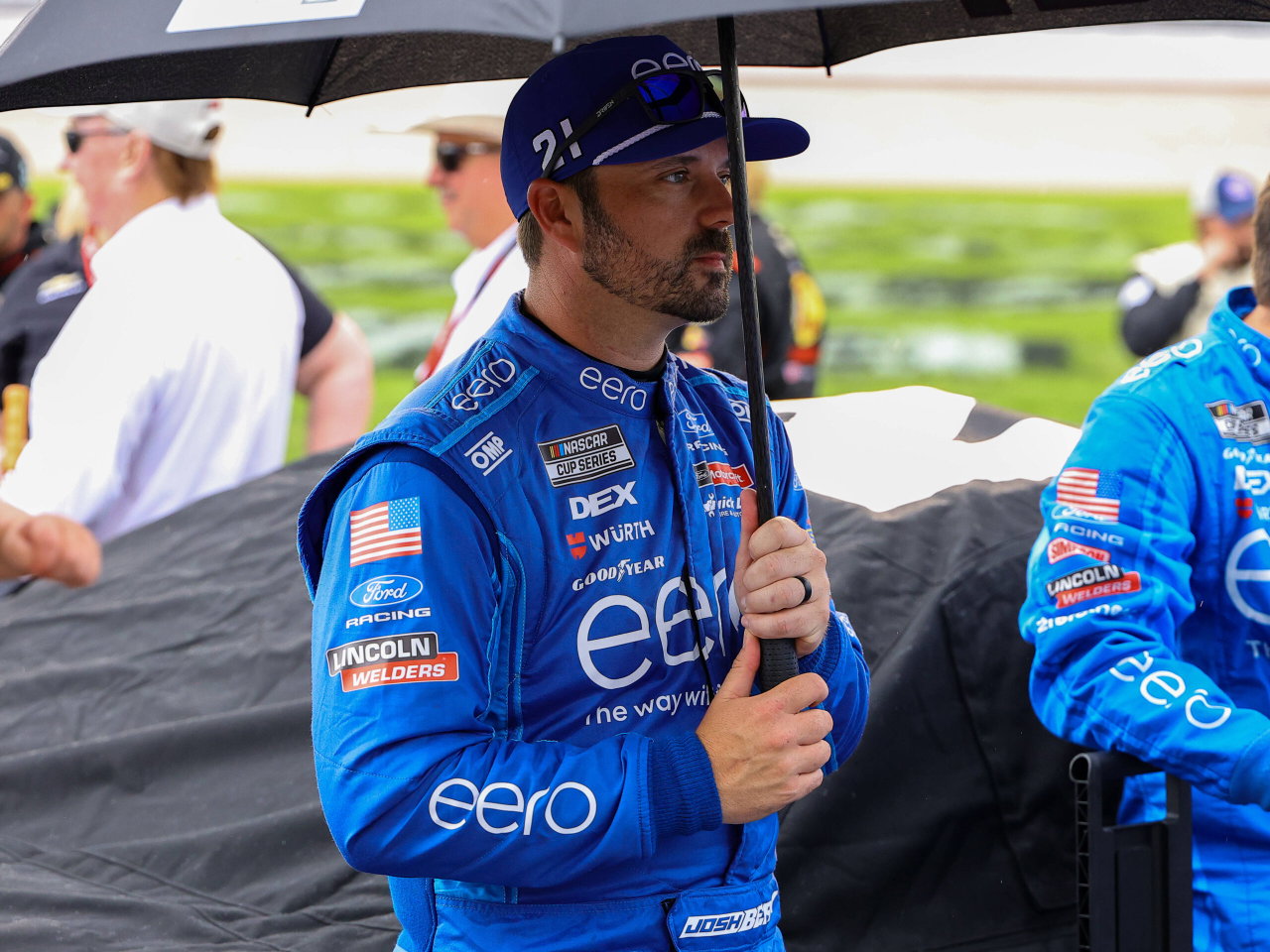
And this is no longer just a theory. Josh Berry is that uncomfortable proof of it, a driver who built his career through persistence. He is a Cup Series winner and has five victories in the ‘O’Reilly Auto Parts Series, but that’s not enough to keep his ride for 2027.
Jesse Love will replace Josh Berry for the No. 21 of Wood Brothers Racing in 2027. In a recent interview, Berry revealed that as the 2026 season unfolds and he searches for a 2027 ride, he revealed that some teams have asked him for 3 million in personal sponsorship funding from him to secure a driving seat for the 2027 season.
“They asked for three million dollars, so it’s been a little bit of a challenge working through all of that….I kind of feel it shows more about the system than it does about me. We’ll just work through that as it comes.” Berry said in an interview this week.
This raises a lot of questions. If a proven Cup winner and O’Reilly series winner must bring millions just to keep a seat. What does that say about the drivers who never reach this stage? Berry is not searching because he suddenly forgot how to drive. He is searching because Cup seats and the increasingly important steps that lead to them are tied to sponsorships, manufacturer assignment, and organizational fit.
There are potentially dozens of drivers below him who never receive the chance to prove what they can do. Berry’s situation makes the story larger than one free agent. And this also raises a more disturbing possibility that NASCAR may be losing potential stars long before they reach the level at which the sport can discover what they are capable of.
Former NASCAR Cup driver Rick Mast recently revealed how things have changed in NASCAR as compared to his era. He described a very different version of the sport. He revealed that when he entered NASCAR, teams competed for drivers.
There were genuine bidding wars after talent and drivers were paid because teams wanted to secure their services. He compared his period with the modern environment in which family history and financial backing can influence who can reach the grid.
“The only thing I can say with certainty is that when I came through, there was almost NO buying your way in. In fact, there were quite a few bidding wars between teams trying to land a driver of choice. And yes, they paid us very well. Like everything else, times are changing,” Mast wrote on X.
This doesn’t mean that the past was perfect; the drivers still had the need for resources, connections, and the ability to attract sponsors. Racing has never been a cheap sport. But Mast’s observation identifies a meaningful change in the balance of power between Old NASCAR and Next Gen Era.
Has NASCAR shifted from a talent selection system to a talent financing system?
The progression that once looked like a pure merit ladder, like dirt or karting to late models, ARCA, Trucks, O’Reilly, and then the Cup series, now carries escalating financial gates at nearly every step. It’s true that talent still matters, but at some point along that climb a driver’s pure ability can become secondary to his or her ability to fund the next level.
A driver does not only purchase a seat. The cost of competing includes the car, engine, tires, crew, transport, insurance, travel, testing, coaching, and physical preparation, and the driver needs funding to survive bad races, mechanical failures, and also development seasons.
A talented driver with inadequate resources may not receive the same number of races as a better-funded competitor. This difference affects everything that follows: the funded driver accumulates experience, builds relationships with crew, shapes and manufactures, and generates statistics. The unfunded driver may be forced to stop before the sport has enough evidence to judge him.
Even if the first driver has greater underlying potential, the system therefore creates a paradox: drivers need results to attract funding, but they often need funding to obtain the equipment capable of producing those results. When a 35-year-old Cup winner is asked for $3 million simply to keep racing. The message to younger, established talent is heartbreaking.
This proves even professionals can become financially vulnerable when a contract expires. Because Berry’s experience clearly suggests that the problem does not disappear even after a driver reaches the Cup Series.
On the other side, Corey Day represents the counterexample to NASCAR’s traditional funding problem. Day emerged from dirt racing as a highly regarded young driver. Day caught the attention of Kyle Larson, who then recommended him to Hendrick Motorsports.
Rather than requiring him to finance every stage of his transition, HMS created a multi-year development relationship that allowed the organization to evaluate and train him. This deal placed him full-time in the No. 17 O’Reilly car for 2026. Day competed across NASCAR’s national series, ARCA, and Trans Am in a program sponsored by HendrickCars.com.
In 2026, Day has already scored two wins in the O’Reilly series at Dover Motor Speedway and Talladega Superspeedway.
“When you have a guy like Kyle who is racing on the track with [Day] and saying those types of things, it certainly gets our attention when we start looking down the road at up-and- coming drivers,” Jeff Gordon told NASCAR.com in a conversation in 2025. “It’s not that we were planning for that, but when somebody comes along that has that type of talent, you start looking at it a little bit differently of what’s possible.”
Jeff Gordon’s explanation of Hendrick’s interest is important. The organization wanted to identify talent early, before a driver spent years of developing habits in another discipline that might be difficult to change later. This doesn’t become a stance against dirt racing.
Day’s success suggests that NASCAR is capable of finding and developing unconventional talent. The troubling question is whether only a certain number of organizations can make it happen. The answer to this is yes.
Finding and developing unconventional racing talent requires major financial resources, creating a competitive gap where only elite, well-funded teams can reliably scout, test, and nurture diverse or non-traditional drivers.
What about the drivers who never gets noticed?
One may have the same or more talent than Corey Day, but luck? That’s debatable. There are so many Corey Day’s existing in dirt racing today who never got noticed by Larson’s endorsement, Gordon’s attention, and HMS’ financial and opportunity backing.
Names such as Bobby Pierce, Ricky Thornton Jr., and David Gravel surface regularly in these conversations, along with regional late model standouts who dominate their circuits yet remain outside the manufacturer and mega-team pipeline.
The point is not whether each one of them will succeed in the Cup Series; this will be easy to disprove and misses out on a bigger issue and context behind it. NASCAR simply doesn’t know how many of them there could be, because the system never gives a structured opportunity to find out and have their “prove-it” moment.
Kyle Larson is the perfect example of what happens when an opportunity is provided. Known for his mastery on dirt tracks, Larson moved into the NASCAR system with early recognition, later earned a full-time Cup ride with Chip Ganassi Racing, and then landed at Hendrick Motorsports, won 2 Cup championships with HMS.
Now imagine the same talent without these same opportunities. Corey Heim also caught attention of Toyota and 23XI Racing, which is why he will compete as a full-time driver in 2027. And like Corey Day, his only merit to securing a promotion is his racecraft.
Money can definitely buy opportunities; the wealthy or well-connected prospects are not illegitimate. But it doesn’t bring talent along with it. Drivers such as Dale Earnhardt Jr., Ty Gibbs, William Byron, and Kyle Busch entered with varying degrees of family or sponsorship resources. Several of them justified the investment with results, but it’s not guaranteed for everyone.
Josh Berry and Corey Day represent two opposite ends of the sport’s strongest organizations. Day is young, highly regarded, and backed by one of the strongest teams in NASCAR that can provide equipment, coaching, technical expertise, and a structured schedule. His development deal gives the team time to evaluate his potential rather than demanding immediate performance.
Josh Berry is 35 and has already proven himself. He has Cup experience, Cup victories, and O’Reilly victories as well. Yet, he is sitting seatless for 2027 and in search of a new opportunity.
No one’s case is wrong here, but the contrast reveals how the system values potential and proven performances differently. Berry’s $3 million revelation makes the issue urgent because it removes the comforting idea that sponsorship pressure affects only inexperienced drivers.
What NASCAR can change?
NASCAR cannot eliminate the commercial demand and reality that the current market of professional racing has. But the sport can improve how it discovers drivers before money becomes the deciding factor. NASCAR and its manufacturers could create a jointly financed development fund for promising grassroots drivers. Selection could be based on race results, quality of competition, adaptability, and references from respected team owners.
It should search for drivers who have produced exceptional results in dirt, late models, and regional touring series without access to major backing. Manufacturers already have development programs, but we know drivers can move to rival camps. Jesse Love is leaving Chevy to join a Ford team to make his Cup debut.
An incentive system to promote young drivers is perhaps one way of going about it it. Or perhaps teams can secure sponsors for talented driver they know are going to make it to Cup Series.
These solutions will not eliminate the role of money. But they’ll reduce the degree to which financial access filters talents before that particular talent gets a chance. The sport does not need to claim that every dirt racer deserves a Cup ride. But perhaps make a roadmap through which a driver can hope to achieve their NASCAR dreams.
The current Josh Berry case makes this situation more saddening. The biggest threat is not that NASCAR has run out of talented drivers. It is that the sport may be filtering them by financial access long before; that is a deeper, more structural crisis. And it totally depends on NASCAR whether the next generation of stars will ever get the chance to become one.