
Imago
Aug 31, 2023; Charlotte, North Carolina, USA; Kevin Harvick answers questions from the media at Charlotte Convention Center. Mandatory Credit: Jim Dedmon-USA TODAY Sports
Imago
Aug 31, 2023; Charlotte, North Carolina, USA; Kevin Harvick answers questions from the media at Charlotte Convention Center. Mandatory Credit: Jim Dedmon-USA TODAY Sports
During the latest episode of the Door Bumper Clear podcast, Connor Zilisch was debunking some rumors prevalent in the late model stock car division. One of them was a claim by FOX broadcast and Kevin Harvick, who suggested that drivers lift their throttle to take the corners on ovals. And somehow, according to them, they get more horsepower while doing so. While this sounds interesting, Zilisch burst the balloon and called out Kevin Harvick’s bluff.


Connor Zilisch voices frustrations towards FOX and Kevin Harvick
Watch What’s Trending Now!
“Can we talk about the broadcast and qualifying and the fact that the Fords are all doing 90 percent? Don’t get me wrong, but Kevin’s raced for 25 years and for him to be saying, ‘The Fords are running 90 percent throttle; they get more horsepower at 90 percent throttle.’ We don’t have carburetors anymore. Dude, they are wide open.”
For the average viewer, Kevin Harvick’s words would come off as the real science behind NASCAR engines. Yes, there are certain specific conditions that tend to help the engine more. The ’90 percent throttle’ use is a prevalent myth. Supposedly, the air-fuel ratio is better, and the engines tend to perform better with this trick. There is no certain proof about the same.
A viewer would expect Kevin Harvick to stay away from utilizing such controversial terminology, considering the lack of trust that it causes. Connor Zilisch points out that there is a very obvious error going on with the Ford cars. They are not deliberately running at 90 percent throttle. In fact, they are not calibrated properly, and the trick is basically nonexistent.
“But at least, I mean, the Fords have been 90 percent throttle for years. Can we at least just calibrate them so they show 100 percent throttle and don’t throw everyone for a loop?”
Imago
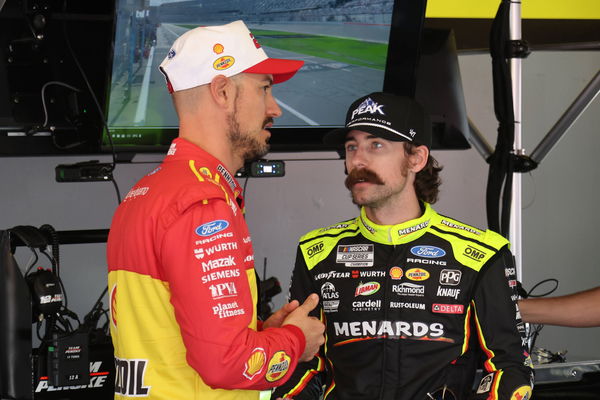
DAYTONA BEACH, FL – FEBRUARY 14: Ryan Blaney 12 Team Penske Menards/Peak Ford talks with Joey Logano 22 Team Penske Shell Pennzoil Ford prior to the final practice for the NASCAR, Motorsport, USA Cup Series Daytona 500 on February 14, 2026 at Daytona International Speedway in Daytona Beach, FL. Photo by Jeff Robinson/Icon Sportswire AUTO: FEB 14 NASCAR Cup Series Daytona 500 EDITORIAL USE ONLY Icon2602142322500
After that, Zilisch had a bone to pick with FOX and their inaccurate broadcast of the O’Reilly Auto Parts and Truck Series. In the FOX broadcast graphics, there is a section that shows the throttle percentage being used by the drivers. Zilisch exposed their fake nature by revealing the truth behind the same.
“Why did the Truck broadcasts and qualifying still have the SMT fake throttle percentage? Like, when they lift in the middle of the corner to 75 percent throttle on the data and it shows on TV, why are we showing that?”
These numbers are nothing more than wrong estimates from the GPS. They are not calibrated to the Tier 2 and Tier 3 cars like the Cup Series. Zilisch debunked the same during the podcast, implying that only Cup Series cars show true throttle data in those graphics, and the O’Reilly and Truck Series’ data is not accurate. Zilisch goes on to point out the glaring errors in the broadcast regarding the same.
“Why are you making it look like we are lifting and qualifying—when we are not—in the Trucks? It’s fine to show the data. This is probably pissing me off more than it should, but it’s been three years we’ve been showing the SMT fake Truck data.
“FOX, if you are listening, you have to get rid of the SMT data for qualifying. That’s not real, the throttle percentage. Only Cup has the real data, where it’s like the real throttle percentage; the Trucks and Xfinity cars—it’s literally just a made-up thing. So, like when they slow down into the corner, because the cars slow down, SMT thinks you are lifting. It’s all GPS. When they show that, in qualifying, it’s not real data.”
Since we have no concrete answer from Ford or NASCAR, let’s dissect the rumors and stories surrounding this trick.
What is Ford’s ’90 percent throttle’ rumor?
If we take Connor Zilisch’s words at face value, then it is a clear hoax. There is no such thing as running on ’90 percent throttle’ to get the best performance out of the car. But it’s not like it’s something impossible to achieve. Yes, this trick has two other angles that we can explore.
One of the possible explanations for the FOX broadcast showing 90 percent throttle is that it’s not showing the throttle input but the butterfly angle. The butterfly flap is a valve that translates the driver’s throttle input to the engine and accordingly opens the valve to let in more air.
It is being suggested that the Throttle Position Sensor used by Ford is calibrated to 90 degrees. So when the drivers push the throttle pedal all the way down, it opens the flap to 90 degrees.
When the TPS is at a 90-degree angle, it means that the butterfly valve is fully open and the engine is getting the maximum amount of air according to its construction. At 90 degrees, the butterfly flap is parallel to the flow of incoming air. As Connor Zilisch mentions, the FOX broadcast for the Cup Series is using the real-time NASCAR data.
Imago
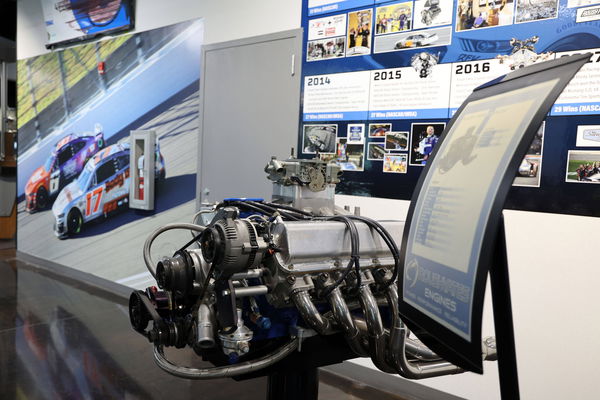
Ein Ford- Roush Yates Motor der früheren Generation im RFK Roush Fenway Keselowski Racing Teams im Museum ausgestellt, rechts Ford Fusion von Chris Buescher, Mooresville, North Carolina, USA, 14.10.2024, NASCAR, Motorsport, USA Rennteam, *** An earlier generation Ford Roush Yates engine on display at the RFK Roush Fenway Keselowski Racing Teams museum, right Ford Fusion of Chris Buescher, Mooresville, North Carolina, USA, 14 10 2024, NASCAR race team,
In that case, if they are calibrated to the TPS of the car, then they are reading the butterfly flap’s angle. The 90-degree angle is simply the maximum angle of the flap and does not correlate to throttle input directly. Here, once again, Connor Zilisch’s words stand true. While it is not exactly a hoax, it is merely the incorrect calibration of the TPS for the broadcast.
However, there is another angle to this story. What is the best advantage of running the car at 90 percent throttle? The drivers can save fuel during the laps without sacrificing a lot of performance. In that case, they will fare much better in comparison to the competition. Assuming that the ’90 percent’ trick is true, there is one way in which it actually works out and affects the Ford cars on track.
There is always a margin of error while using a machine at its absolute limit. Let’s say the power curve of Ford’s V8 allows them a sweet spot. At this point—that is, the 90 percent throttle input—the car is producing the best fuel efficiency with a minimal drop in power.
Now, Ford can calibrate the ECU of the car to cap out the engine power at 90 percent even though the drivers are driving flat out. It eliminates the need for manually monitoring the throttle input. A combustion engine does not have a linear power curve. It needs a specific RPM and a specific fuel-to-air ratio to function. What is best in one situation might not necessarily be good enough for other situations.
If the Ford engines are actually better when run this way, they would try to keep the throttle input in that certain range. Now, why is there no proper explanation for this from Ford?
It’s simple: why give up the advantage to the other teams when you can work on it silently? Let’s say Ford came clean, and the next day they explained this trick they were using. The other teams will immediately start copying the same strategy or try to reach a similar threshold.
This way, Ford will be negating their own advantage. So, if we assume that this trick is not a hoax, then forget any explanation from Ford Racing. While it is easy to take a stand, in matters like this, there is always an angle that pops up to explain its feasibility.
Written by

Edited by

Suyashdeep Sason