
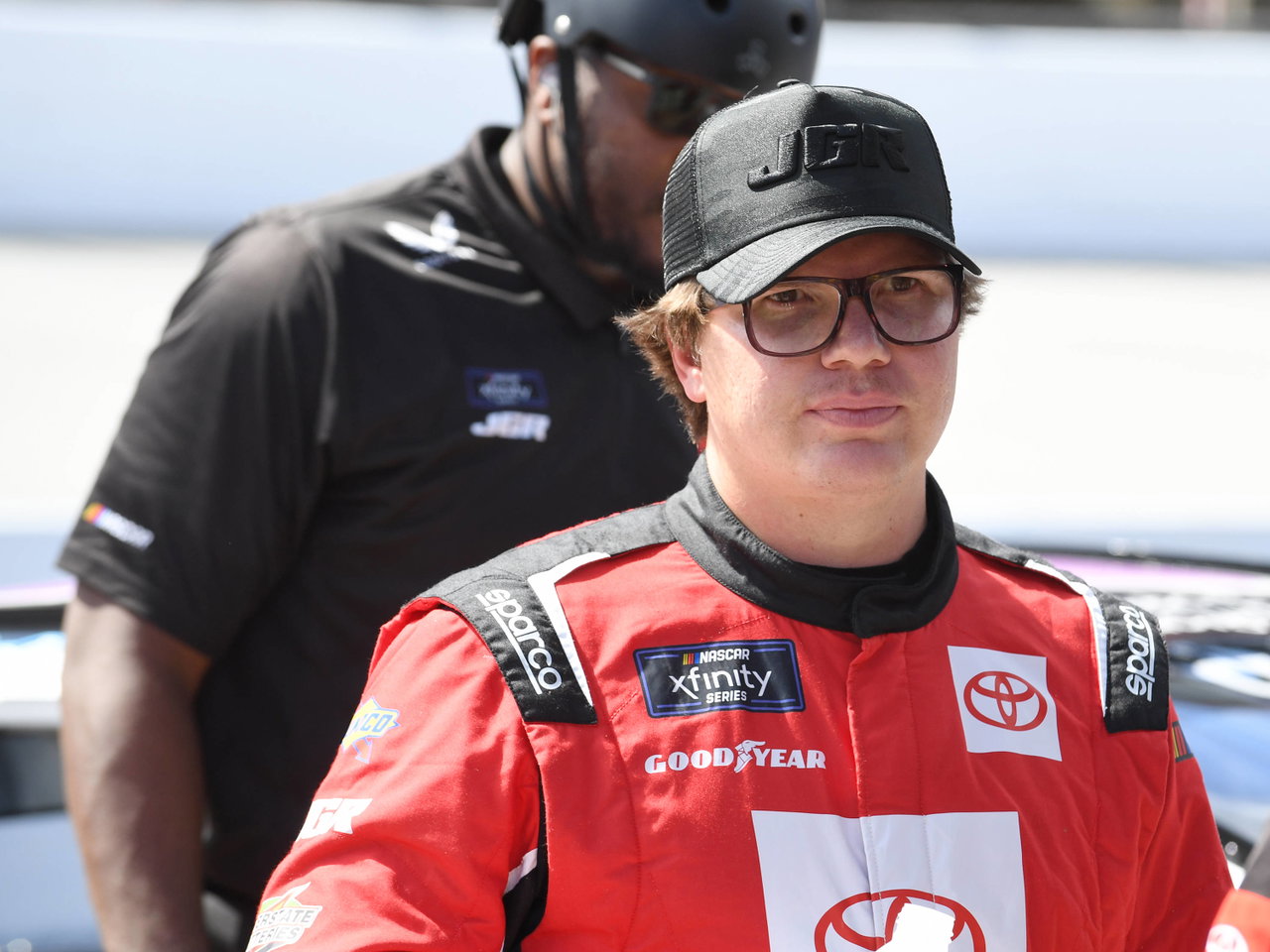
Sheldon Creed is in the strongest season of his NASCAR O’Reilly Auto Parts Series career, leading the rankings with three wins, twelve top-5s, nineteen top-10s, and 2259 points. So why would he wish to leave the team he’s achieved these results with? Well, Creed’s comments after Las Vegas offer a revealing look at the business side of NASCAR.
Watch What’s Trending Now!
In an interaction with Bob Pockrass posted on X, Creed shared a side of NASCAR that is rarely discussed publicly: his 2027 move to Sam Hunt Racing will be the first time he will be paid to drive a race car.
“I get paid for the first time in my life by a race team, so I’m excited about that,” Creed said after finishing P13 at Las Vegas.
Creed’s comment came just hours after he announced that he would leave Haas Factory Team at the end of the 2026 season, despite entering Las Vegas as the championship leader. He said that both parties tried to negotiate a potential continuation throughout the summer, but could not reach an agreement.
“Yeah, they knew, and we’re all bummed, like we all want to work together again. That’s… it sucks,” he said.
“I have zero complaints, and I wouldn’t say it was my first choice to move on, but, unfortunately, business has to make sense and that overrules results and performance on track sometimes,” Creed said.
NASCAR confirmed that Creed’s move to Sam Hunt Racing’s No. 26 Toyota is a multiyear deal, with Creed replacing Dean Thompson. Ironically, Creed is walking away from a championship-contending Haas program to join an organization whose immediate target for 2027 is simply making the playoffs. However, Creed said he sees a longer-term opportunity at SHR, particularly if he does not receive a Cup Series opportunity.
“If I don’t ever get that call, I felt like Sam’s is somewhere I can race for the next 15 years and make a good living and be able to raise my family and, yeah, just try to build a good life.” With much reassurance, Hunt also said the team built an offer that “not only helps him on track, but off track”.
Moreover, having raced for Richard Childress Racing, Joe Gibbs Racing and Haas, Creed has seen how different manufacturers and organizations operate. He believes Toyota’s resources can help him contribute to Sam Hunt Racing while continuing his own development.
“I believe that Toyota resources are arguably the best in our sport,” Creed said. “I’ve gotten to race for every manufacturer now, so I’ve gotten to see it all and see the way different manufacturers work and different teams work.”
Additionally, his teammate, Sam Mayer, has already announced a return to JR Motorsports for 2027, meaning neither of Haas Factory Team’s current full-time O’Reilly drivers will return next season. Meanwhile, Dean Thompson, who currently drives for Sam Hunt Racing, will move in the opposite direction and join Haas as the organization expands to three full-time O’Reilly entries in 2027.
Despite his move being motivated by business reasons, Creed still holds the championship as his top priority. He was disappointed with his P13 finish at Las Vegas because he believed the team had an opportunity to earn a much larger points advantage, instead of the 19-point lead over Carson Kvapil, after Justin Allgaier’s crash dropped the JR Motorsports driver from second to fourth in the standings.
“I just don’t know if I’ll be able to afford one of those again,” Creed said.
That said, several examples explain why the business side matters. A September FanAmp report said drivers are expected to bring at least $1 million for a full-time ride. Part-timer Brad Perez told the outlet a seat in a car expected to finish 25th or worse runs $40,000 to $45,000 a race, and $100,000 to $150,000 at top teams like JR Motorsports or Joe Gibbs Racing. Of his own earnings, he said: “I don’t necessarily make a living doing this yet”.
Perez went further, explaining that the money he earns from racing is roughly equivalent to another part-time job. He said he tries to make around $1,000 when he is behind the wheel, but it all depends on the kind of sponsorship deal he’s able to strike. He added that he has had several races in 2026 where he made nothing and therefore relies on other work.
And even securing the money for a seat may not be the end of the financial risk. Perez told FanAmp that some teams can ask drivers for an additional $10,000 to $15,000 “crash clause” on top of the race fee. The money is paid upfront and held to cover potential repair costs if the driver wrecks; if the car survives the race, the team returns it. However, Perez stressed that such clauses are not universal and said he had never personally been charged one.
Another case comes from 2019, when NASCAR reported that MBM Motorsports driver Joey Gase was sometimes expected to help find $2,000 to $10,000 for a race weekend. His crew chief said last-minute sponsorship stickers could be the difference, noting that Gase’s ability to bring money into the organization was part of what allowed his career to continue.
Even for Creed, when he moved to Joe Gibbs Racing for the 2024 Xfinity season, NASCAR reported that he had little sponsorship behind the opportunity. Later that year, Creed acknowledged just how much of a gamble he had taken on himself, saying that he and his backers had “brought all the money we could” and that he was not making a dollar from racing that season. Earlier in the year, he had put the situation even more bluntly, telling NASCAR that he wanted a “paid-for ride.”