
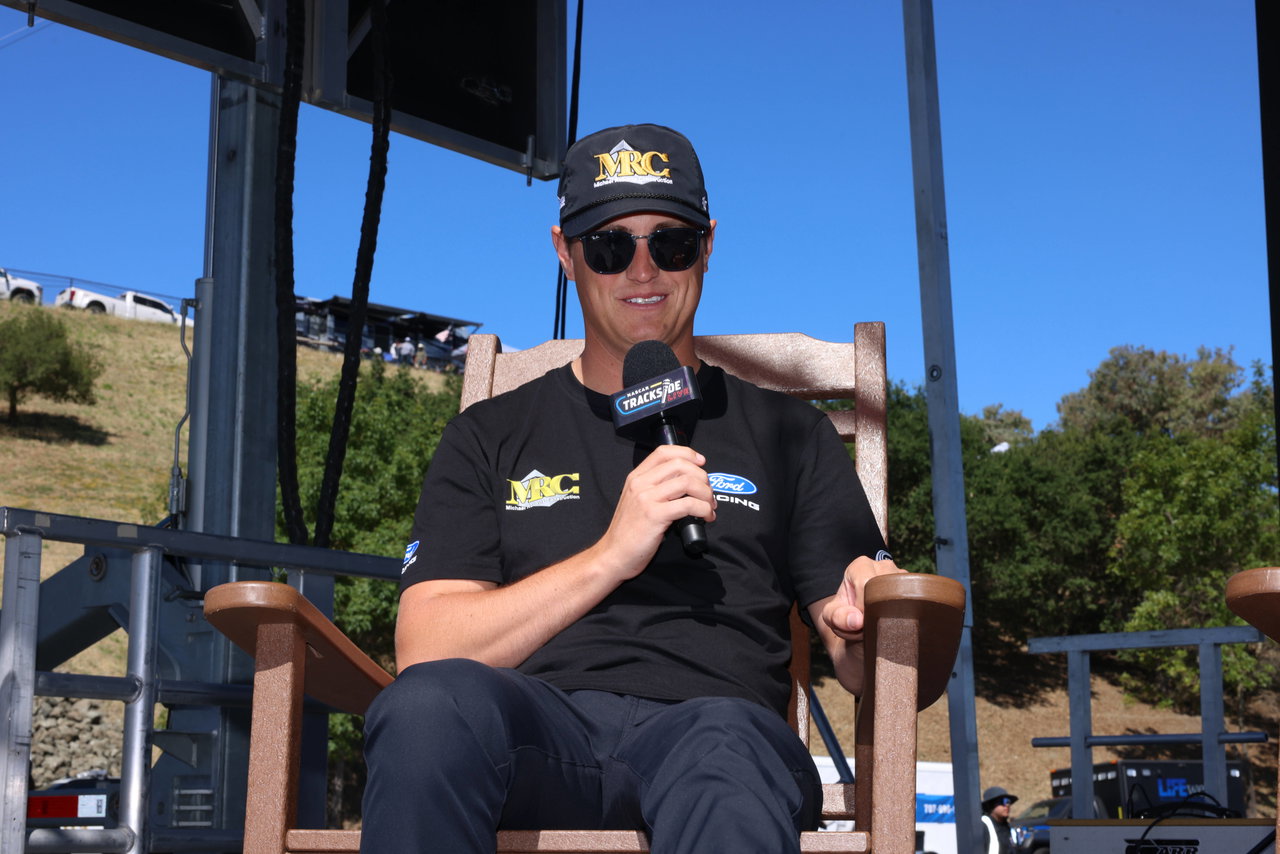
Michael McDowell and Ricky Stenhouse Jr. had a heated exchange on the cooldown lap at Charlotte last week. McDowell made contact with Stenhouse before eventually spinning him, but NASCAR chose not to penalize either driver. According to NASCAR vice president Mike Forde, the incident was quickly settled once the two reached pit road, and officials viewed it as a heat-of-the-moment reaction. A week later, another cooldown lap ended with a driver putting his car into a rival’s rear bumper. But this time, the incident carried a history that stretched back to July.
Watch What’s Trending Now!
Zane Smith was the one driving, but both the drivers had already been on NASCAR’s radar for months. Their latest clash followed a July incident at Chicagoland Speedway, where contact between them triggered a crash and reignited a feud that had previously drawn public criticism from Smith. That history proved crucial to NASCAR’s decision to fine Smith $50,000 for the Phoenix incident.
Speaking on Hauler Talk, Forde revealed that officials had summoned Smith and Hocevar for a meeting at Atlanta in July and delivered a pointed warning: “If you guys can’t figure it out, we will help you figure it out.”
But the Phoenix incident was not simply another case of post-race retaliation. NASCAR had reviewed video, audio, and data from the contact, and Forde said the previous warning was the primary reason officials decided to penalize Smith. The radio exchange inside the No. 38 Ford also offered a revealing detail about what Smith knew before he struck Hocevar.
The Phoenix incident unfolded during the closing stages of the race, when contact involving Carson Hocevar, Ross Chastain, Smith, and Josh Berry disrupted the battle on track. Chastain made contact with Hocevar, sending the No. 77 Chevrolet into the chain reaction and affecting Smith’s No. 38 Ford and Berry’s No. 21 Ford.
Zane Smith finished 15th, while Hocevar crossed the line in 12th. The contact in Turn 3 had involved all three cars, but Smith’s response came after the finish. He accelerated toward Hocevar’s slowing Chevrolet on the cooldown lap and hit its rear bumper.
Smith’s team had already told him over the radio that Hocevar had been hit by Chastain and pushed into the No. 38. The message was direct: “The [No.] 77 shipped you,” Smith was told, with his team explaining that Hocevar had missed the corner after Chastain made contact and had then been sent into Josh Berry and Smith.
That explanation did not appear to settle Smith’s anger. According to reporting by RACER, his team also told him before he climbed out of the car that Chastain had initiated the contact. Smith responded, “I don’t give a [expletive].” His spotter had also alerted the team that Smith was “all over [Hocevar] on pit road.” These exchanges provide context for the confrontation, although NASCAR identified the earlier warning as the main reason for the fine.
The contact after the checkered flag became the central issue behind NASCAR’s decision. Officials fined Smith $50,000 under Sections 4.4a and 10.5.2.5a of the NASCAR Rule Book, which cover the available penalties and conduct that compromises event or participant safety. Smith can appeal the penalty, and Forde declined to discuss further details while the appeal window remained open.
Why NASCAR treated the Phoenix incident differently
The contrast with Charlotte was immediate. NASCAR said it had held a lengthy discussion before deciding not to penalize McDowell or Stenhouse for their cooldown-lap clash. Officials viewed that altercation as a heat-of-the-moment exchange that was quickly defused in the pits.
McDowell also pushed back against comparisons between the two incidents. In a social media post, he argued that contact at Charlotte was fundamentally different from Smith hitting Hocevar at speed: “How about we use our brains here and realize that rubbing doors in first gear at 40 mph is different than smashing someone at 130 mph. The fact that this has to be explained is mind-blowing to me.”
The speed was another important distinction. Reports on the Phoenix incident said Smith accelerated to more than 130 mph before striking Hocevar’s car. Dale Earnhardt Jr. also criticized the move on his podcast, warning that stock cars are not built to absorb that kind of direct rear impact at such speed. While NASCAR’s public explanation centered on the prior warning, the potential safety risk added weight to the criticism of Smith’s actions.
The $50,000 penalty also had a precedent. In 2024, NASCAR fined Bubba Wallace the same amount for hitting Alex Bowman’s car on the cooldown lap after the Chicago Street Race. Bowman had already lowered his window net, and the impact sent his car into a concrete barrier. The circumstances were different, but that case showed that post-race contact could carry a substantial financial penalty when safety was at stake.
NASCAR wanted its warning to carry weight
Forde’s explanation suggested that NASCAR considered the Phoenix contact a situation in which that intervention had become necessary. He said video, audio, and data review played a part in the decision, but the key factor was the conversation officials had already held with Smith and Hocevar after their Chicagoland run-in.
“When we have drivers called into the hauler like that — we don’t have it often, but when we feel like it’s necessary — we’re serious about those conversations,” Forde said. He stressed that NASCAR did not want those meetings to become a box-ticking exercise or a public-relations gesture. Officials expected the drivers to take the warning seriously and change their behavior.
The July meeting had followed the drivers’ July 5 clash at Chicagoland, where Smith appeared to intentionally wreck Hocevar, leaving both cars damaged. Their tension continued afterward. Smith told the media that he disliked Hocevar “as a human,” while Hocevar publicly downplayed the feud and joked that the pair needed couples counseling. The meeting at Atlanta was intended to address their conduct, but the Phoenix confrontation showed that the animosity had not gone away.
That history explains why the penalty was about more than a single collision. NASCAR had already intervened privately, made its expectations clear, and warned the drivers that it would step in if they could not resolve their differences. When Smith hit Hocevar after the Phoenix finish, officials had a previous conversation against which to judge his actions.
Smith can still appeal the $50,000 fine, but NASCAR’s reasoning is clear: the governing body wants drivers to race aggressively without allowing personal disputes to spill into potentially dangerous retaliation. In this case, the warning had already been delivered. The Phoenix penalty was NASCAR’s way of enforcing it.