
Welcome to yet another chapter of “NASCOURT.” If you thought NASCAR’s legal department might finally get a breather after settling its massive antitrust dispute with 23XI Racing and Front Row Motorsports, think again. The governing body is back in court again, only this time they have gone from sued to the suer.
Watch What’s Trending Now!
NASCAR filed a complaint this week in the U.S. District Court for the Southern District of New York, against hundreds of unidentified defendants in China for allegedly engaging in “mass counterfeiting” with a “deliberate and coordinated scheme” to distribute pirated and counterfeit goods. The lawsuit claims that the defendants unlawfully exploited NASCAR trademarks, team branding, racing graphics, car numbers, and logos on a wide variety of goods that were meant to appear genuine to appear legit to the customers.
Now, is counterfeit products being there in the market new? No, and they have been floating in the background from years. Be it fake die-casts, knockoff hats or cheaply copied shirts carrying driver numbers and sponsor logos. One or the other time fans across the sport might have come across a listing that sells this “apparent official merchandise” at an unbeatable cost. Well as they say if it is too good to be true, it is too good to be true. And to tackle this, NASCAR is attempting to do something more than just removing a few fake storefronts from the internet.
The sanctioning body has initiated a broad legal campaign against hundreds of vendors who are allegedly engaged in the production and online distribution of unapproved NASCAR products. What makes the situation particularly complicated, however, is the level of anonymity involved.
“NASCAR this week sued hundreds of anonymous defendants in China that are allegedly selling pirated and counterfeit products. These individuals and businesses, NASCAR asserts, are engaged in ‘mass counterfeiting’ and a ‘deliberate and coordinated scheme.'” https://t.co/qOnfgPlfok
— Adam Stern (@A_S12) May 15, 2026
According to NASCAR, many of these vendors use layers of fictitious business names, incomplete locations, phony contact details, and frequently changing internet storefronts to make it very challenging to identify the true owners. NASCAR claimed that even in cases where addresses were found, many of them seemed to be fake or unrelated to any real business location.
Authored by Keaton Smith of Whitewood Law, the complaint stated: “Few, if any, of the defendants provided a complete and accurate physical address on their respective e-commerce store sites.” And NASCAR clearly does not believe these are isolated individuals selling bootleg T-shirts from random garages.
Legal experts say this type of “John Doe” lawsuit is common in intellectual property cases involving overseas counterfeit sellers. NASCAR is seeking court orders to stop the defendants from using its trademarks and to force online marketplaces, search engines and social media platforms to disable services connected to the sellers.
Rather than the isolated storefront, the filing argues that the operation depends on the large-scale, coordinated networks that can quickly get back on after takedowns using new identity and accounts.
The “whack-a-mole” problem and NASCAR’s broader commercial fight
At the center of NASCAR’s frustration is what many industries now call the “whack-a-mole” problem. Usually, takedown requests are used to get rid of fake listings. However, if one account vanishes, another frequently arises almost instantly under a different alias. And the issue stretches far beyond racing.
Imago
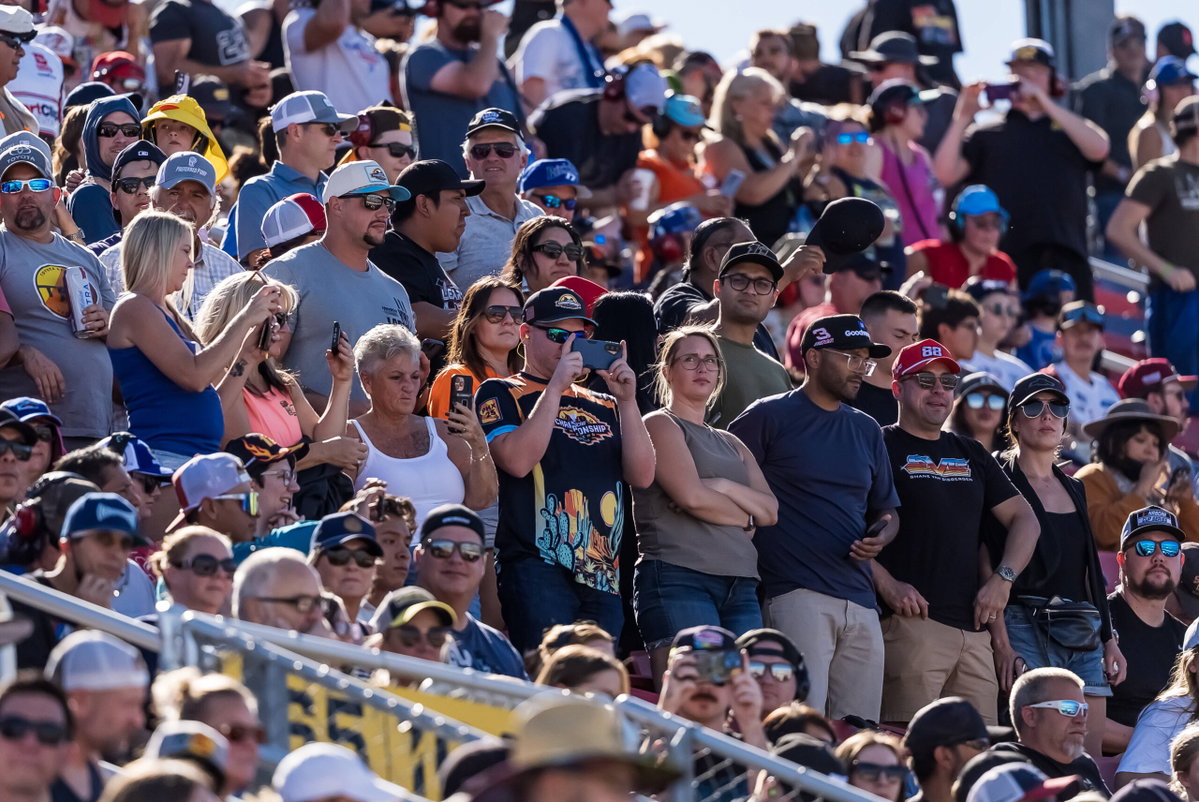
November 2, 2025, Avondale, Az, USA: Fans watch their favorite drivers race during the NASCAR, Motorsport, USA Cup Series Championship at the Phoenix Raceway in AVONDALE, AZ, USA. Avondale USA – ZUMAa161 20251102_aaa_a161_007 Copyright: xWalterxG.xArcexSr.x
Similar issues have recently plagued major sports leagues worldwide. For instance, the National Basketball Association has sued counterfeit vendors in the past, claiming that numerous businesses continue to communicate constantly through online communities and underground digital marketplaces.
The scope of the problem was further demonstrated by a 2024 report from the Office of the U.S. Trade Representative, which discovered that 84% of the entire value and 90% of the total quantity of counterfeit goods intercepted by U.S. Customs and Border Protection came from China.
The lawsuit also reflects a wider debate around counterfeit goods. Because some fans out there are arguing that high prices by the official merchandiser is what pushes the buyers to get these cheaper alternatives. While some say, that these goods directly harm the team, the sponsor and the entire sport commercial ecosystem.
So for NASCAR, the fight is ultimately about far more than fake hats and copied stickers. It’s unclear if NASCAR can actually slow the process. In the past, counterfeit networks have evolved rapidly, changing platforms and identities nearly as swiftly as law enforcement. One thing is evident from this lawsuit, though: NASCAR no longer considers the issue to be background noise. It now views it as a full-scale assault on the sport’s commercial side.