
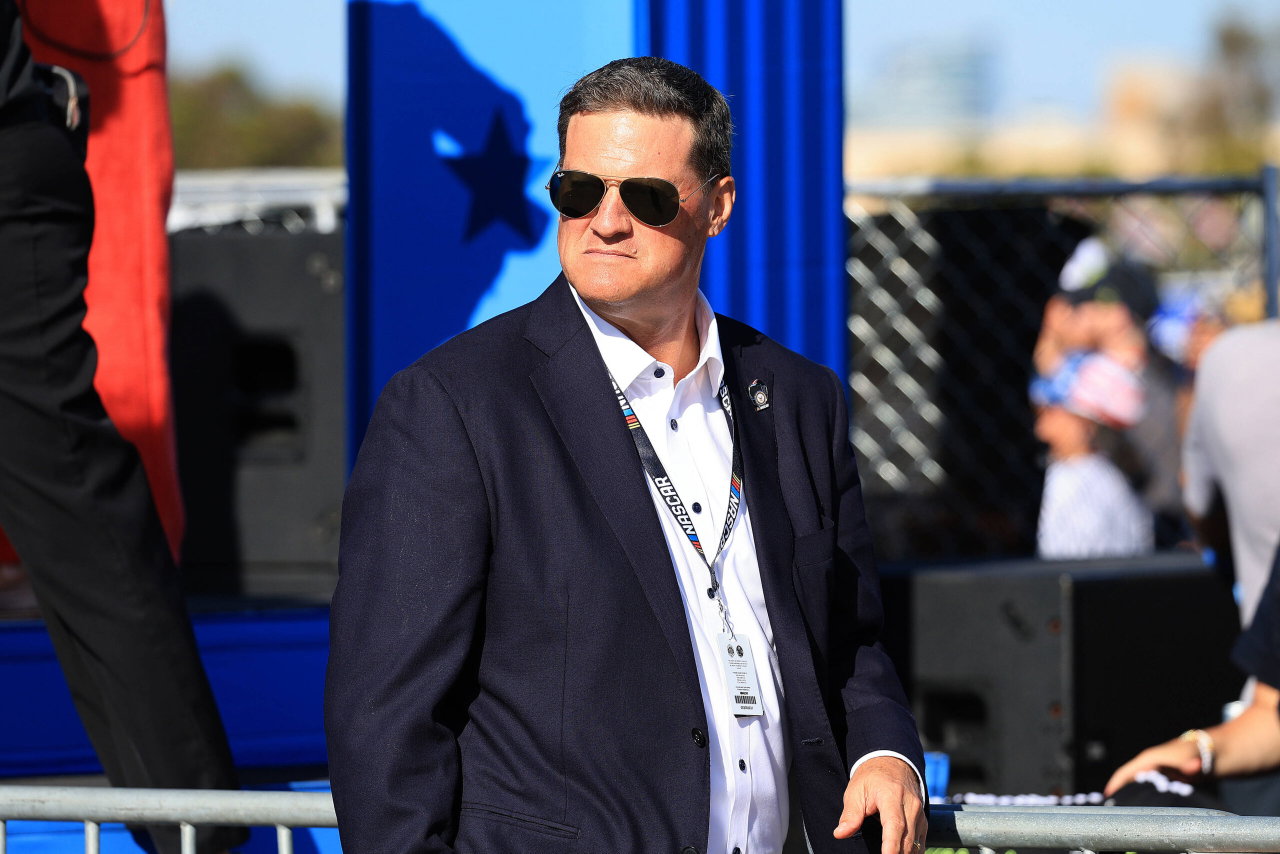
Kevin Harvick asked Steve O’Donnell a straightforward question on his Happy Hour podcast. How much time does NASCAR’s leadership actually spend watching other racing series? Do they show up at Formula 1 races, IndyCar events, or do they mostly just talk about it?
Watch What’s Trending Now!
O’Donnell said both. He mentioned getting to one or two Formula 1 races and an IndyCar event. He talked about what F1 does post-race, how drivers sit in a room and speak directly to the camera while commentators go quiet. He found value in that. Then he listed what NASCAR already does better than anyone: fan access, driver accessibility, the open culture of the paddock. His instinct was not to copy another series. It was to identify what to learn and what to protect.
“There’s some things that we do really well that I wouldn’t touch. Our fan experience is great. The access to the drivers is great,” O’Donnell said. “But there are other things they do, I think is fantastic at F1 with just the podium, the driver sitting in a room having to talk, you know, commentators are quiet. You hear that, that’s pretty cool.”
That same logic, selective, specific, and clear about what to preserve, is showing up in every major decision O’Donnell has made since taking over as NASCAR’s CEO outside the France family in April. The sport is now three races into the 10-race postseason format, having just concluded a fiery opening round at Bristol Motor Speedway. And one of the big changes we’ve seen with the Next-Gen car is a bump in horsepower at short tracks and road courses. The jump from 670 to 750 has moved the needle in the right direction, but NASCAR isn’t going to shy away from more experimentation.
How the Next Gen Car set the direction
To understand why the horsepower conversation is happening now, you have to go back to 2022, when the Next Gen car fundamentally changed how the sport operated. When NASCAR introduced the Next Gen car, the baseline engine output was throttled down to 670 horsepower. That number came from months of meetings with drivers, teams, engineers, and manufacturers.
O’Donnell was a core part of those discussions. The figure sat within an economical range for manufacturers and directly served the car’s primary mission: cutting astronomical costs. By 2021, the Cup Series had a serious spending problem.
Top organisations were exhausting enormous sums developing proprietary components—expenditures that produced marginal performance gains but offered zero value to fans in the stands. Consequently, prospective team owners shied away from entering the sport, and the economics were rapidly becoming unsustainable.
NASCAR’s response was aggressive standardisation. The Next Gen car came equipped with independent rear suspension, a sequential five-speed transmission, 18-inch wheels, and a modular chassis. The platform was built to accommodate future technological shifts, including a potential hybrid or electric powertrain. The strategy worked: savings materialised, the financial model stabilised, and high-profile ownership groups immediately entered the sport.
But short-track and road-course feedback arrived quickly and never stopped. The Next Gen car stifled the aggressive, high-friction racing that fans historically associated with those venues. Drivers demanded a machine that required heavier throttle control and penalised mistakes. By 2024, persistent garage complaints forced internal conversations at NASCAR to pivot from listening to acting.
The decision came on October 8, 2025. Making an appearance on the Dale Jr. Download podcast, O’Donnell announced that NASCAR would bump engine output from 670 to 750 horsepower at road courses and ovals shorter than 1.5 miles for the 2026 season.
The new rules configuration covered a 17-track schedule layout, including Phoenix Raceway, Darlington Raceway, Bristol Motor Speedway, Martinsville Speedway, Dover Motor Speedway, Nashville Superspeedway, North Wilkesboro Speedway, Iowa Speedway, Richmond Raceway, New Hampshire Motor Speedway, and World Wide Technology Raceway at Gateway.
O’Donnell was still NASCAR president when he broke that news. He officially became CEO on April 25, 2026, marking the first time in the organisation’s 78-year history that an executive outside the founding France family assumed absolute day-to-day corporate control. The horsepower direction, and the ongoing assessment of its on-track product, belong entirely to him now.
What 750 horsepower actually does in NASCAR
The engineering behind this horsepower bump is simpler than it sounds. At Phoenix, teams weren’t running some new engine. They used the same sealed engines from 2025. All NASCAR really changed was one part: the tapered spacer that controls airflow into the intake manifold.
They widened the spacer holes by about an eighth of an inch. More air in means more combustion, and more combustion means more horsepower. That’s it. But horsepower isn’t the whole story here.
NASCAR also shortened the rear spoiler to three inches and pulled some of the stabilizing strakes off the rear diffuser. So the cars now have more power but less grip holding them to the track.
That’s a tough combo for the rear tires. Get aggressive on the throttle coming off a corner, and you’ll feel it. It might not show on one lap. But stretch that out over a 30 or 40-lap green-flag run, and the stopwatch starts telling on drivers who are overdriving their cars.
John Probst, NASCAR’s EVP and chief racing development officer, keeps describing this as one connected system rather than a bunch of separate changes. Horsepower, downforce, drag, tire compound. They all affect each other.
Add 80 horsepower to a high-downforce car, and you get one kind of racing. Add that same 80 horsepower while cutting downforce, and you get something completely different. NASCAR did this on purpose.
So why stop at 750 horsepower instead of going to 800 or 900?
Steve O’Donnell has answered that pretty directly. Going past 750 would cost the garage somewhere between $40 million and $50 million. And that number doesn’t stay isolated. It hits braking systems, cooling packages, engine rebuild schedules, and manufacturer development budgets. Eventually every team on the grid feels it.
Doug Yates, CEO of Roush Yates Engines, backs this up. Going from 670 to 750 horsepower was very doable with the current engine architecture. But getting back to the 900-horsepower era would mean a full redesign, and that would shorten engine life significantly. There’s a bigger-picture reason too.
O’Donnell has talked about NASCAR eventually building a completely new engine architecture later this decade. Manufacturers need about three years to design a new engine program from scratch. So pushing everyone through a costly horsepower overhaul now, only to swap in a new platform a few years later, doesn’t add up.
That matters even more with Dodge reportedly exploring a return to Cup Series racing in 2027 while it figures out short-term engine plans. NASCAR didn’t want to put the industry through two expensive transitions back-to-back. So 750 horsepower became the landing spot. It’s enough to sharpen the racing right now, without complicating whatever comes next.
What the 2026 NASCAR season has actually shown
NASCAR now has case studies from events; it can study. And the results matter precisely because they’re not all telling the same story.
Phoenix Raceway was the first major test, and it gave the clearest positive signal. Mike Forde, NASCAR’s vice president of racing communications, pointed to the technical success of the package. Full-lap speeds didn’t change dramatically, but tire loading went up significantly.
More load meant faster wear. Faster wear meant more strategy calls, more variation in results, and more passing. Phoenix showed the concept worked, and it worked at a track where the old package had struggled to produce much action at all. Darlington was a messier story.
Lap times fell by roughly 1.5 seconds over 10 laps during practice, so the tyre degradation was real. Drivers said the car got noticeably harder to keep stable. But Denny Hamlin, after finishing the race, called the improvements directional rather than dramatic. Darlington’s groove is narrow no matter what package is under the car. More horsepower made the car tougher to drive. It didn’t make the track any wider.
Nashville Superspeedway is where the unintended consequences showed up. More power combined with less aerodynamic stability put extra strain on the braking system.
The heat load got so extreme that it caused catastrophic right-front brake-rotor failures during the race. Ross Chastain, Connor Zilisch, Chris Buescher, and then-leader AJ Allmendinger were all taken out because of it. A large chunk of the 38-car field ended up caught in incidents at various points in the race. It was a blunt reminder that changing one thing on a race car changes what every other part has to handle.
Bristol Motor Speedway was the most recent Chase race run under the 750-horsepower setup, held on September 19. Joey Logano won it with a dramatic pass six laps from the finish, and Kyle Larson came in a close second.
John Probst described the approach at the start of the season as crawl, walk, run. NASCAR is still somewhere in the middle of that process.
The honest read is that the package has worked well at some tracks and exposed problems at others. And both of those outcomes are useful to NASCAR right now.
The changes that reveal the bigger picture
Horsepower has been the most visible catalyst for change. Yet O’Donnell has enacted two other sweeping overhauls that follow the exact same competitive logic, and together, this triad reveals a clear philosophical shift.
In July, NASCAR rolled back years of strict weekend limitations by restoring a single, full-field 50-minute practice session for most non-superspeedway events. To accommodate the extended track time, teams also received an additional set of practice tires. Before this pivot, Cup weekends relied on restrictive, split-group practice blocks. While this initially looked like a minor scheduling adjustment, O’Donnell connected it to a fundamental flaw in the sport’s recent philosophy when speaking with Harvick in September.
“We’ve made decisions in the past like, you know, let’s cut a set of tires to save some money. Well, what did that just do, right? Took away track time, took away driver development.”
That admission carries immense weight coming directly from the chief executive. The Next Gen car is a radically different beast from its predecessors, forcing garage teams to wrestle with new suspension geometry, sequential shifting, wider wheel dimensions, and unique aerodynamic traits.
A generation of young drivers was already struggling to adapt to an unfamiliar platform, and truncated practice windows only starved them of the laps needed to master it. Restoring a comprehensive 50-minute session gives crew chiefs a vital buffer to decipher how the aggressive 750-horsepower package interacts with tire wear and chassis balance long before qualifying pressure mounts.
The absolute dismantling of the elimination playoff format fits this identical pattern. After twelve years of high-drama, multi-round elimination grids, O’Donnell abolished the format entirely to introduce a modified, cumulative version of The Chase—the 10-race postseason structure that defined the sport’s modern golden era. O’Donnell noted that the decision stemmed from reevaluating NASCAR’s modern identity and honoring the consistent competition feedback their core fanbase had voiced for a decade.
Three distinct pillars: engine output, practice volume, and championship architecture. Each pivot actively dismantles a mandate engineered during a previous regime. While each past decision boasted legitimate cost-containment or modernization logic at the time, they systematically stripped away traditional elements whose intangible value eluded spreadsheets.
O’Donnell occupies an unprecedented vantage point because he helped construct the very architecture he is now dismantling. He sat in the formative Next Gen design panels and defended the original 670-horsepower engine compromise. His willingness to completely alter those pathways is not an indictment of past leadership; rather, it represents a pragmatist adapting to four seasons of real-world racing metrics that simulation models failed to predict.
What NASCAR is working out for 2027
O’Donnell hasn’t announced a 2027 horsepower package. There’s no confirmation of that yet.
What he has said is that engine output is still an active, evolving conversation. John Probst indicated earlier this year that expanding the 750-horsepower package to 1.5-mile tracks is a question for 2027, not something to rush into mid-season.
Intermediate racing at tracks like Kansas Speedway and Charlotte Motor Speedway has actually been one of the strongest parts of the Next Gen era. NASCAR isn’t looking to fix something that’s already working. Dodge is a practical constraint to all of this.
If the manufacturer commits to a 2027 Cup Series return, the technical rules need to stay stable enough to justify that investment. At the same time, Ford’s Mustang Dark Horse SC is already set to debut in 2027, which is a major manufacturer commitment within the current Next Gen platform. Sudden technical changes announced mid-process would mess up planning for everyone involved.
O’Donnell was candid about this in September, admitting the sport’s long-term roadmap still needs more clarity:
“If I asked you or Rick Hendrick or Joe Gibbs, you know, where are we going in 2028, I don’t know. That’s our fault, right?”
That’s a pretty transparent admission for a chief executive to make. It suggests that individual technical decisions, whether about horsepower, aerodynamics, tires, or the postseason points format, are really just short-term adjustments. The bigger question NASCAR is still working out is where all of this is actually headed.
Part of that destination involves the powertrain shift happening in the background. The Next Gen platform was built from the start to accommodate hybrid capability. NASCAR even showed off an electric prototype in 2024, built with Chevrolet, Ford, and Toyota on a modified Next Gen chassis. It had three electric motors, all-wheel drive, and a 78-kilowatt-hour battery. Officials were clear that this was a demonstration of what’s technically possible, not the start of an all-electric series.
So an elevated V8 short-track setup and an EV prototype can exist side by side without contradicting each other. O’Donnell’s approach, whether it’s about the F1 media conversation, practice schedules, or the revised Chase format, seems to come down to watching outside innovation while protecting what makes NASCAR special. More power at the right tracks, paired with tires that wear down fast and less aero downforce, creates a car where throttle control actually matters.
At North Wilkesboro Speedway during a January preseason test, Ricky Stenhouse Jr. put it simply: “The more horsepower, the better.” But he tied that directly to the tire compound too. Combining real mechanical power with a tire that degrades hard over a long run was exactly the direction teams had been asking for. That’s the feedback loop NASCAR finally seems to be listening to.
Coming out of Bristol, Larson leads the Chase by a single point over Hamlin, with Logano sitting 16 points back. Kansas, Talladega, and the Charlotte oval are next on the postseason schedule. None of those tracks use the 750-horsepower package.
So the drivers who dominated under the high-output setup now have to switch back to standard intermediate specs on the sport’s bigger tracks. That contrast, same field, same championship stakes, different engine package, will give NASCAR some of its most useful data yet.
Whatever comes out of the 2027 design process will be shaped heavily by this postseason, Dodge’s engine plans, manufacturer development data, and how reliable the components hold up. If a new number does get announced, it’ll likely be incremental. But the direction of travel has been clear all season.
O’Donnell has spent 2026 treating NASCAR less like a polished product and more like a sport worth restoring to its rawer form. By prioritizing the human element over perfect simulator numbers, he’s reshaping what the sport looks like heading into the next decade.