
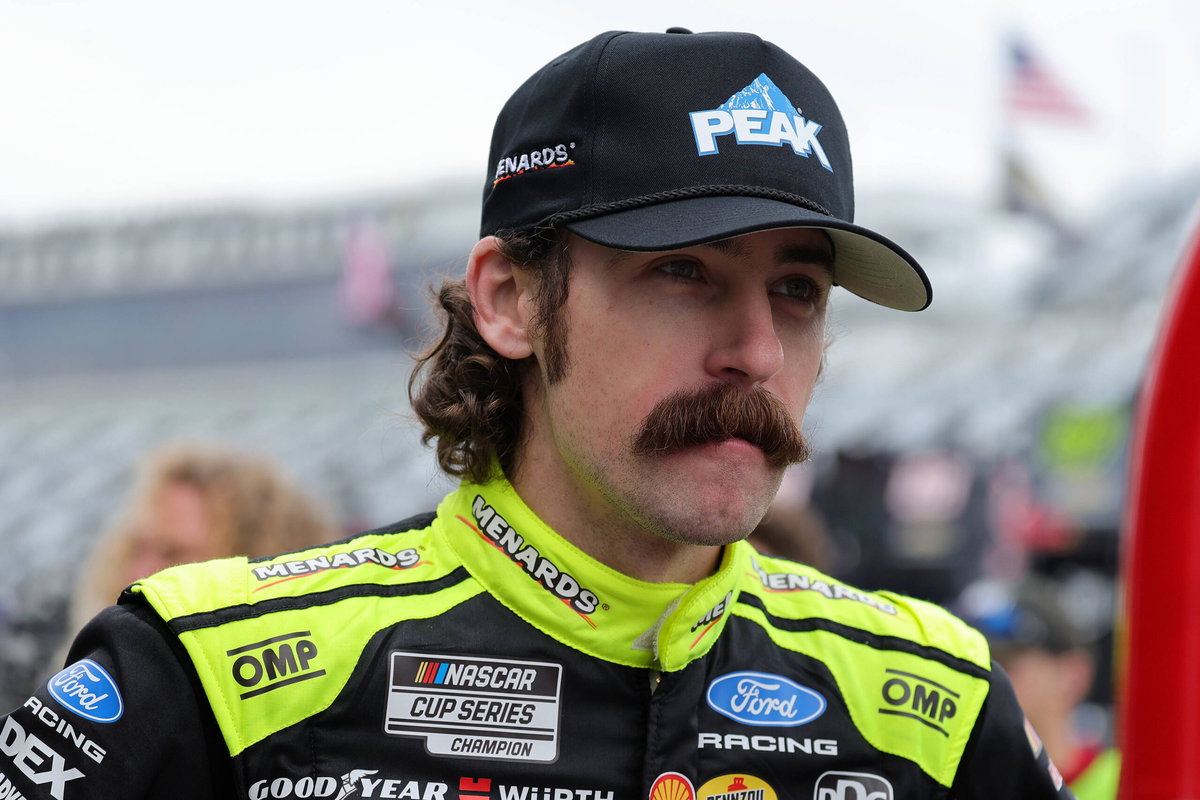
Joey Logano probably looked up at the cloudy skies last Saturday at Kansas Speedway and smiled to himself. He had won the Bass Pro Shops Night Race just a week earlier, and he knew that if qualifying was washed out, NASCAR’s 70/30 metric formula would come into play, potentially handing him a prime starting spot. And that is exactly what happened. Logano started on the front row, a stroke of fortune that left his Team Penske teammate, Ryan Blaney, feeling rather differently.
Watch What’s Trending Now!
The metric, which is largely dependent on where a driver finishes in the previous race, with the remainder based on overall owner points, has affected Blaney several times over the last few races, making his job of finishing toward the front more difficult than it needs to be. And after securing an impressive fifth-place finish at Kansas, he took a swipe at NASCAR, quipping that he hopes the rain will finally work in his favor.
“It’s just [that] everywhere has its difficulties when you have to start in the back, and maybe it’ll rain in Vegas, and we’ll actually be benefited by the metrics,” Blaney said in an interview with journalist Matt Weaver.
2026 has been a great qualifying year for Blaney, when he is actually able to drive his car out on the track. He’s had an average starting position of 8.6 and has four pole positions. In the Chase, though, he has gotten a chance to show his qualifying pace just once in four races.
The session at Darlington was canceled due to bad weather, forcing Blaney, who had DNFed in the previous race at Daytona, to start 24th. He worked his way through the field brilliantly to finish fourth. Then, at Gateway, qualifying went ahead and Blaney was blistering, earning third on the starting grid. But sadly, luck wasn’t on the No. 12 driver’s side.
A brake rotor issue, which affected much of the garage, forced Blaney to retire from the race. That sent him down to 29th on the starting grid for Bristol the following weekend, with qualifying once again washed out by weather. And once he got on track that weekend, Blaney had another storm to weather. A Hurricane named Carson Hocevar.
Blaney, who had won Stage 2 and was hunting for a victory that could strengthen his championship hopes, was spun out of the race after contact with Hocevar. He was classified 33rd, and once again, following yet another washed-out qualifying session at Kansas last weekend, the metric determined that he would start 25th.
This time, the Ohio native avoided the bad luck, putting together a brilliant drive to finish fifth. His result at Kansas also moved him back up to fifth in the Chase standings after he slipped to sixth following Bristol. But with just six races remaining, the pressure is mounting. If the metric continues to leave him starting deep in the field because of unfortunate results, Blaney knows the road to the championship could only get harder.
And heading into Las Vegas, for the first time in a few weeks, he wishes for rain. At least, that’s what Blaney, who has now gotten used to working his way up the field after starting from the back, told Weaver. The frustration, however, is not unique to him.
After qualifying was canceled at the Chase opener in Darlington, former Cup Series champion Kevin Harvick offered a particularly blunt assessment of NASCAR’s system on the Happy Hour podcast.
“Let’s be clear, I hate the metric. There is no reason for the damn metric. We should be random drawing for qualifying every week to keep it mixed up,” Harvick said.
The Darlington starting order also showed a glaring issue with the formula. Hocevar and RFK Racing’s Chris Buescher, who were both caught up in incidents during the Daytona regular-season finale, were forced to start 34th and 35th. Tyler Reddick, meanwhile, had finished third at Daytona and started from the pole alongside fellow Chase driver Daniel Suárez, who had finished second.
It meant the starting grid was heavily shaped by what had happened in the previous race, rather than how fast each driver might have been that weekend.
NASCAR did not always use a metric formula to set the grid when qualifying was canceled. During the 2020 season, due to the effect the pandemic had on race weekends, starting positions were temporarily determined through a weighted random draw. The system gave teams within the same points tier an equal chance of landing a front-row spot, meaning a bad finish the previous week would not automatically send a driver to the back of the grid for the next race.
From 2021 onward, NASCAR tried a more complicated formula when qualifying was canceled. It considered four factors: owner points, the driver’s finish in the previous race, the team’s finish in that race, and the driver’s fastest-lap ranking. The system was meant to create a more balanced starting order, but drivers found it too confusing.
So, in 2022, NASCAR simplified things to the current 70/30 formula. Ironically, that simpler system has since drawn criticism from some in the garage.
Harvick now believes NASCAR should return to the simpler random-draw approach, and Hall of Famer Dale Earnhardt Jr. has also previously expressed support for bringing random qualifying positions back.
“You’d be in the garage and walk over and draw a pill. That’s how they did it. That’s how they do it in dirt, right? A guy gets a bad draw, that’s just fate. And now he’s got to overcome… I just don’t think it’s [the metric formula] actually helping us,” Earnhardt Jr. said on his Dale Jr. Download podcast.
Blaney has shown that he can overcome the metric and charge through the field. But each recovery costs valuable track position and creates another obstacle in a Chase where every point matters. With six races remaining and Kyle Larson continuing to build his advantage at the top after the Kansas win, Blaney knows he cannot afford many more setbacks. Rain or no rain, he needs to start toward the front in Vegas.