
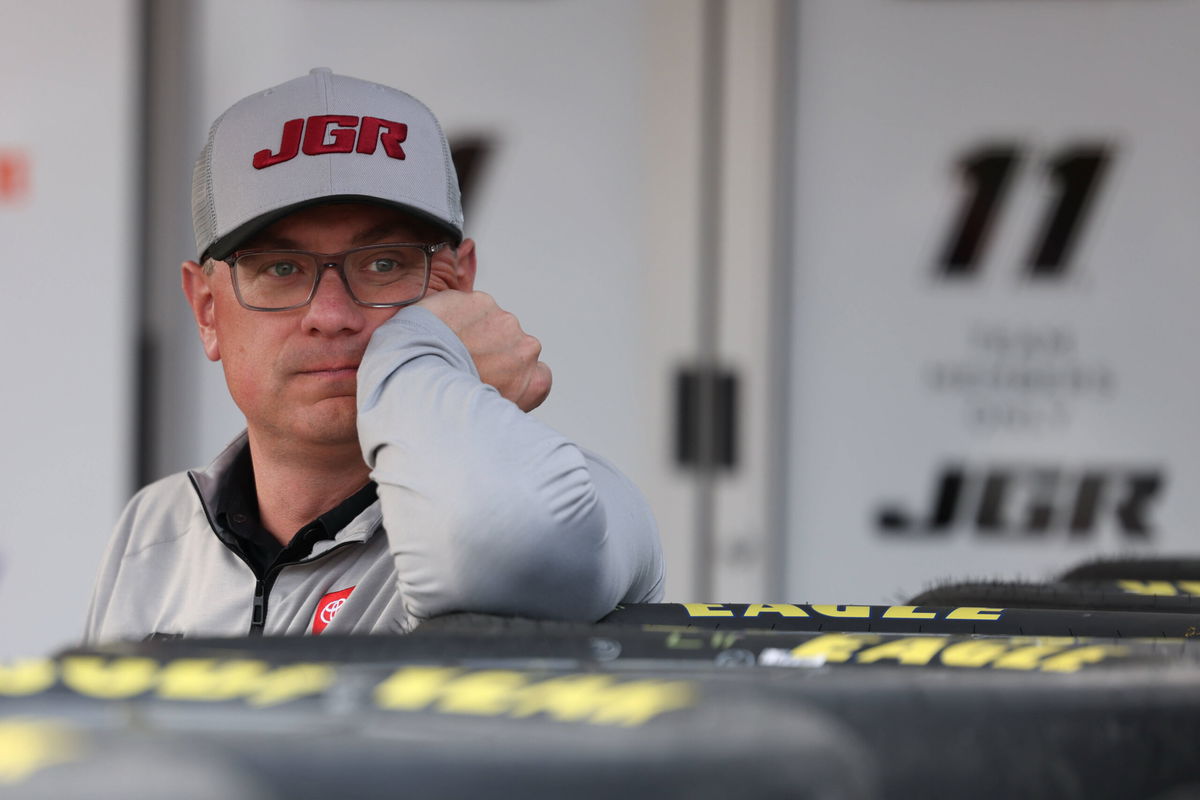
Joe Gibbs Racing’s legal fight with Chris Gabehart has taken another turn. This time, the dispute involves evidence that no longer exists. JGR has spent months accusing its former competition director of taking trade secrets to Spire Motorsports, allegations that could have major implications for both sides when the case goes to trial next year. But proving what Gabehart allegedly took is one thing. Establishing what might have been hidden is another.
Watch What’s Trending Now!
The two sides now clash over whether jurors should be allowed to draw their own conclusions about missing evidence, with Gabehart’s defense arguing that JGR is trying to turn suspicion into proof.
The dispute centers on seven text messages between Gabehart and Spire co-owner Jeff Dickerson that were reportedly deleted in November 2025. JGR wants the court to let jurors consider whether Gabehart deleted the messages to conceal information relevant to its trade-secret claims, as reported by Matt Weaver.
JGR is seeking an adverse-inference instruction, which would permit jurors to conclude that the missing messages contained information damaging to the defendants. Such an instruction would not establish that the messages proved misconduct, but it could influence how jurors interpret the missing evidence when considering JGR’s claims.
Gabehart said he deleted the conversation after receiving a job offer from Spire while negotiating his departure from JGR. He described panicking over the situation and said the messages concerned the terms of the offer. Dickerson also had automatic deletion enabled to manage message volume. JGR attempted to recover the conversation through forensic examinations and the parties’ cellular carriers, but those efforts failed.
Gabehart’s attorney, Cary Davis, opposed JGR’s request, arguing that the team was trying to replace missing evidence with assumptions. His filing stated:
“The Motion’s real purpose is transparent. Having found no evidence that Mr. Gabehart shared JGR proprietary information with Spire—and facing sworn testimony from both Mr. Gabehart and Mr. Dickerson that none was shared—JGR asks the Court to tell the jury to assume such evidence existed, and existed only in seven deleted texts.
“That is not a remedy for lost evidence; it is a substitute for evidence JGR never had. JGR remains free to cross-examine Mr. Gabehart about the deletion at trial; it is not entitled to have the Court do its persuading for it.”
The parties also disagree over when Gabehart should have anticipated litigation and become obligated to preserve potentially relevant evidence. JGR points to photographs Gabehart took of his JGR computer on November 7 last year, arguing that his actions indicated he should have expected a legal dispute.
Gabehart acknowledges taking the photographs but disputes that this alone established that litigation was reasonably foreseeable. JGR sent him a formal cease-and-desist and evidence-preservation letter on December 15, one month after the text conversation was deleted.
Spire has filed its own opposition, arguing that an adverse inference against Gabehart could unfairly affect jurors’ consideration of the separate claims against the organization. The team says JGR has not shown that its documents were distributed at Spire before Gabehart began working there months after the messages were exchanged.
Spire also argues that the court should wait until trial to determine whether an adverse inference is appropriate, when the evidence and proposed jury instructions can be considered together.
The deleted-texts dispute follows a hearing earlier this week on October 13, in which Judge Susan C. Rodriguez considered JGR’s separate push for contempt proceedings over the existing injunction. That order restricts Gabehart from performing competition-director duties at Spire that are similar to the responsibilities he held previously at Joe Gibbs Racing.
During the hearing, JGR pointed to Gabehart’s attendance at multiple competition meetings and his contributions to processes it considered part of his former role. Gabehart and Spire challenged those examples as insufficient to establish a violation. The judge did not issue a ruling on the contempt request or JGR’s push to expand the injunction.
The dispute ultimately comes down to how far Gabehart can use his racing knowledge at Spire before it crosses into JGR’s protected trade secrets. JGR argues that his access to its internal methods threatens its competitive advantage, while Gabehart and Spire dispute those claims.
The court has yet to decide whether jurors will be allowed to draw negative conclusions from the deleted texts. Gabehart and Spire want the request denied or deferred until trial, when the evidence can be considered in full.
With the trial approaching in February, the missing messages have added another layer to the case. The question now is whether JGR can convince the court that their deletion warrants more than questions at trial.