
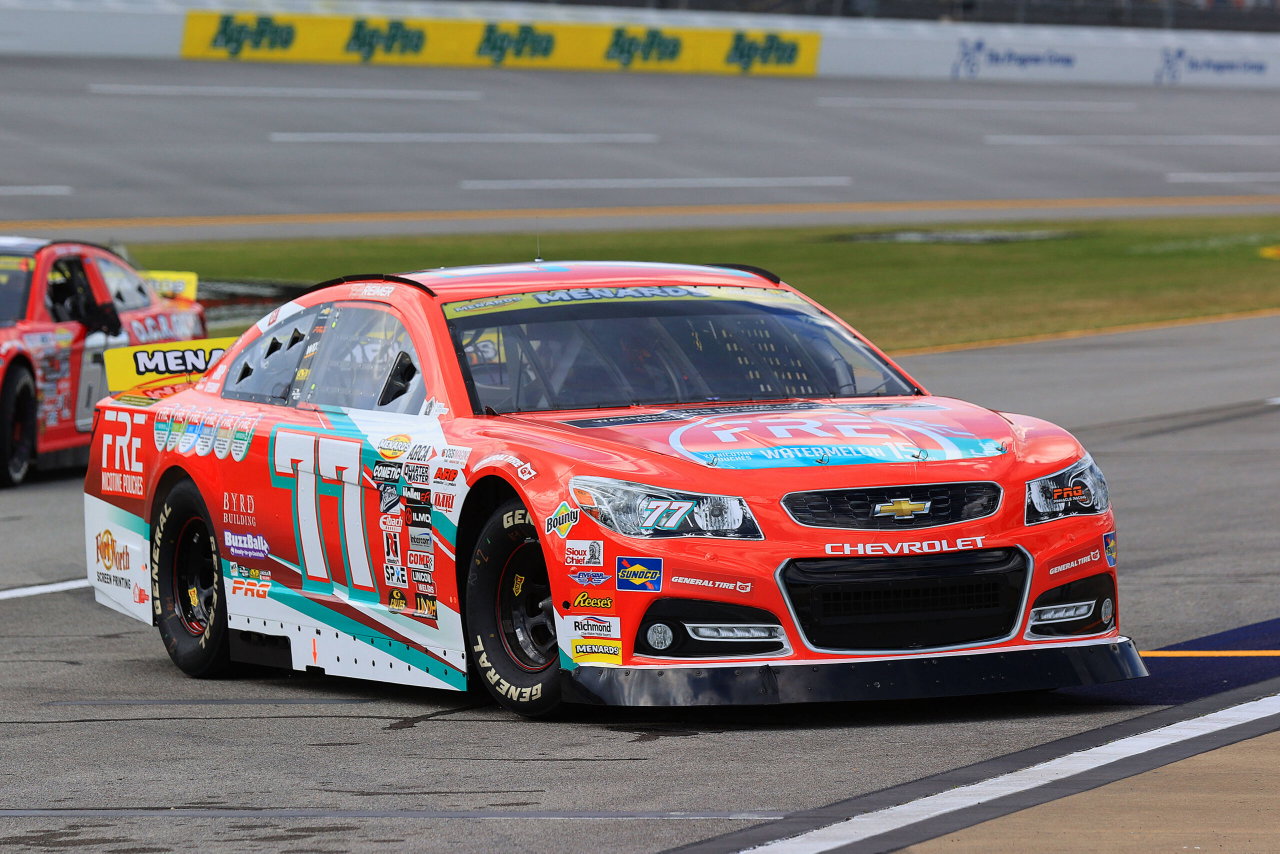
It’s been a fairly strong season for Taylor Reimer in the ARCA Series. She entered seven races on the 2026 schedule, and Sunday’s event at Springfield marked her second consecutive fourth-place finish, following a similar result at Elko Speedway in June. However, Reimer likely felt she could have finished even higher at Springfield, especially after receiving a penalty she believed was undeserved.
Watch What’s Trending Now!
Reimer’s result came with some frustration after she received a mid-race restart violation, which she attributed to unclear track markings. The Oklahoma driver, competing in the No. 77 Chevrolet for Pinnacle Racing Group, later took to social media to highlight how difficult it can be to see the restart line from inside a race car on a dusty dirt oval.
“My POV standing here taking this picture. Now imagine seeing this from inside a racecar, with a windshield covered in dust and visibility already minimal. There are TWO TINY red lines, the exact same color as the post beside them, and the faintest “restart line.” All I ask is that you look at it from a driver’s POV and make it more obvious for next year.” Reimer wrote in a post on X.
Reimer had climbed as high as second before the penalty. Officials ruled that she committed a restart violation after the third caution of the day, when she moved ahead of leader Max Reaves during the restart. She was forced to serve a pass-through penalty as a result, dropping her deep into the field. Reimer resumed around 15th but fought her way back to fourth by the checkered flag.
According to ARCA’s restart rule, the leader must be the first car to reach the designated restart line. The violations are treated as in-race infractions that can result in a pass-through or other position penalties. But in the post-race interview, she spoke about how she hoped for ARCA to see her perspective.
“They have a cone, and then they have a white line that’s probably like this long on the inside of the track, and so when I’m restarting on the outside, the line doesn’t go all the way across so I just genuinely couldn’t see the line,” Reimer told Josh Calloni in a post-race interview.
Still, Reimer credited her team for giving her a fast car. She chose to focus on the positives and look ahead to the next dirt race at DuQuoin, which will be her next ARCA Menards Series start.
As for the Calypso 100, Joe Gibbs Racing driver Max Reaves dominated much of the event and held on for the win after late contact with Gavan Boschele, with Isaac Kitzmiller second and Thomas Annunziata third.
Reimer has made quite an impression during her limited ARCA Series schedule this year as she continues transitioning from dirt to pavement racing. She is far from the only female driver making an impression at this level, with several others also putting together strong performances and steadily building their résumés.
How other female drivers have been faring at the grassroots level
There has been a noticeable rise in female drivers making their mark across the grassroots and development levels in recent years. Mia Lovell, just 19, is in her first full ARCA Menards Series West season and has already put together some impressive results, including a career-best second-place finish at Sonoma Raceway. She has also competed in Pro Late Model races, showing that she can adapt across different types of racing. Lovell is not the only one making waves, either.
Lanie Buice has picked up ARCA poles and strong finishes while also competing in the CARS Tour Late Model Stock division. Also, Jade Avedisian became the first woman to win a CARS Pro Late Model Tour race — in Jacksonville in 2025 —and has made ARCA starts after a successful dirt-midget background.
Dirt and late-model racing continues to give female drivers a platform to win and compete at the front, building on breakthroughs made by drivers like Reimer. Yet making the jump to NASCAR’s national series remains a major challenge.
Whether this growing wave can eventually lead to more full-time national-series opportunities will likely come down to results and sponsorship. For now, though, the contrast is hard to ignore: more women are competing and succeeding at the developmental level, but none currently have a full-time seat in NASCAR’s top three national series.