
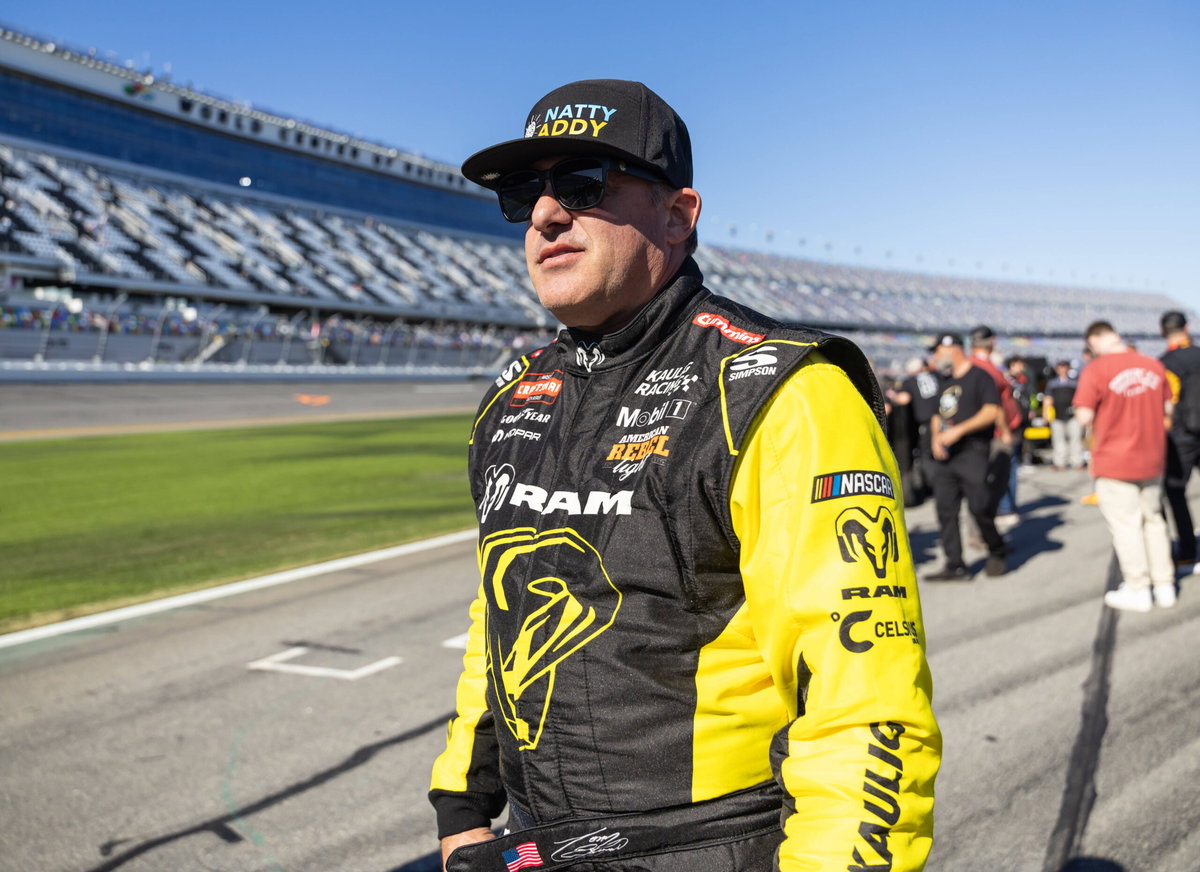
Tony Stewart was completely consumed by anger under the Daytona lights on July 7, 2001. He had just been shown a black flag, which he believed he didn’t deserve, and was marching toward the NASCAR hauler when veteran journalist Mike Mulhern approached him. Furious, Stewart slapped the tape recorder out of Mulhern’s hand and kicked it under a team hauler. Moments later, “Smokes” nearly got into a physical altercation with a NASCAR official.
Watch What’s Trending Now!
The garage was rattled, but not entirely surprised. Stewart was already developing a reputation as a hothead, and despite his immense talent, incidents like this added to a certain degree of infamy. There were plenty of them throughout his career. Ask him about those moments today, though, and there’s clear regret in his response.
“Part of my frustration, and part of the reason I was so mean to people, is I just wanted to be a normal person,” Stewart said on Tuesday’s episode of the “Door Bumper Clear” podcast. “I wanted to be the person I was.”
The nickname “Smoke” actually dates back to Stewart’s early racing days, when his aggressive driving style often saw him burn rubber and send smoke pouring from his tires. As he rose through the ranks of motorsports, the name became even more fitting.
Stewart had an almost unrivaled hunger to win, and the fiery interviews and frequent confrontations with fellow drivers and journalists only added to the image. But in reality, it was the sport and the environment he was around continuously that got to his head.
“People thought I was just trying to be an a****** all the time to be an a******. No, I was uncomfortable. I just didn’t like the position I was in,” he said.
Stewart highlighted that the NASCAR schedule in the early 2000s was even more unrelenting than it is currently. He pointed out that unlike modern-day NASCAR schedules, when practice and testing aren’t part of the calendar anymore, his time in NASCAR was even more grueling, leading to the all-important point: today’s NASCAR drivers shouldn’t be complaining about anything.
“We would test Monday and Tuesday after a race. Wednesday was your only day off. You had Thursday morning to finish up whatever you needed to. And you were back on a plane early afternoon. Go to a market, go to a Home Depot appearance for two and a half hours. You were at the track Friday, Saturday, Sunday, get on the plane, go to another track, start the cycle over, test Monday and Tuesday again,” the three-time Cup Series champion continued.
That routine got to Stewart, he realised in hindsight. He admitted that he was always in the moment and never understood what it would be like to just let go of his competitive edge away from the track.
This approach made him successful, of course. Stewart went on to have an immensely decorated career at the top level of the sport, winning 49 races, including two crown jewels in his home state of Indiana, three championships, and eventually earning a place in the Hall of Fame in 2020. At the same time, it also cost him a lot.
For instance, in 2002, he punched a photographer after finishing 12th in the Brickyard 400, drawing widespread backlash from the NASCAR community. The sanctioning body fined him $10,000 and placed him on probation for the rest of the season. His primary sponsor, The Home Depot, also handed him a $50,000 fine.
Even then, Stewart admitted the incident was a “wake-up call” for his behavior. Sadly, it wouldn’t be the last time he lived up to his “Smoke” nickname.
Just two years later at Sonoma, he punched fellow driver Brian Vickers in the chest after a race while Vickers was still sitting in his car. Another $50,000 fine followed, along with a loss of 25 championship points.
When asked if he would have changed anything about his approach, Stewart had a humble response.
“Absolutely. And 1,000% if I had the ability to go back, I would do it a lot different,” Stewart revealed. “I would have been a lot nicer to people. I would not have been so locked in all the time. That’s the one thing.”
He also believed he might have been more successful if he knew there were things he could change. The introspection on Stewart’s part is something he credits to his wife, Leah Pruett.
A drag racer herself, Pruett’s entry in Stewart’s life in 2020 was one that allowed him to discover a much-needed balance as well as helped him break down walls he had built around him.
“I did not have a wife. I did not have a family. I dated some great girls during my Cup career,” Stewart said. “But I was so focused on racing that I never even put solid effort into any relationships. And that was my fault, not their fault. Knowing what I know now, I would love to go back and do it all over again. And I think I would be just as good, maybe even better, because I’ve learned how to focus at the right times.”
Stewart also revealed that he enjoys his time at drag races now because of how open and interactive it is, with fans allowed access everywhere apart from the start line. And with an inspirational figure as his wife, Stewart also enjoys the fact that when they are at restaurants, people come up to say hello because of Pruett and not because of his own NASCAR fame, something the Hall of Famer finds rather relaxing after a career where he never turned the switch off.
For Stewart, that change has brought a sense of normalcy he never had during his NASCAR career. After years of being unable to switch off “Smoke,” he can finally enjoy being Tony Stewart.