
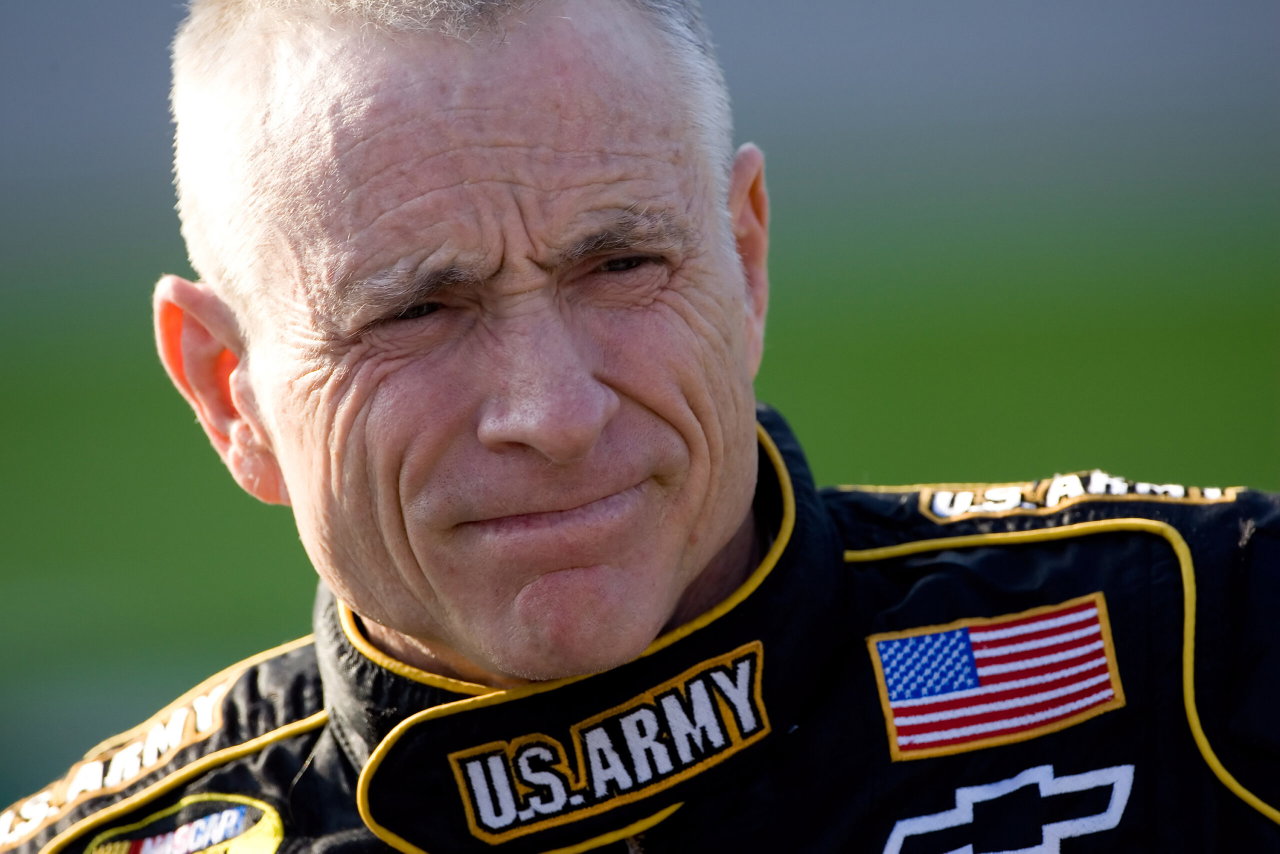
Mark Martin’s place in NASCAR history is secure, but the road there nearly ended before his Cup career began. Before the No. 6 Ford and Jack Roush, the Batesville, Arkansas, native was left broke by his first NASCAR attempt.
Watch What’s Trending Now!
That collapse came up in a conversation shared by Kenny Wallace Media on X, with Wallace reading Martin’s autobiography, Never Lift. Wallace recalled his father warning him that competition could kill a racer, then asked Martin how he had experienced it. Martin’s answer was stark.
“It almost killed me. Yeah, twice,” he said. “Highest of highs, lowest of lows. This should be an inspirational story to anyone, whether they’re a motorsports fan or not, because you’re talking about a kid who came from the dirt track in Arkansas and made it all the way to the NASCAR Hall of Fame.
“I went back and started from one single lug nut in your palm or your hand. I didn’t even have a toolbox.”
His answer was about the emotional and professional toll of competition, not two literal crashes.
Martin began racing at 15 and won on his third start at a dirt track in Locust Grove. He became the American Speed Association’s 1977 Rookie of the Year and won three straight championships from 1978 through 1980. That success brought him to NASCAR’s Cup Series in 1981.
He finished 14th in points and second in Rookie of the Year voting in 1982. Those early Cup efforts came with his own operation, which he had to finance himself.
The momentum did not last. In 1983, a $50,000 sponsorship deal fell through when the company failed to pay. Having exhausted his resources, Martin sold his team and spent the rest of the season moving between owners. At 24, he later called himself broken physically, emotionally, and financially. His NASCAR dream looked finished, and he had no clear route back to the Cup garage.
His father offered another path, asking whether he wanted to run the family trucking company. Martin refused. He returned to short-track racing, accepting that he might spend the rest of his career outside NASCAR.
He was not choosing a comfortable alternative; he was choosing a way to keep racing at all. The rebuild began with almost nothing.
Martin won his fourth ASA championship in 1986, then returned to NASCAR through the Busch Grand National Series in 1987. He won three times and finished eighth in points, putting him back on Cup owners’ radar. Jack Roush, who was building a new Cup operation, took notice and hired him for 1988. Martin earned his first Cup victory at Rockingham in October 1989.
The partnership produced 35 Cup wins through 2006, along with 41 Busch and seven Truck Series victories. Martin finished with 40 Cup wins, 56 poles and 882 premier-series starts. He also finished second in the championship standings five times.
That is why Martin is widely regarded as the greatest driver never to win a Cup championship, a description used by the NASCAR Hall of Fame itself. His five runner-up finishes could have defined his career.
In 1990, a 46-point penalty at Richmond left him 26 points behind Dale Earnhardt in the final standings. Martin eventually stopped allowing the missing title to overshadow his achievements. The comeback made the No. 6 era possible.
That comeback is central to Never Lift, his autobiography co-written with motorsports journalist Mark “Bones” Bourcier and published in August 2026. Martin’s son Matt said there was “basically a book’s length before you even get to the 6 car,” a reminder of how much of the story preceded his best-known chapter.
His relationship with racing today offers a fitting coda. In October, Martin declined an invitation to take a few laps in a Late Model at Pensacola, even after being told nobody would time him.
“I just enjoy not being under that kind of pressure,” he said, adding, “Kenny Wallace is right, competition will kill you.”
For a driver who once rebuilt from nothing, stepping away from the stopwatch shows how much that fight took out of him.