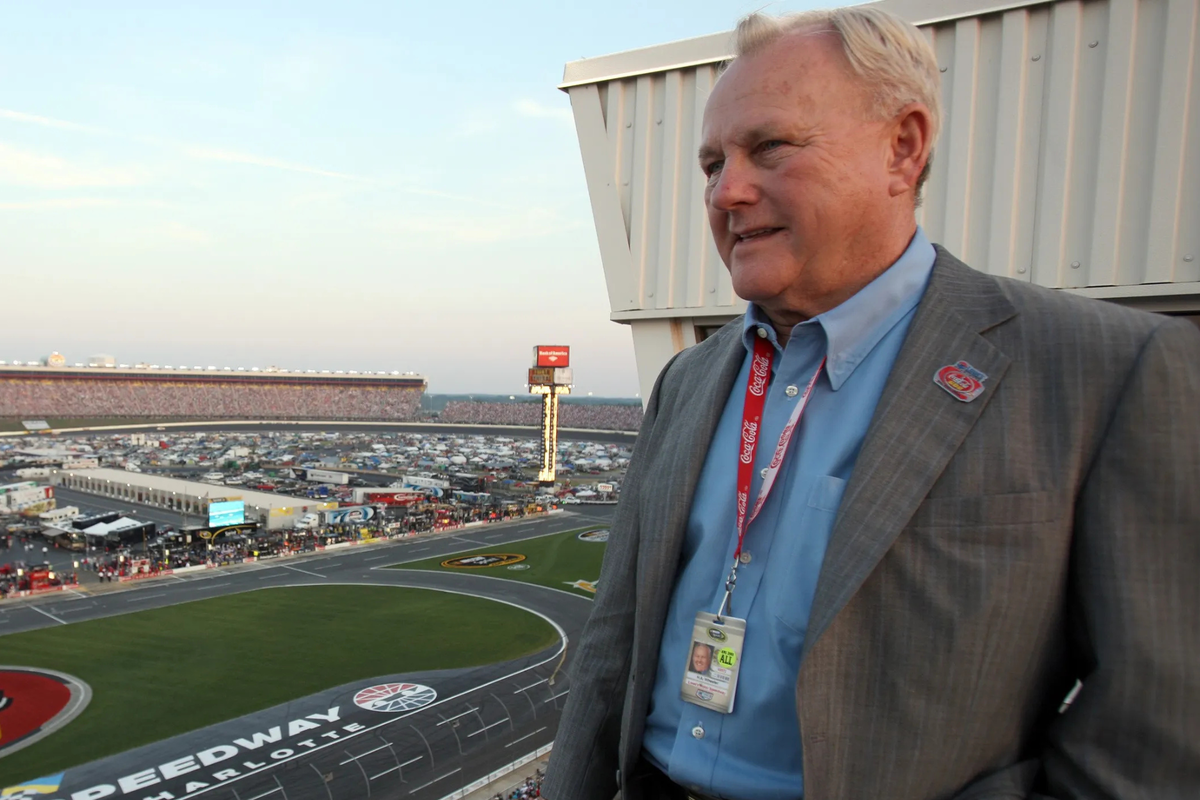
The P.T. Barnum of NASCAR stays close to fans’ hearts. In 1985, when the Coca-Cola 600 was crowded at Charlotte Motor Speedway, Humpy Wheeler’s imagination knew no bounds. A stuntman known as “The Flying Greek” flew into the air in a school bus and jumped over a line of junk cars in the infield while the crowd waited for the green flag. The stadium roared, not for a lap finished, but for a spectacular performance that only Wheeler could have imagined.
Watch What’s Trending Now!
Wheeler, who passed away in August 2025, transformed Charlotte into NASCAR’s ultimate stage for almost thirty years. A fresh inductee for the 2026 class of the NASCAR Hall of Fame, let’s deep dive into the personality who not only improved a racetrack but also contributed to the definition of an era.
Who is Humpy Wheeler?
A prominent figure in American racing, H.A. “Humpy” Wheeler is most remembered for his revolutionary leadership during his tenure as president and general manager of Charlotte Motor Speedway from 1975 to 2008. Wheeler, who was born in Belmont, North Carolina, on October 23, 1938, gained the moniker “P.T. Barnum of NASCAR” for his creative race promotion strategies. During his tenure, NASCAR’s national profile was raised, and the fan experience was transformed by innovative ideas.
Despite early opposition from NASCAR officials, Wheeler’s talent for entertainment produced unforgettable pre-race spectacles, such as a three-ring circus with trapeze artists and elephants and a stunt in which “Jimmy, The Flying Greek” leaped a school bus over a line of junked cars.
He also had a key role in the development of night racing at superspeedways and the “NASCAR Experience,” which brought spectators closer to the action. These initiatives raised the bar for motorsports fan interaction and made Charlotte Motor Speedway a world-class racing attraction.


Wheeler has received widespread recognition for his services to the sport. In addition to being a nominee for the NASCAR Hall of Fame Class of 2026 in the Landmark Award category, which recognizes noteworthy contributions to the development and prestige of NASCAR, he was inducted into the International Motorsports Hall of Fame in 2006.
Announcing the 2026 Landmark Award nominees, with Former President and General Manager of Charlotte Motor Speedway, Humpy Wheeler, joining the ballot alongside Alvin Hawkins, Lesa France Kennedy, Dr. Joseph Mattioli and Les Richter. #NASCARHall pic.twitter.com/poU0ZVzpS3
— NASCAR Hall of Fame (@NASCARHall) April 21, 2025
Apart from his skill as a promoter, Wheeler left behind a legacy of coaching upcoming business titans and supporting fan-focused innovations that still have an impact on the sport today. His place as one of the most significant individuals in the history of auto racing has been cemented by his theatrics and innovative leadership, which have permanently altered NASCAR.
Who is Humpy Wheeler’s wife, Patricia Wheeler?
On May 12, 1962, Humpy Wheeler married Patricia Adele Williams in Charlotte, North Carolina. The couple had three children: Patti, Tracy, and Trip. Earlier, the family used to live in a lakefront home in Mountain Island Lake, having moved there in the late 1990s from Lake Norman. They shifted to SouthPark, Charlotte, in 2019. A year later, the former residence on Mountain Island Lake sold for $3.4 million.
Wheeler had had a series of health challenges in recent years. On August 20, 2025, he died peacefully with his family by his side, according to Charlotte Motor Speedway officials. He was 86 years old and left behind a legacy of motorsports excellence.
His daughter, Patti, continues that legacy with her own achievements. She served as senior executive vice president of Speed, the 24-hour motorsports cable network owned by Fox Sports. She was also the founder and owner of Wheeler Television, Inc., from 2001 to 2010, producing live event coverage of NASCAR, the American Le Mans Series, and World of Outlaws, along with many series. From 1994 to 2001, Wheeler was President of World Sports Enterprises (WSE).
What innovations is Humpy Wheeler credited with in NASCAR history?
First and foremost, Humpy Wheeler played a pivotal role in turning Charlotte Motor Speedway from a traditional racetrack into one of the most iconic and fan-friendly venues in motorsports. He joined the track in 1975.
Under his direction, Charlotte became the gold standard for race-day entertainment, introducing large-scale pre-race shows with skydivers, pyrotechnics, and themed promotions—often tying them to cultural events or current trends to attract a wider audience.
In 2001, Wheeler made history by organizing a pre-race celebration that involved 5,000 firefighters and was inducted into the Guinness Book of World Records.
When he set up “The Flying Greek” to leap a school bus over a line of automobiles in the infield before the Coca-Cola 600 in 1985, it became one of his most well-known promotions. Not only was that kind of flair entertaining, but it was also calculated. Charlotte was able to maintain its advantage in both TV ratings and attendance thanks to it.
Wheeler also pushed for the introduction of lights at Charlotte in 1992, helping to pioneer night racing at superspeedways. As a result, the NASCAR All-Star Race under the lights was born, and it is now a fan favorite and a mainstay of the Cup Series schedule. Additionally, he sought to increase exposure, safety, and accessibility, making Charlotte one of NASCAR’s most media-friendly racetracks.
Wheeler was one of the first to recognize the value of fan devotion and branding. Long before driver branding became commonplace, he actively promoted drivers as personalities and developed original events like the “10 Greatest Moments in NASCAR” exhibit.
In addition to redefining Charlotte Motor Speedway, Wheeler had changed NASCAR’s perspective on entertainment and promotion by the time he resigned in 2008. Many of the immersive fan experiences that exist today have their origins in the model he established.
Wheeler’s position as the trailblazer who elevated racing above the race itself is solidified as he is now being acknowledged on the biggest stage in the sport as a 2026 NASCAR Hall of Fame contender in the Landmark Award category.
Why Humpy Wheeler’s influence still shapes NASCAR today
Apart from being a promoter, Humpy Wheeler was a visionary who had many roles that each had a unique impact on NASCAR. His impact at Charlotte Motor Speedway and elsewhere goes far beyond the hoopla and fireworks. He helped change the sport’s commitment to safety to pushing the limits of race-day theatrics.
Because of Wheeler’s brilliant marketing, races are now must-attend events. Embracing theatrics, he planned extravagant pre-race festivities that included everything from school bus jumps and circus-style parades to jet flyovers and simulated military invasions. However, his goal was to develop an emotional hook that attracted new followers to the sport, not only to generate excitement.
Giving fans more than they paid for was his straightforward yet revolutionary idea. This way of thinking contributed to NASCAR’s rise in popularity during the 1980s and 1990s, particularly during a period of peak public interest.
He campaigned for improved cooperation between tracks, NASCAR, and safety developers and promoted ideas like SAFER barriers. In addition, Wheeler advocated for better pit road practices and was a strong supporter of the track’s emergency response standards, which were influenced in part by his personal experience with severe wrecks.
For Wheeler, motorsport was a long-term endeavor. He frequently spoke at universities or coached up-and-coming talent at Speedway Motorsports in an effort to mentor young promoters, engineers, and marketing specialists. His guidance produced a generation of business leaders who continued his audacious ideas and fan-first philosophy.
Wheeler, who is arguably unappreciated, was also instrumental in diversifying NASCAR’s image. At a time when the sport was being criticized for its lack of inclusion, he pushed for outreach into new markets and backed driver development initiatives. His capacity to comprehend local identities and relate NASCAR’s Southern heritage to a wider national audience paved the way for the sport’s expansion.
Humpy Wheeler’s talents extended far beyond the grandstands, whether he was planning a pre-race stunt that garnered media attention or subtly advocating for advancements that could save lives. He never forgot who the sport was truly for: the fans. He helped to advance the sport, safeguard its members, and get it ready for the future.
That is why Humpy Wheeler’s presence still resonates loudly in the walls of NASCAR. Although he is no longer with us, the icon’s contribution remains a massive asset to the sport.
Related Newsletters