
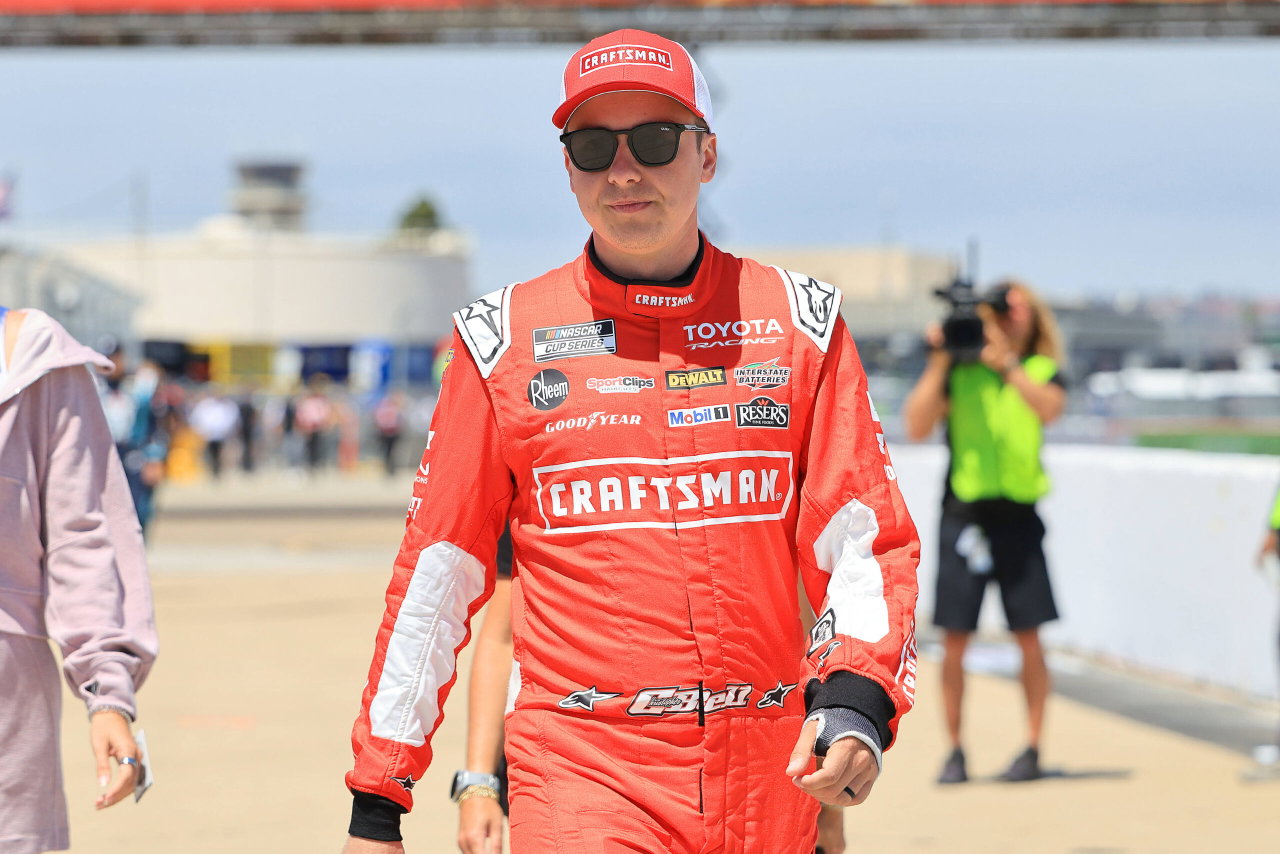
Christopher Bell had a reason to feel good about his afternoon at Martinsville Speedway. His No. 20 Joe Gibbs Racing Toyota had moved forward, his team had made a useful strategy call, and he was running close enough to the leaders to believe he could compete. But there was something Bell had not accounted for. William Byron was running faster without pushing his car nearly as hard. That realization changed how Bell viewed his entire race, and his 10th-place finish made the championship situation even harder.
Watch What’s Trending Now!
“I don’t know. I mean, I think, at least myself, I got tricked into thinking I was better than I was. My team had a great strategy. Qualifying, Stage 1, and obviously much better tire management at the start of Stage 2. So, you know, I felt like I was pretty good.”
Bell’s confidence had not come from nowhere. He finished fourth in Stage 1 after starting 14th, while crew chief Adam Stevens helped him gain track position through an early pit stop. The No. 20 also looked competitive when Stage 2 began. Then Stevens passed along a piece of information about Byron that Bell could not ignore.
“Then Adam came on the radio and said that William had run 100% throttle. And I’m like, well, I’m at 100%, and he’s at 80%. I don’t know. I was pretty close on the short run, and then on the long run, I fell off.”
That was the difference Bell had been missing. He could stay with the faster cars for a few laps, but maintaining that speed was another matter. Byron’s No. 24 Hendrick Motorsports Chevrolet had enough performance to dominate without requiring the driver to put in the same effort.
He eventually led 362 of 500 laps, won both stages and took his first victory of the 2026 season. Chase Elliott followed him home, giving Hendrick Motorsports the top two positions.
Bell, meanwhile, had other problems to deal with. A caution for Carson Hocevar spinning on Lap 199 brought the field back together, but Bell was caught speeding on pit road. He then found himself in the middle of another incident on Lap 216. Joey Logano attempted to pass the No. 20 on the inside entering Turn 1, but the cars ran out of room. Bell made contact with Denny Hamlin, and both Joe Gibbs Racing teammates spun.
The incident also gave Kyle Larson an important opportunity. The championship leader had fallen a lap down after staying out during the opening stage, just as Hamlin had. When the caution came out for Bell and Hamlin, Larson received the free pass and returned to the lead lap. He eventually finished ninth, limiting what could have been a damaging afternoon.
Bell’s own recovery was enough for 10th, but the result carried a significant championship cost. He collected eight stage points and moved ahead of Hamlin into second place.
However, Larson still leads him by 67 points, with Hamlin another three points behind Bell. The Martinsville race was the ninth of 10 Chase events, leaving only the November 8 finale at Homestead-Miami Speedway.
Bell’s post-race comments also showed how little room remains for another disappointing performance. When asked about approaching the finale, he described it as another opportunity to fight for a win. Yet the numbers leave him needing far more than a respectable finish.
For Bell, Martinsville was not simply a race where strategy failed to deliver a victory. It showed how misleading early speed can be when the car cannot sustain it.
Larson heads to Homestead with a commanding advantage, while Bell must find the long-run performance that eluded him in Virginia.