
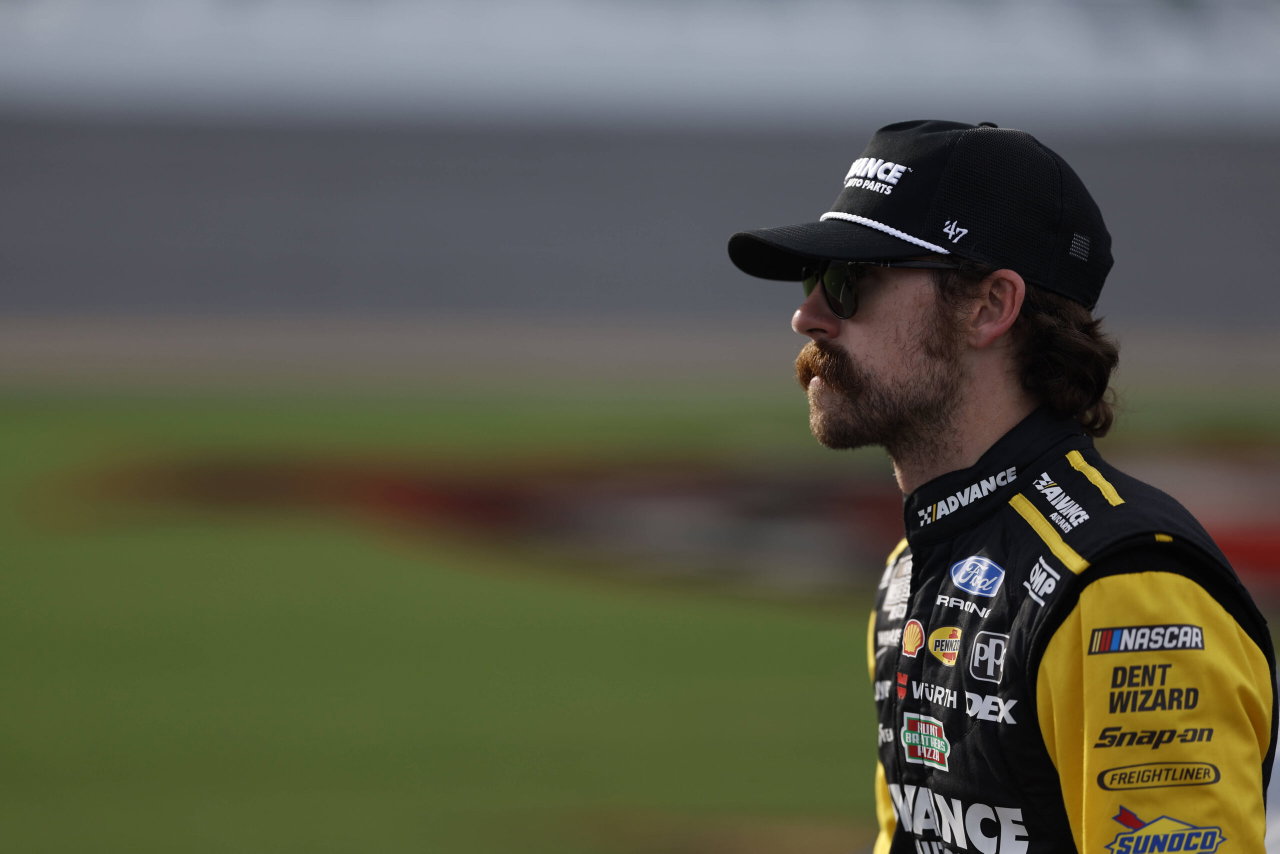
Ryan Blaney isn’t content with NASCAR’s current performance metric, and he is done accepting that as an unavoidable part of the Chase. He let his frustrations out again after being forced to start deep yet again at Kansas.
Watch What’s Trending Now!
According to the No. 12 Penske driver, NASCAR needs to pick a clear approach. Instead of repeatedly putting championship contenders in difficult positions when qualifying is washed out.
“Either just do one thing or the other,” Blaney said while discussing the situation on SiriusXM NASCAR Radio.
Blaney’s issue stems from NASCAR’s 70/30 performance metric, which uses 70% of a driver’s previous-race finishing position and 30% of the current owner-points position. Under normal circumstances, the metric determines qualifying order. When qualifying is canceled, however, it becomes the starting lineup itself.
Why has that differentiation become important? Because venues like Darlington, Bristol, and Kansas had their grids determined by the metric rather than actual qualifying speed.
Blaney is that one driver getting caught on the wrong side of that equation on many occasions, a pattern he certainly does not like.
Following his wreck at Daytona, Blaney started 24th at Darlington, and still managed to finish P4. At World Wide Technology Raceway, qualifying ran normally and Blaney qualified third. However, a brake-rotor issue forced him to retire, and that DNF pushed him to 29th on the metric at Bristol, where he again had to fight for position.
Even though he won Stage 2, his contact with Carson Hocevar later in the race resulted in a P33 finish, and the post-race brawl became the big headline.
Because 70% of the metric is based on the previous race’s finishing position, his P33 result caused significant damage to his hopes of starting at the front in the next race. Blaney’s sixth-place championship position contributed only 30% of the calculation, which resulted in a 25th-place starting position. According to NASCAR, the Bristol finish accounted for 23.1 of Blaney’s 24.9 metric score.
Adding salt to Blaney’s wounds, his Bristol result did not reflect the pace of his car for most of the evening. He had led 202 laps and won Stage 2 before making contact with Hocevar in the later stages of the race.
But as they say, numbers don’t lie. The metric does not factor in whether a driver ran at the front or the back for a significant chunk of the race. It only sees the final finishing position.
Regardless, Blaney still performed well at Kansas, finishing P5 after climbing from P25, and collecting 37 points in the process. While this moved him back up the Chase standings, it also highlighted the brunt work required simply because of where the metric placed him in the first place.
His frustration had already become clear before Kansas, as he mentioned ahead of the race (as per NASCAR.com), “I got done saying last week, ‘Oh, the metric is what it is.’ And now I’m starting to slowly hate it like you all for what’s been happening to us”.
He admitted that the situation was difficult indeed, but also acknowledged that the team had done a strong job adapting to the deep starting positions.
The reason that there has been such a huge debate on the metric system is that different drivers have felt it impact them differently. Joey Logano, who won Bristol before starting on the front row at Kansas, has been on both sides of the situation. He started 13th at Darlington, second at Bristol and first at Kansas. Logano said the system has “played a fair amount” but argued that it rewards recent performance and points position.
While NASCAR has defended the mechanism as a performance-based alternative to a random draw, it also noted that the system rewards what drivers have recently accomplished instead of relying purely on chance when weather prevents qualifying.
However, Blaney’s concern is about what happens when the system gets used repeatedly during a championship where every point counts. The 2026 Chase has 10 races with no eliminations or resets. This means that a poor finish carries into the cumulative championship instead of being wiped away by a new round. A deep starting position can only make things worse from there on.
This has led other prominent NASCAR voices to question the system as well, such as Kevin Harvick, who wants NASCAR to return to a random draw for qualifying. Dale Earnhardt Jr. has also previously supported the idea.
Meanwhile, Blaney has already joked about hoping for the weather to finally work in his favor. “Maybe it’ll rain in Vegas, and we’ll actually be benefited by the metrics,” he said after Kansas.
The joke captures the unusual position Blaney finds himself in. His performances have shown that he can recover from the back, but each recovery requires passing cars, managing traffic, and potentially sacrificing stage points. But in a format where every stage point and finish matters, he can’t afford to start the races from scratch.
With Las Vegas next, Blaney’s frustration and criticism are therefore less about one bad starting position and more about the repeated cycle. His results have placed him in situations where he must overcome the same obstacle again and again. And his “either just do one thing or the other” stance shows that he wants NASCAR to settle on a system that does not keep creating that disparity when qualifying is lost to weather.