
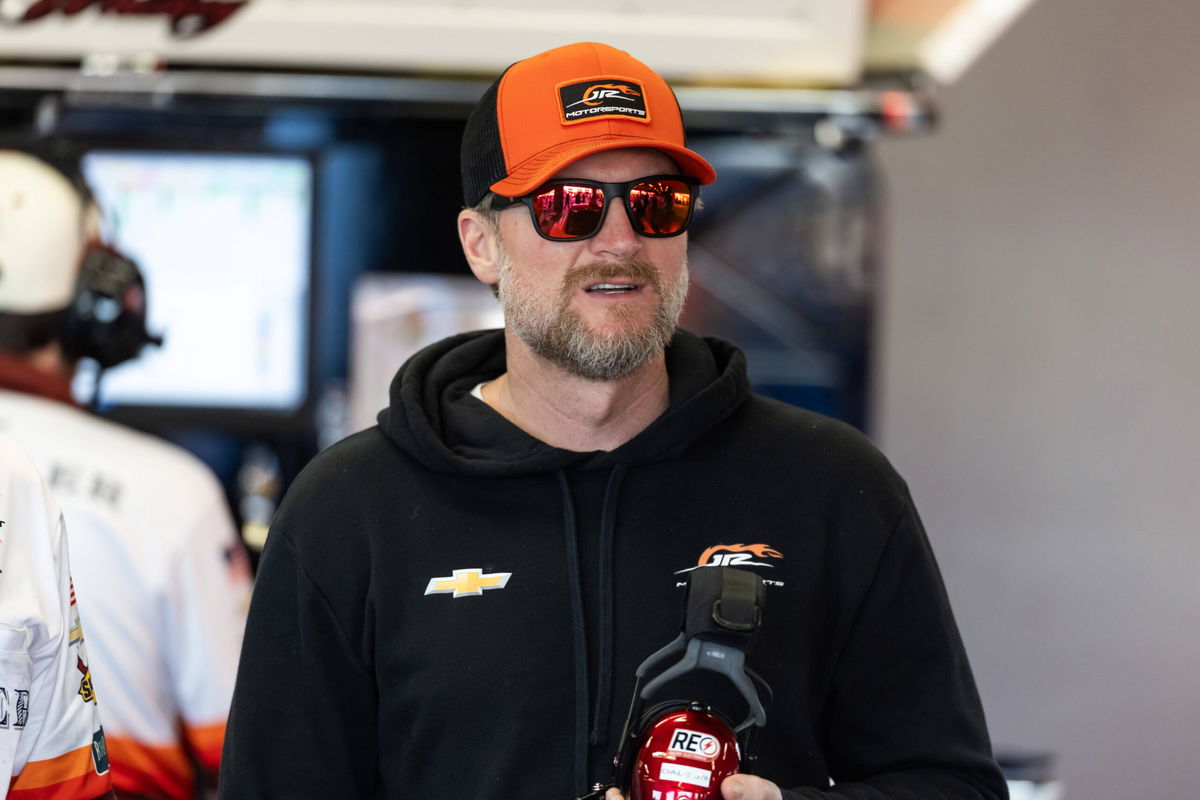
Denny Hamlin’s Las Vegas pit call quickly became a source of frustration, with Travis raising the obvious question: why surrender the lead when Kyle Larson was sitting a lap down? Hamlin later admitted that had he known Larson’s situation, he would have ignored the call and stayed out. But Dale Earnhardt Jr. is pushing back against the growing criticism, arguing that Chris Gayle’s call cannot be judged solely by the final scoreboard. And that the JGR crew chief deserves far more credit for the season he has put together.
Watch What’s Trending Now!
“I think he’s been doing a hell of a job all year, and it’s difficult to sit here and nitpick a single call in a series of hundreds that he made that day. Now that we know the scoreboard at the end of the game, it’s easy to say, man, that was not the way to go. Maybe it would have been a better result overall to have done something different, but in the moment, in the heat of the moment, he doesn’t know how the race is going to play out,” Dale Earnhardt Jr. defended Chris Gayle on the Dale Jr Download podcast.
Dale Jr. believes that judging Gayle entirely through the lens of the final result ignores the information available when the decision had to be made. The controversy began during the opening stage of the South Point 400.
Hamlin had started from the pole and had already made a green-flag pit stop before a caution for Zane Smith’s spin. The No. 11 had nine-lap-old tires when Gayle called him back to pit road for two fresh tires. Several other cars stayed out, leaving Hamlin to restart around ninth while Larson suddenly received an opportunity to return to the lead lap.
The timing was particularly painful because Larson had just spent roughly 26 seconds on pit road making major adjustments to his No. 5 Chevrolet. That lengthy stop dropped him a lap down, but Hamlin’s decision to pit under the caution allowed Larson to take the wave-around and erase that deficit. Hamlin quickly drove his way forward, reaching fourth, but he was now chasing track position rather than controlling the race from the front.
Then came the mistake that turned a questionable strategic decision into a disastrous afternoon. With three laps remaining in Stage 1, Hamlin moved high while trying to gain more positions and got into the marbles. The No. 11 spun, damaging the car’s underbody and aerodynamic performance. He went from fighting for stage points to leaving the opening segment without any, and the damage would remain with him for the rest of the race.
Hamlin has since made it clear that the information he had at the time mattered. He admitted that he did not know exactly where Larson was after the No. 5’s long stop. Had he known Larson would find himself back on the lead lap after a pit stop by the No. 11 team, Hamlin would’ve made a better decision to keep his rival at a disadvantage.
Yet Hamlin has also defended the people making those decisions. He explained that his team was focused on making the No. 11 as fast as possible, analyzing his feedback and figuring out how to improve his car rather than constantly monitoring Larson’s situation. In the bubble of the racetrack, Hamlin acknowledged that it is difficult to keep the entire championship picture in perspective while simultaneously calling one driver’s race.
That distinction is exactly why Dale Jr. is willing to give Gayle a mulligan. The crew chief has overseen a strong season despite the change in leadership atop Hamlin’s No. 11 team, and Dale Jr. believes one questionable call should not erase the hundreds of decisions Gayle has made successfully throughout the year.
Gayle, meanwhile, explained that the decision was not made with Larson’s situation in mind. Hamlin had only nine-lap-old tires after his earlier green-flag stop, while several cars that had pitted later were sitting on tires that were only three or four laps old.
Gayle believed the fresher rubber could give Hamlin the opportunity to regain the lead before the stage ended. He later conceded that it was “not a great call” in hindsight, describing it as essentially a 50-50 decision based on the information available at the time.
For Hamlin, the bigger lesson is not simply that Gayle made the wrong call. He has already accepted responsibility for the spin and said the team must improve at understanding who it is racing and reacting to the bigger championship picture. Dale Jr.’s argument is that those lessons can be taken without turning one difficult decision into a verdict on Gayle’s entire season.
And that may be the fairest way to view the Vegas controversy. The call did not work. Gayle himself acknowledged that in hindsight. But as Dale Jr. pointed out, the scoreboard was only clear after the race was over.