
There’s an unspoken rule among public figures: don’t air your dirty laundry in public. In a sport like NASCAR, where rivalries and confrontations are common, that kind of drama is a gold mine for fans and the media. Gillett Evernham Motorsports learned that lesson the hard way in 2008, and the fallout ended with driver Patrick Carpentier losing his ride.
Watch What’s Trending Now!
“I think it’s a complete lack of respect.” Carpentier had written on his website at the time, not mincing his words in the slightest.
“I never was shy to take the blame when I thought it was my fault, but here, everybody knows it’s like driving in a straight line. The driver just has to keep the steering wheel straight. He should have taken a time out and calmed down before we spoke.”
It was a difficult rookie season for Carpentier. With the No. 10 GEM Dodge outside the top 35 in owner points, he had to qualify on speed to earn a spot on the starting grid. And during his qualifying run in Talladega, he dipped his tires onto the apron, prompting team director Mike Shiplett to publicly blame and criticize him in the garage.
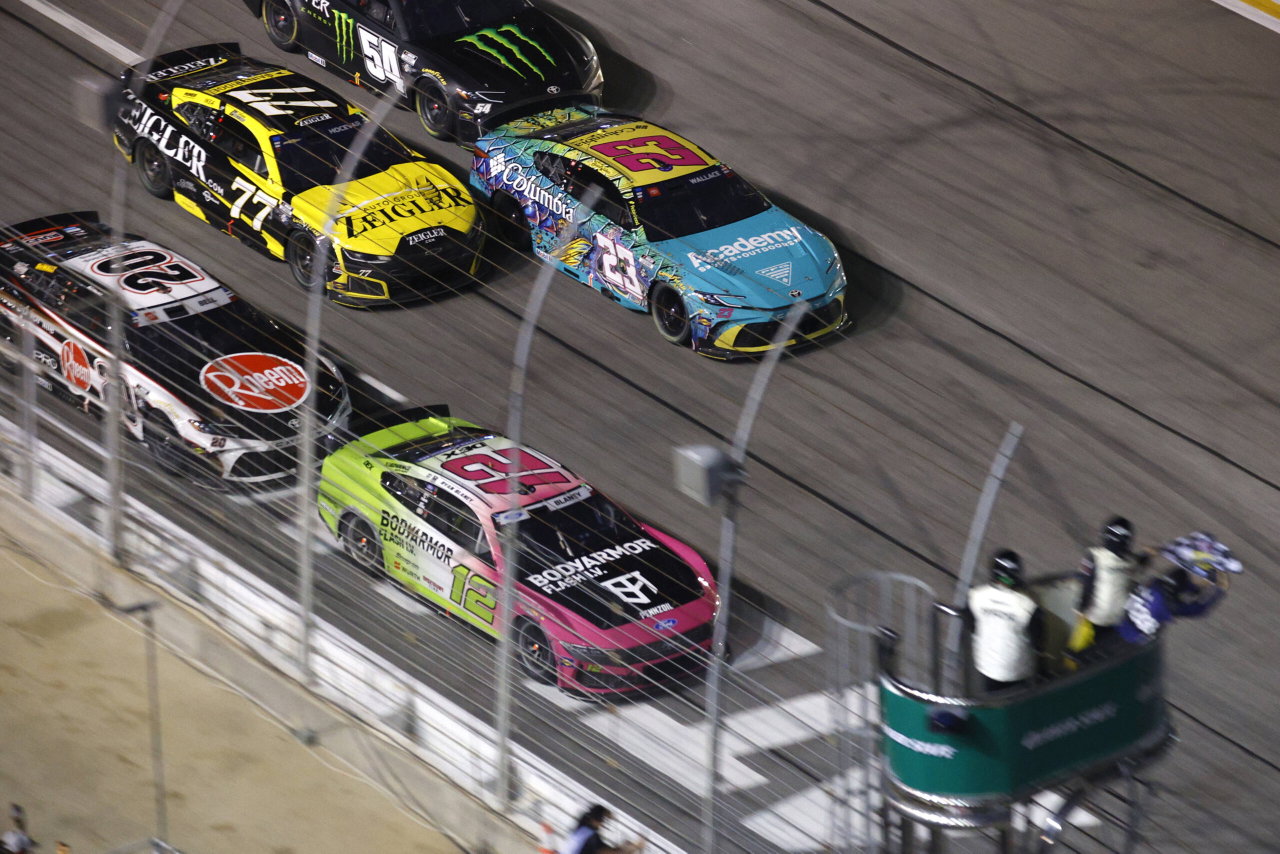
Today in NASCAR, if a driver goes below the apron, it results in an automatic penalty, as seen with Bubba Wallace at EchoPark Speedway last month, where a second-place finish turned into a 29th-place result. But in 2008, it wasn’t a penalty unless a driver used the apron to pass another car.
In qualifying, Carpentier wasn’t doing that. Shiplett, however, had other reasons to lose his temper with the driver.
In Shiplett’s mind, dipping onto the apron cost the car valuable time and potentially cost them a chance to qualify. Ironically, the aftermath showed that even if he hadn’t gone below the apron, it wouldn’t have changed the outcome.
Carpentier looked at the data. He found that the car was slower than the cut-off time even before he went below the apron. So, desperate to start the race, he went low to try and find some time.
Carpentier continued, “I gave it all I had, and now he blames me? This is totally unacceptable. It’s not as if my teammates were on the first row. They both ran slower than me.”
Carpentier had also slammed Shiplett for unfair criticism and for ignoring times when he outperformed expectations. “What is worse is that he seems to have forgotten pretty quickly races like Dover or in Atlanta where I’ve qualified a car that he himself didn’t think was fast enough to earn a place on the starting grid. I realize now that some people have a really short memory span in NASCAR.”
Clearly, the team did not appreciate the stunt or the comments, and Carpentier got his marching orders.
Overall, his results from previous races did not put him in a very comfortable position either. Carpentier had just four Top-20 finishes and failed to qualify for the race four times. And so, the public fallout meant that his brief Cup Series stint full-time had come to an end.
Since then, he has only had a handful of part-time appearances for different teams in his NASCAR career, including stints at Tommy Baldwin Racing, Michael Waltrip Racing, Latitude 43 Motorsports, FAS Lane Racing, and Go FAS Racing.
Beyond stock cars, he also dabbled in other disciplines, finishing an impressive 6th on his debut at his home race in Canada during the 2014 FIA World Rallycross Championship. He returned to the event in 2015, but his final professional race in motorsport came when he returned to NASCAR for a final one-off at the 2016 Brickyard 400, finishing 34th.
Looking back, it’s hard to pin Carpentier’s dismissal on one qualifying run alone. The public fallout with Shiplett seemed to play a bigger role than the Canadian’s on-track performances. GEM clearly backed the veteran crew chief, who had delivered success to the team by guiding Kasey Kahne to multiple Xfinity Series (now the O’Reilly Auto Parts Series) wins in 2007 before being promoted to the No. 10 car in 2008. And when times got difficult, the team chose to stand by that trust.
In NASCAR, disagreements happen all the time. They’re just usually kept behind closed doors. For Carpentier, one heated exchange became the final straw, bringing an abrupt end to a full-time Cup career that never got a second chance.