
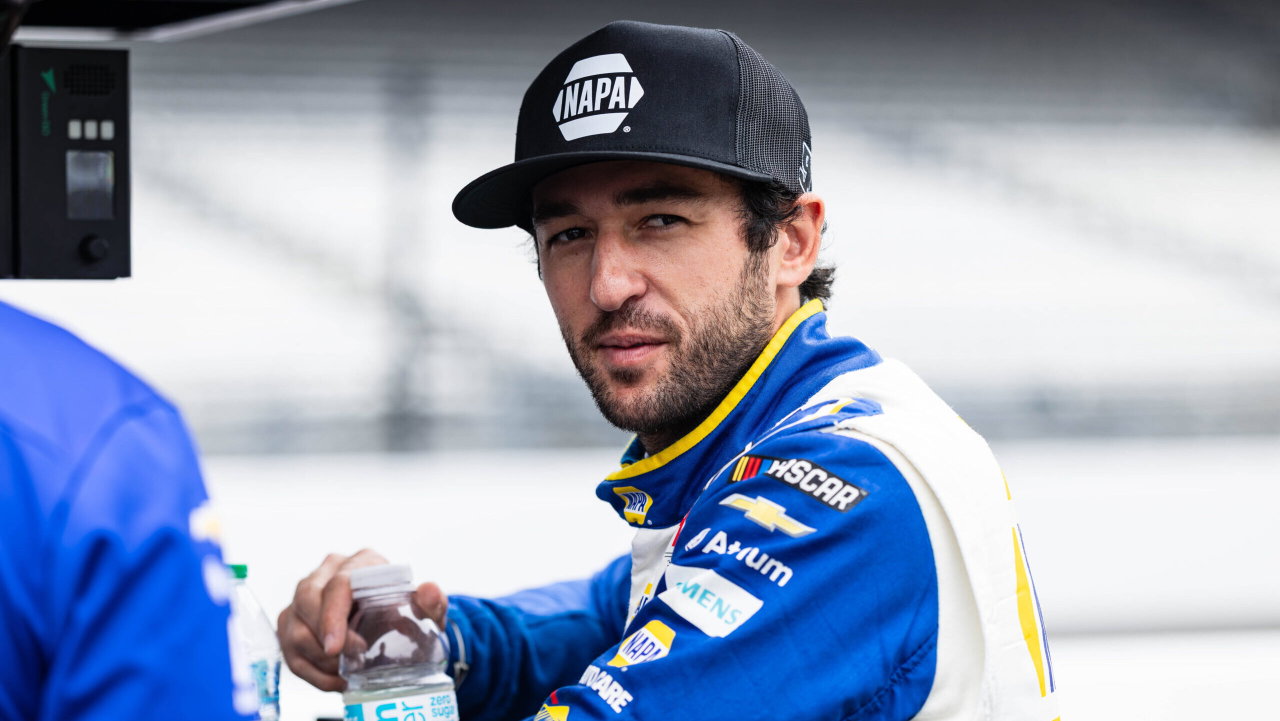
Chase Elliott entered Gateway with a legitimate shot to move up in the Chase standings. However, the race quickly turned into a nightmare for the Hendrick Motorsports driver. A chaotic afternoon filled with wrecks and mechanical failures left several Chase contenders scrambling for points, and Elliott was eventually caught in the fallout.
Watch What’s Trending Now!
His brake rotor failure proved especially costly, taking him into Joe Gibbs’ Racing driver Chase Briscoe’s path and adding another layer to an already disastrous race. By the time Elliott spoke afterward, his frustration was pointed toward NASCAR.
“Yeah, we’ve been blowing brake rotors since we started coming here in this particular vehicle. So yeah, obviously we’re in a box there where you can’t do a whole lot about it. And long straightaways with heavy braking on both ends of the track. And it just puts you in a really tight box as it pertains to temperatures and making the brakes live. So it’s a really, really tough balance and one that obviously is kind of, you know, you can get it right,” the 2020 Cup Series champ said to Frontstretch.
The Hendrick Motorsports driver had quietly put together a strong race and was running sixth late in the 240-lap event. But on Lap 213, his brake rotor failed entering Turn 1, sending the No. 9 Chevrolet sliding into Briscoe’s path.
The incident ended what had been a promising run for both drivers. Briscoe had already survived several incidents earlier in the race and was still fighting near the front when Elliott’s Chevrolet collected his Toyota. The contact brought both drivers’ strong performances to an abrupt end, with Elliott ultimately classified 31st.
Elliott also took responsibility for the consequences of the incident, apologizing to Briscoe after the race. He understood that Briscoe had been an innocent victim of the mechanical failure and had little opportunity to avoid the spinning No. 9 Chevrolet.
For Elliott, the result carried major consequences in the Chase standings. He dropped to 11th after Gateway and now sits 93 points behind Chase leader Denny Hamlin, turning what could have been an important championship day into a major setback.
That said, Elliott was hardly the only driver to suffer from brake problems. Team Penske’s Ryan Blaney also endured a catastrophic failure while running sixth on Lap 155. His brakes disintegrated on the front stretch, sending his Ford into the outside wall and leaving him with a 35th-place finish. As a result, Blaney has dropped to fourth place in the Chase standings.
Unlike Elliott, though, Blaney pointed toward the teams rather than NASCAR when discussing the problem.
“I mean, it’s all team related,” Blaney told veteran journalist Matt Weaver. “We’ll have to look and see what we felt really good about ours. We haven’t had a failure in our company on the brakes here. So, we’ll just have to look at, you know, was there anything different? But no, I think just leaving that up to the teams is probably the best way to do it.”
The failures continued throughout the race. Zane Smith crashed after suffering a brake failure on Lap 131, while Chris Buescher suffered another failure on Lap 238 and hit the wall entering Turn 1. The pattern became difficult to ignore at a track already notorious for placing enormous demands on braking components.
The increased 750 horsepower package for 2026 only appeared to make that challenge more difficult. NASCAR had already seen multiple brake failures at Nashville Superspeedway in May, and Gateway’s long straightaways followed by heavy braking zones created another severe test.
The scale of the problem was reflected in the race itself. Gateway produced a record 18 cautions, with 87 of the 247 laps running under caution. Two red flags were also required during a chaotic finish that left multiple Chase contenders nursing damaged cars or severely compromised championship positions.
Hendrick Motorsports vice chairman Jeff Gordon subsequently called for NASCAR and manufacturers to work together on future brake solutions at heavy-braking tracks.
“We shouldn’t be coming here with teams feeling like the margins are that close,” Gordon said after the race at World Wide Technology Raceway.
Elliott, however, stopped short of directly demanding a technical change, leaving the responsibility with NASCAR. He instead accepted whatever changes NASCAR decided to make, choosing to focus on making the most of the situation