
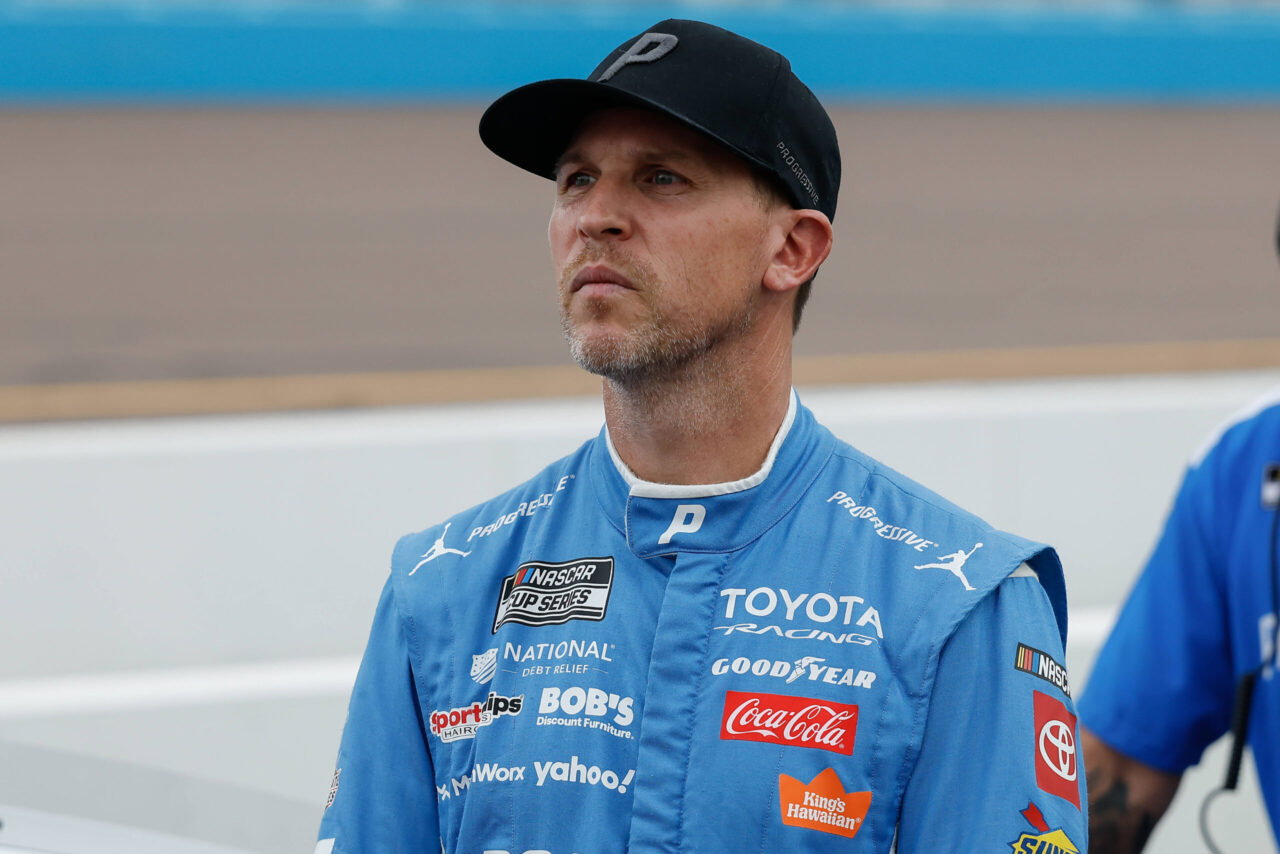
Martinsville taught Denny Hamlin everything he knew about tire wear. It just cost him a shot at Kyle Larson. The Joe Gibbs Racing veteran started from pole and trusted the short track’s familiar pattern, then spent the afternoon scrambling for track position while the laps ticked away. Looking back, Hamlin admits the lesson he learned is the one that turned a promising day into a missed opportunity.
Watch What’s Trending Now!
“I think that it was the conservative call, definitely not the aggressive call, and it certainly wasn’t the right call in retrospect of where my lap times went as that run went on, and we just didn’t hang on like we typically have,” Denny Hamlin said on the Actions Detrimental podcast.
Hamlin’s comments perfectly captured the frustration behind his sixth-place finish at Martinsville. The No. 11 team had a plan built around what usually happens at the Virginia short track, but the opening stage unfolded differently. Hamlin and his crew chief chose not to pit, hoping to protect their track position and potentially benefit from a caution. Instead, the lack of an early yellow left them running on worn tires while much of the field charged past on fresh rubber.
Hamlin explained to Earnhardt that he understood Gayle’s reasoning at the time. The first run at Martinsville often produces the most severe tire falloff because the track starts relatively green after being washed overnight. As cars lay down rubber, grip improves, and tire wear can become less punishing. Hamlin had seen the pattern repeatedly, just as he had at Darlington, where the first run can also be especially tough on tires.
“I don’t need the explanation of why, but I knew why,” Hamlin said, recalling the conversation with Gayle over the radio. “But then I did say to him, yeah, but it’s the first run. And, you know, unfortunately, the first run is always worse.”
That familiarity became part of the problem. Hamlin knew the tires could fall off sharply, but he also knew the team had often seen a Stage 1 caution at Martinsville. Gayle was trying to protect the position they had built. With Hamlin and Larson running near the front early, pitting could have put them behind the field if a yellow came at the wrong moment. Gayle later confirmed that the team had considered both the track’s caution history and the changing pace when making the call.
“Yeah. That was part of our thought,” Gayle told Matt Weaver. “There’s typically cautions. We also were very aware of the pace, and the pace was kind of trending one way, and then it just dramatically changed on us very late, where there wasn’t anything you could do about it. Then you didn’t get the caution, and then that looked, that just left you in a spot where you were sitting ducks when you’re going to, okay, be P14 or P15, whatever we finish that stage.”
The strategy left little room for recovery once the expected yellow failed to arrive. The opening 130 laps ran without a yellow incident, and the drivers who stopped for fresh tires took advantage.
Hamlin had led 40 laps after starting from pole, yet fell to 17th by the end of Stage 1. Larson, who made the same no-stop gamble, dropped to 23rd and a lap down. William Byron, meanwhile, capitalized on the fresher tires to win the stage.
The setback forced Hamlin into a recovery drive. He gradually worked his way back toward the front, but track position remained difficult to regain. His afternoon became even harder when a Lap 216 incident involving Christopher Bell and Joey Logano sent Hamlin spinning and caused damage on the left-rear of his Toyota. He recovered to finish sixth, while Bell finished 10th.
Earnhardt pointed out another unusual feature of the race: the long green-flag stretches, including a 230-lap run that was the longest at Martinsville since September 1987. The race offered none of the repeated cautions that might have helped Hamlin recover from the early strategic mistake.
The consequences were significant. Hamlin entered Martinsville 73 points behind Larson and left 70 points back, having gained only three points despite the leader’s difficult day. With Homestead remaining, the No. 11 team needs a near-perfect finale and help from the competition to keep its title hopes alive. Hamlin’s reflection was not an attempt to pin the blame solely on Gayle. He understood why the call was made, but the outcome was undeniable: a strategy built on Martinsville history failed when the race refused to follow its usual script.