
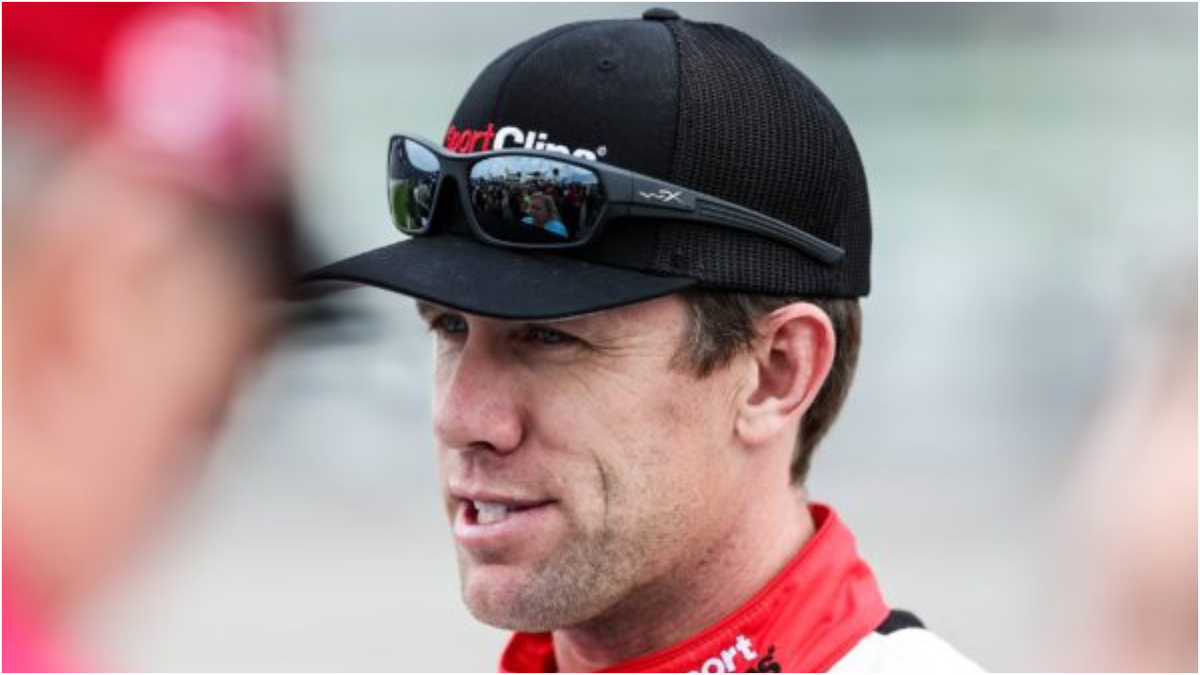
When Travis Pastrana walked into NASCAR in 2012, the garage wasn’t impressed by résumés. It wanted lap times. Carl Edwards, a race winner, a title contender, a man who knows exactly what Cup-level pace demanded, had watched the skepticism build around Pastrana and decided to answer it himself. What he saw put the debate to rest.
Watch What’s Trending Now!
Pastrana’s sporting history is absurd: The man jumped out of a plane at 12,500 feet without a parachute. He separated his spine from his pelvis at 14 years old, lost two-thirds of his blood, spent three months in a wheelchair, and got back on a dirt bike the moment doctors cleared him. He had 17 X Games medals, a double backflip on a motocross bike, and a night in Las Vegas in which he replicated three Evel Knievel jumps back-to-back.
The garage looked at all of that and asked the only question they cared about: Sure, but can he drive a race car? Many doubted Pastrana could match Cup-level pace, but Carl Edwards answered that question himself:
“Damn, Travis Pastrana can drive a race car.”
Edwards recalled a test day at Atlanta Motor Speedway during their time as Roush Fenway Racing teammates on the Stacking Pennies podcast. Pastrana was struggling, and someone asked Edwards to hop in his car and run some laps to give the team a baseline. Edwards got in thinking he was about to show the daredevil what proper NASCAR pace looked like.
“I got in this car, and I’m thinking, ‘You know, I’m gonna really lay one down. This is gonna be good,” Edwards said. “Three real good laps, got out, and it was the same exact speed you were going.”
That is not a small thing. Edwards was one of the most precise and technically complete drivers of his era. His telemetry data was used as the benchmark for maximum capability for race cars at Roush. Crew chiefs told underperforming teammates to study Carl’s throttle traces. When he ran three laps in Pastrana’s car and matched him exactly, that was the sport’s internal evaluation system delivering its verdict.
The two had history before Roush. In December 2010, they represented Team USA together at the Race of Champions in Düsseldorf, running against Michael Schumacher and other global names in identical cars. That paid off in team bonding when Pastrana joined the team two years later.
At the 2013 NASCAR Media Tour, Edwards and his Cup teammates showed up in matching black suits. Pastrana arrived late in a purple shirt and plaid jacket and said he didn’t get the memo. The garage loved it. What they did not forgive as easily were the other things.
Pastrana was driving the No. 60 Ford, the winningest car number in Xfinity Series history. Edwards had personally won the Nationwide Series Owner’s Championship in that same car in 2011. The equipment gave him zero excuses. His teammate, Trevor Bayne, was regularly contending for wins in comparable machinery. If Pastrana struggled, it was on him.
He did struggle, but not because of speed. NASCAR requires a completely different skill set from anything Pastrana had done before. In NASCAR, unlike rally racing, sliding destroys your tires. It starts a chain reaction of crashes.
He had no background in terms like “wedge” or “track bar.” He regularly lost time on pit road, struggling to brake a heavy stock car to pit-road speed. Pack racing at 180 mph with cars three-wide was something no amount of dirt bike experience prepared him for.
What saved his reputation was his attitude. Edwards and the crew regularly noted that Pastrana was on the NASCAR simulator software until two or three in the morning, memorizing tracks. He wanted to be a real racer, not a celebrity in a race car, and that got him genuine respect across the garage. The 2013 season ended with four top-tens, a pole at Talladega, and a decision to step away when the funding ran out. Edwards defended him throughout.
Why the NASCAR Garage Listens When Edwards Talks
The credibility behind Edwards’ assessment of Pastrana comes from a specific kind of credibility. He spent a decade at Roush Fenway Racing in a culture where data sharing was minimal, and teammates were competing against each other.
Edwards worked alongside Greg Biffle, Matt Kenseth, and Ricky Stenhouse Jr., building his entire career on raw self-reliance and a close working relationship with crew chief Bob Osborne. He out-drove his equipment consistently on high-wear tracks like Atlanta and Bristol.
Then, in 2015, he moved to Joe Gibbs Racing, a completely different world. Shared telemetry, transparent setup notes, four teammates all working toward the same manufacturer goals. The Toyotas required smooth, precise inputs, not the aggressive, sliding style Roush Fords demanded. Edwards adapted and made the Championship 4 in 2016.
He lost the 2011 title to Tony Stewart on a tiebreaker after finishing top five nearly every playoff race. In 2016 at Homestead, he was leading late before a crash with Joey Logano ended it. He shook hands with Logano’s crew chief and walked away from the sport weeks later.
A man who won at both Roush and JGR, lived through two championship heartbreaks, mentored a daredevil into a legitimate racer, and set the telemetry standard for his entire organization, when he says someone can drive, you believe it.