
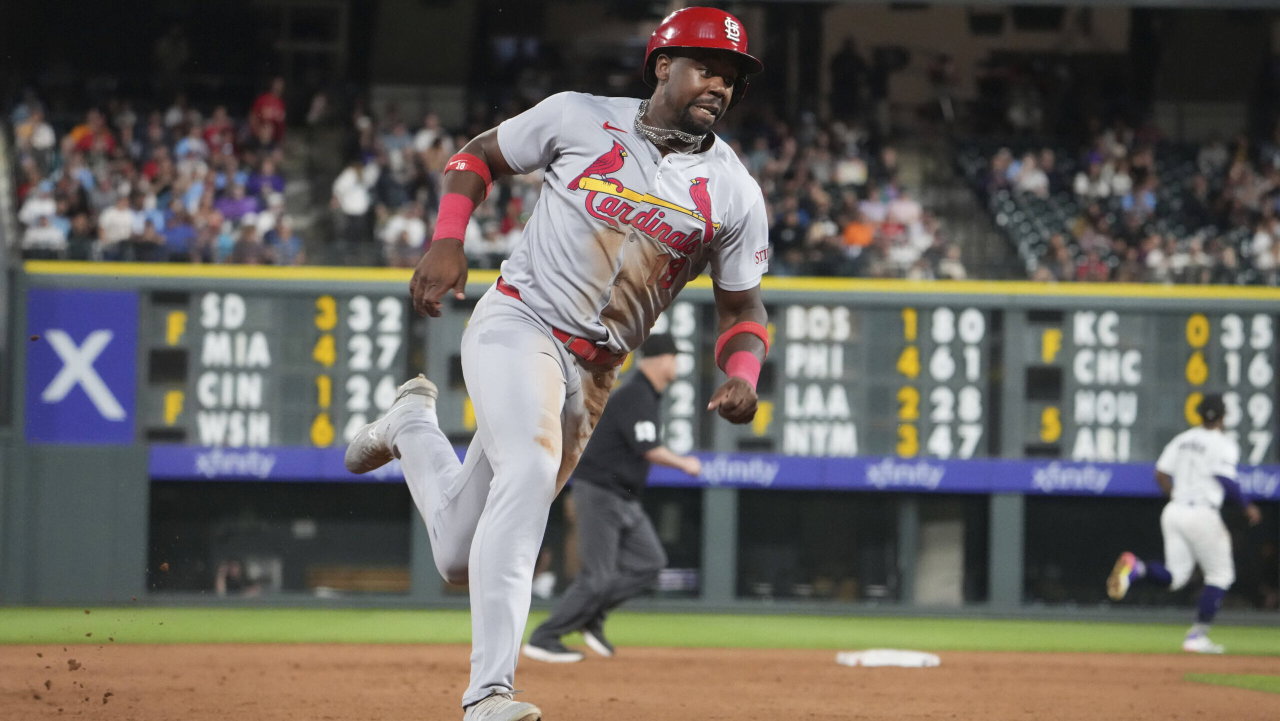
It appeared as though the 43,863 fans in attendance had already decided who they wanted to win. They celebrated every home run hit by someone wearing a Phillies jersey, but for the non-Phillies players? The boos were louder and merciless. So when Jordan Walker stepped up to the plate in the third and final round, you can imagine how the crowd reacted. But the St. Louis Cardinals slugger defied all odds and scripted history.
Watch What’s Trending Now!
“I was once told you don’t boo nobodies, so it feels pretty good,” Walker said after he won the game.
Citizens Bank Park in Philadelphia was chosen as the venue for both the Home Run Derby and the All-Star Game this year. MLB selected two of the Phillies’ most beloved stars, Bryce Harper and Kyle Schwarber, for the eight-man tournament to fire up the crowd. And it got exactly what it wanted.
Notably, the HR Derby introduced a new format this year. They removed the timed format and restricted the number of pitches for each player. Willson Contreras of the Boston Red Sox made it to the semis, hitting 13 HRs in 20 pitches (a limitation for Round 1). Jordan Walker followed suit with the same numbers. Even Junior Caminero and Schwarber advanced to the next round.
The baseball community had high hopes for Harper and Ben Rice, but both were eliminated. Schwarber managed to outscore Contreras in the semifinals, while Caminero, the Tampa Bay Rays’ third baseman, lost to Walker.
Even with Harper out of the picture, the people in the stands never failed to remind Walker that they were rooting against him. In fact, he admitted that he was nervous, saying, “Everybody was booing me like crazy.”
The semifinal and final rounds were limited to 15 pitches each. And Schwarber, going first, managed 11 home runs. This meant Jordan Walker needed 12 to win the title.
He missed a few during the early throws, and the ask became 6 out of 6 for the win. The 24-year-old did just that. He first tied the game at the last moment, which earned him the bonus, and he hit all of them for a homer. 413 feet, 450 feet, and 407 feet. That was enough to stun the crowd, and Kyle Schwarber.
This made him the first Cardinals slugger to win the Home Run Derby, and he won it in style and went on to script history. Before him, Albert Pujols held the franchise’s best finish, reaching the 2003 final before falling to Garret Anderson.
“He was awesome today,” his dad, Derek Walker, said afterward. “I just loved everything about it. Just his attitude, his approach, the smoothness of his swing – looked like his dad. But I thought, yeah, he just did a great job. We’re just so proud of him. He’s just — really, we’re proud.”
However, that doesn’t mean it was easy.
True, players go to opponents’ stadiums all the time, and there are numerous examples of fans booing individual players when they score against the home team. Bryce Harper is one of the biggest examples in this context, as he has been booed routinely by the Washington Nationals fans ever since he joined the Philadelphia side.
So far, Jordan Walker has played 372 games in the major leagues. He should be accustomed to it by now. But in truth, nothing prepares you to face a crowd that wholeheartedly wants you to fail. And both Walker’s performance and comments prove how tough a job it was.