
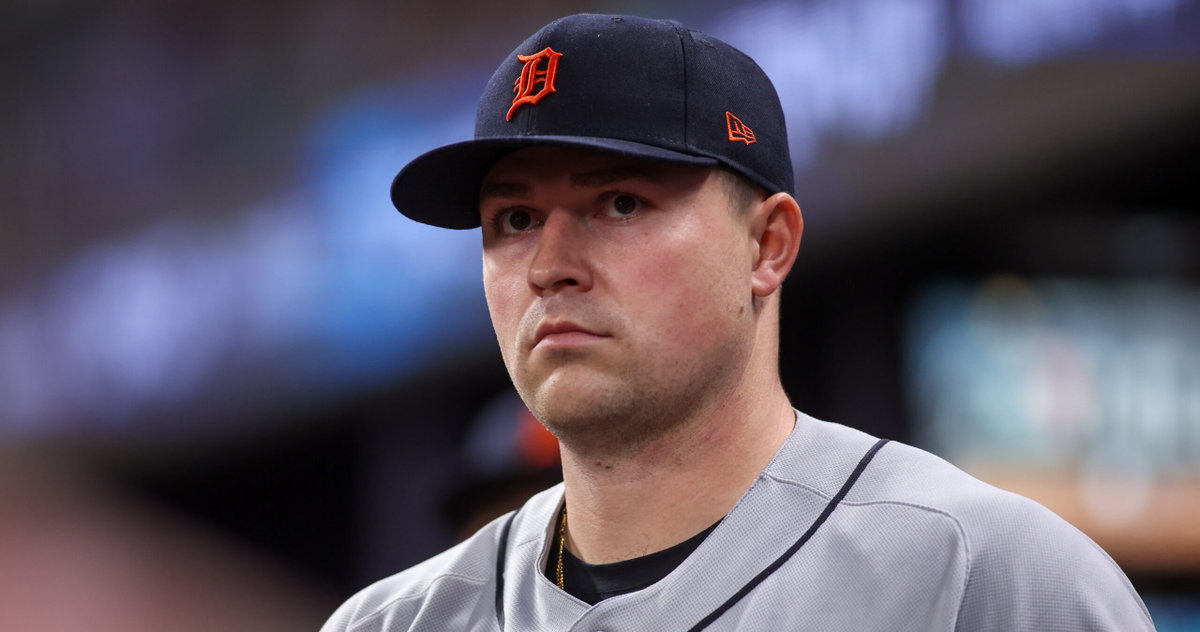
Tarik Skubal is firing back against Commissioner Rob Manfred’s push for a salary cap. With the MLB labor contract expiring on December 1, the Tigers ace is aggressively defending the players’ union. If a new deal isn’t reached by that deadline, a lockout could delay the season and cancel games.
Watch What’s Trending Now!
“It’s [salary cap] not good for players. If you ask any other player in any other union, in the other major sports, they would agree, and they would want our CBA structure,” Skubal told Jesse Rogers of ESPN.
Skubal’s defense of the MLBPA’s demands comes after Manfred openly spoke about competitive imbalance in the league.
“The one thing that they’re the biggest on right now is the lack of competitive balance in the game, and I think that’s going to be the cornerstone issue of the negotiations with the MLBPA,” Manfred said on the Pat McAfee show. “Our payroll gap from top to bottom is $446M. That’s not a fair fight.”
For the upcoming CBA, the MLB has pushed for a hard salary cap and floor of $245.3 million and $171.2 million, respectively. Bridging the payroll disparity that exists within the league has been the owners’ strongest argument behind this proposal. Currently, there is a $340 million gap, per Spotrac, between the highest (Los Angeles Dodgers, $420 million) and lowest (Miami Marlins, $80 million) spending teams.
The league says the current system hurts fair competition. But a hard cap puts a strict ceiling on what players can earn. This makes people doubt if teams will ever pay players what they are truly worth.
Skubal, himself, won a $32 million arbitration case in the offseason this year. It made him one of the highest-paid pitchers in baseball before free agency. Furthermore, the reigning Cy Young winner was also projected to secure one of the largest pitching contracts, around $400 million, in MLB history once he becomes a free agent. But under a salary cap system, such contracts won’t be a reality.
MLB is the only professional North American sports league without a salary cap. Skubal has highlighted how the salary cap does not help increase competitive balance by drawing on the NBA’s example.
“If you look at the NBA, look at all the tanking that happens in that cap system. They’re racing to lose. You think that’s a good thing? They just had to implement anti-tank rules. Tell me that cap system’s healthy and I’ll tell you that it doesn’t promote competitive balance,” stated Skubal, per Rogers.

Spoke with Tarik Skubal today about the league's salary cap proposal. He's on the executive subcommittee: "It's not good for players. If you ask any other player in any other union, in the other major sports, they would agree, and they would want our CBA structure.”
Just recently, the NBA passed the new anti-tanking rules to curb intentional tanking and benching healthy players. These rules are designed to penalize the teams with the worst record during draft selection. Per Skubal, these rules are a direct reflection of what the salary caps could not fix.
The MLBPA has been historically against the introduction of a salary cap in Major League Baseball, leading to multiple work stoppages. And in response to the MLB owners’ first proposal, the union has warned about a similar situation in the near future.
The players’ union’s rebuttal to the MLB’s proposal
With the MLB team owners and the MLBPA at opposite ends. It is no secret that the upcoming CBA negotiations will be a long uphill battle.
A day after the players’ union proposed a $150 million floor and raising the luxury tax to $300 million, the MLB responded with a hard salary cap and floor demand. They pushed for the teams’ payrolls to sit between $171.2 million and $245.3 million.
Hence, the floor would make teams like the Marlins and the Guardians ($87 million) invest more in their roster. The cap, on the other hand, would stop franchises like the Dodgers from operating on a payroll that’s entirely on another level. Apart from the record-setting 10-year, $700 million Shohei Ohtani deal, the Dodgers have signed more exorbitant contracts as well.
This year, they signed Kyle Tucker on a four-year, $240 million contract. Other high-market teams like the Mets would also have to curb their budget. The Mets have signed Bo Bichette to a three-year, $126 million deal this offseason, bringing their payroll to a whopping $381 million.
The players’ association believes a salary cap will make rich owners richer by limiting players’ salaries. The MLBPA is strictly against the introduction of a salary cap. They reiterated it in their statement on the owners’ proposal. Their vehement protests led to the 1994-1995, 232-day strike, the longest work stoppage in the history of the sport.
“The owners responded today with a demand for a salary cap system, something generations of players have fought against. The last time the owners made such an explicit push for a cap—over 30 years ago—it led to the longest work stoppage in MLB history,” the statement read, per Jesse Rogers of ESPN.
“For generations, our members have fought against cap systems because they harm players at all levels, erode or eliminate contractual guarantees, pit player against player, lead to more work stoppages, not less, and get worse for players over time. Caps don’t lower ticket prices for fans, eliminate tanking, or ensure teams are run with equal competence. They suffocate competition by offering owners an all-purpose excuse for inaction and mediocrity.”
With December 1 approaching fast, baseball is heading straight for a messy labor war. Tarik Skubal and the union refuse to give in on a salary cap, while Rob Manfred and the owners insist the huge spending gaps are ruining the game.
Unless someone backs down soon, fans should brace for a lockout that could delay or cancel games.