
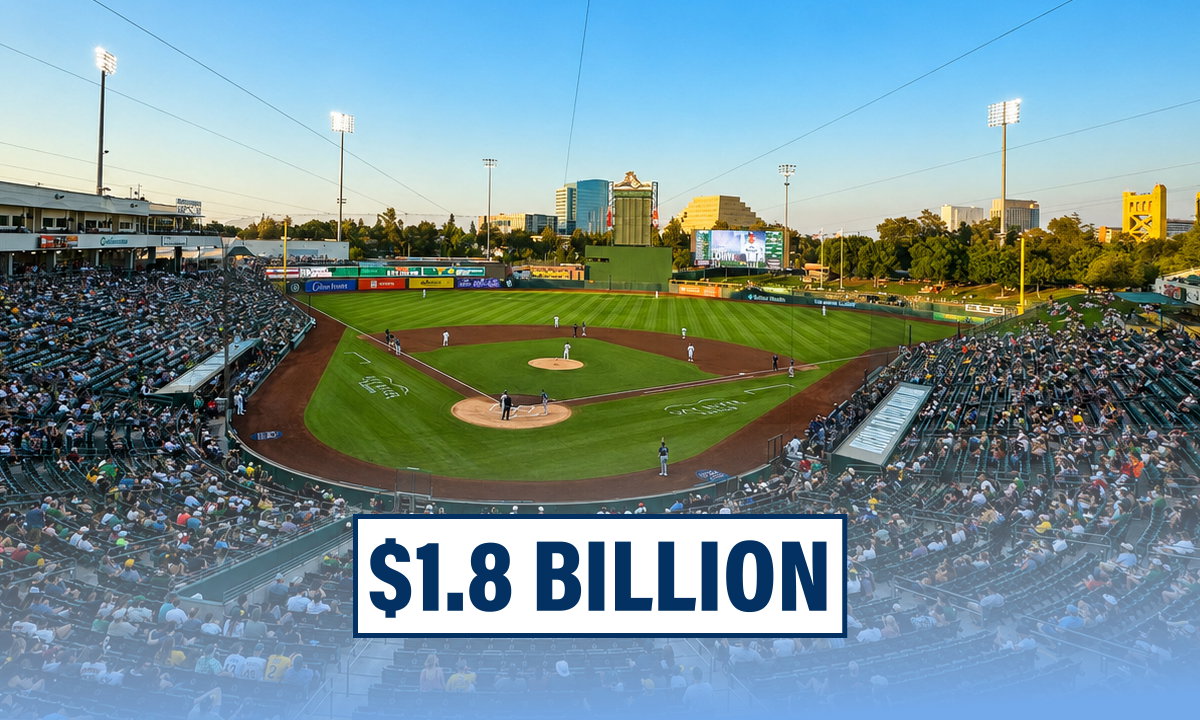
Sacramento is spending $1.8B to prove what Miami couldn’t: A baseball stadium can save a city. After the Athletics moved from Oakland to Sutter Health Park in West Sacramento, California, the place became their temporary home. But things are about to change, as they are planning a move to Las Vegas, and Sacramento wants its own team and ballpark. With that, California will have 5 MLB stadiums, excluding the Athletics. Now comes the real question.
Watch What’s Trending Now!
This growth can bring in massive revenue, but will Sacramento be able to enter the MLB market with its own team?
Sacramento has already intensified its efforts. They have built “The Sacramento Pitch” campaign. And the best part is that the group has already assembled approximately $1.8 billion in public and private investment to support its expansion proposal.
The team might still need some more funds from investors before the expansion, which will begin in 2028 when the Athletics move out.
Local partners have been the biggest support behind the entire initiative.
The United Auburn Indian Community and the Shingle Springs Band of Miwok Indians have each contributed $250 million. Even developer Mark Friedman has added $150 million through his land and equity investments. This clearly shows that even locals want this expansion to happen.
Friedman had outlined why the city will be a good MLB market. Per Sports Business Journal, with the population of 2.7 million in the metro region, Sacramento ranks as the 20th-largest media market in the USA. Nielsen data had noted that the city had 1.55 million TV homes during the 2025-26 season.
Sacramento already has a potential stadium site ready.
The Bridge District area, located south of Sutter Health Park in West Sacramento, at a 50-acre stadium site, has already been approved for an MLB-sized stadium. Plus, in the West Sacramento area, the government structure allows the city to access tax increment financing that could help fund the infrastructure improvement needed for the stadium.
Why is Sacramento chasing MLB so aggressively?
Firstly, getting your own team brings a sense of pride, and that’s exactly what Sacramento is chasing right now. With the team, the proposed project is not just about building a stadium but also about the growth it will bring to the city. The stadium will become a hub for retail space, restaurants, and entertainment venues and will only help the city in the future.
Plus, the establishment area matters the most.
In the West Sacramento area, the Bridge District is growing, where the locals are already planning to establish commercial and residential units. With this expansion, they will create an area that will bring in year-round money, not just limited to MLB games.
But they are not the only ones aiming for such better economic growth.
Like Sacramento, even Nashville is pitching for an MLB team.
Music City Baseball group wants an MLB team, which they will call the Nashville Stars. They are aiming to bring in more jobs for people, creating about 2,500 opportunities, generating $12 billion in economic output over 30 years, and attracting more visitors.
They are also planning a new stadium with 40,000 seats at an estimated cost of $1.2 billion.
Sacramento wants the same. They are aiming for total economic development rather than just sports expansion.
The direct economic boost: Jobs, construction, and game-day spending
A new stadium will bring better opportunities and help grow the city. Fans will spend more on purchasing tickets for the game, will buy food, visit restaurants, and so much more. While many have shown their doubts on social media, the current scenario makes it likelier than ever.
Over the past few decades, the city has transformed former industrial land like the riverfront into an area that includes housing, businesses, and restaurants.
This shows the team can handle a complex project.
Even their mayor, Martha Guerrero, showed confidence in the city’s ability to make the jump. People will have various ways to earn. First up is construction.
Building the ballpark district around the stadium will create jobs for construction workers, engineers, contractors, and suppliers over several years.
Plus, there can be unlimited economic growth, as fans coming from outside will get massive crowds to restaurants, hotels, parking facilities, bars, and retail stores. Reportedly, the proposed ballpark district would generate about $1.77 billion in new tax revenue over the next 40 years.
Under the plan, about $1 billion of that revenue would be invested back into the ballpark district. This money could help pay for infrastructure, public improvements, roads, and utilities. The remaining $770 million would go to local public services. This money would help support schools, Yolo County, and other local government agencies.
From creating extra employment opportunities to giving it all back, Sacramento seems to be planning it very smartly.
Building an entertainment district, not just a ballpark
Sacramento is thinking about fans’ desires and focusing on creating a large entertainment plus business hub around the ballpark.
The proposed area covers about 50 acres in West Sacramento, and officials are envisioning better facilities, like restaurants, retail stores, hotels, housing, offices, and entertainment spaces surrounding the stadium.
The main goal is to create a place where fans can come in and enjoy before and after the game. And not just limit themselves to just coming and watching the sport.
Plus, the Bridge District is already among the fastest-growing areas in West Sacramento, which will help in expansion.
All in all, they are trying to bring in a success just like Madison Square Garden did.
The arena developed into an entertainment hub by bringing in stars like Marilyn Monroe, Elvis Presley, and Taylor Swift. Plus, located in Penn Plaza, which has access to better transportation, restaurants, bars, and clubs. They don’t just sell games but a total experience.
Now that the Knicks are in the NBA Finals, the city is set to earn $832 million.
Imagine if Sacramento builds the same kind of hub, how much success will it bring to the entire city!
Tax revenue windfall vs. public spending concerns
The expansion sounds all positive with a long-term investment plan that will eventually help the city make more money. And that’s not totally wrong.
The team will have more games, which will attract tourists. Their local hotels, restaurants, and bars will see more crowds, and the economy will get better. But then comes in a hard-hitting reality.
What if all this is just promises rather than actual results?
While some fans are supporting the project, some are not sure about it. Even economists have argued on the same lines.
Per the 2005 survey of American Economic Association members, 85% of economists agreed that state and local governments should stop giving financial subsidies to sports teams. They argued that teams should pay for their own stadiums rather than depending on taxpayer money.
One of the biggest examples of that is Miami-Dade County, which approved a plan of about $347 million in taxpayer money to help build a new 37,000-seat stadium for the Miami Marlins. This was done to bring more benefits and major economic growth.
But they failed.
In 2013, reports showed very few people in the games. In one viral picture, only four fans were seen waiting to buy single-game tickets when sales were open.
This shows that things don’t always go as planned. Even though Sacramento isn’t taking tax money directly from the people, it will rely on businesses that will open near the stadium, and if that doesn’t work, it will lose everything.
Even one Reddit fan pointed out the same: “Improve our public transit, build affordable housing, repair our roads, pay teachers $250k starting with college loan forgiveness with public money…but NO public money to billionaires for stadiums that could bankrupt our cities. Organize protests and public vote referendums 🗳!! The people DO NOT SUPPORT PUBLIC FUNDING FOR STADIUMS THAT BILLIONAIRES CAN ENTIRELY FUND THEMSELVES!!”
For now, it all depends on how local businesses grow.
What happens to local businesses?
If Sacramento gets an MLB team and builds a new stadium district, the impact would go far beyond baseball games. Local businesses could see a major boost because thousands of fans would visit the area throughout the season.
First, hotels would benefit from fans and tourists from other cities. What works in their favor is that MLB teams play 81 home games each season, and fans travel for them. Some visitors would stay overnight, increasing hotel bookings and hotel-tax revenue.
On top of it, restaurants, bars, and cafes near the stadium will also get more customers. Local vendors will get a major benefit, with fans buying team jerseys, hats, and other merchandise to support their teams.
Plus, with time, the stadium can also gain popularity through concerts and corporate events. While the concerns remain, there are good examples like Texas, which has shown great results.
The “Major League City” effect
This expansion not just promises economic growth but also gives the city the exposure that it’s been looking for ages.
When a city gets its own team, more fans notice it around the country. It will help them bring in more TV exposure, media attention, and recognition. Just take Oklahoma City’s example.
Before getting the Thunder in 2008, the place was rarely even mentioned as a major league city. But now it has gotten major exposure worldwide.
Plus, let’s not forget the Sacramento leaders are already positioning themselves as “MLB-ready” because of the city’s growth ability. The city has about 2.7 million residents in the expansion region, and about 4.1 million live within 50 miles. Plus, they have added 200,000 jobs since the pandemic.
As Commissioner Rob Manfred noted, “When people want your product, I think it’s kind of incumbent on you to try to figure out a way if you can deliver that product to them.”
The growth is evident. And they only have one permanent Big Five team, which is an added advantage for MLB expansion.
The big question: Are sports teams actually economic engines?
No matter how hard you debate, sports teams have become economic engines for the cities. Fans love their teams, they go into the stadium, watch the game, and end up paying for food, seats, and drinks. And if it’s in another city, the hotels also gain profit.
With the teams’ success, the stadiums become a money magnet.
But let’s not forget that stadiums don’t automatically generate money. It totally depends on fans how they want to spend their money. What if they come in and just pay for the tickets and go? What will happen to the local vendors? That’s what everyone’s ignoring.
Which is making Sacramento’s MLB push feel less like sports expansion and more like creating permanent economic growth. And more importantly, fans are looking forward to Nashville, Charlotte, and Salt Lake City being the next on the expansion list. But all things said and done, unless the CBA negotiations find a way out, these remain an unlikely scenario.