
Imago
Source: IMAGO
Imago
Source: IMAGO
The Toronto Blue Jays are the absolute favorites to land Kyle Tucker, and we all know it. But every passing day, Toronto gets more and more tense about where the signing is going. But after his recent reports, this might be the best time for Ross Atkins to act and get Tucker to Toronto.


“He doesn’t think the Jays or any team are going to give Kyle Tucker 400 million,” said Nick Gosse. “Now, as we’re a couple of months or a month, you know, after that, I would do this deal in a heartbeat.”
Watch What’s Trending Now!
Kyle Tucker entered free agency projected near 11 years and $400 million, setting early market expectations. As weeks passed without movement, those projections softened toward deals like 10 years, $384 million. The change reflected hesitation rather than talent decline, reshaping how teams valued long-term commitment structures.
That shift quietly altered the offseason landscape and opened doors once thought firmly closed leaguewide.
Kyle Tucker’s market cooled due to late-season struggles, durability questions, and teams guarding payroll flexibility carefully.
Large-market clubs like the Dodgers, Yankees, and Mets showed interest but resisted decade-long financial obligations contracts. Luxury tax pressure and existing megadeals limited aggressive offers, slowing negotiations across the league overall.
As momentum slowed, shorter high-AAV structures became realistic alternatives instead of expected mega contracts initially.
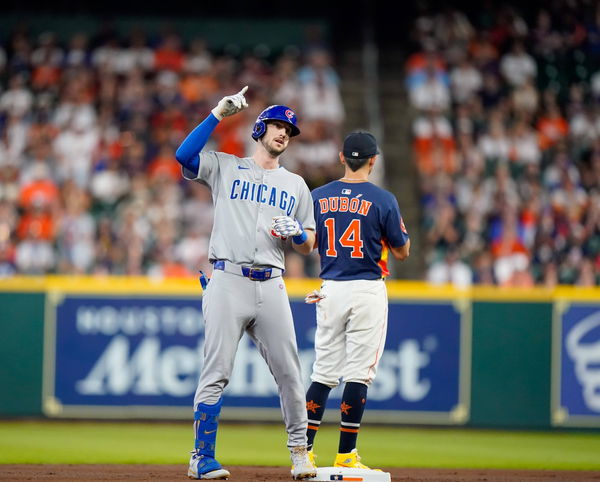
Imago
June 29, 2025, Houston, Texas, U.S.A: June 29, 2025 Houston, Texas ,U.S.A -Chicago Cubs outfielder Kyle Tucker (30) reacts after a hit during the game between the Chicago Cubs and the Houston Astros at Daikin Park in Houston, Texas. The Houston Astros defeated the Chicago Cubs 2-0. Houston U.S.A – ZUMAh146 20250629_aap_h146_014 Copyright: xJeromexHicksx
That cooling market strengthened Toronto’s position, aligning opportunity with urgency inside a clear win-now window. Unlike rivals, the Blue Jays retained flexibility and motivation after recent playoff success runs. Reports indicated Toronto considered short-term offers like 2 years, 86 million, with options attached potentially.
Such structures reduce long-term risk while improving the odds of Toronto landing an elite bat this offseason.
On the field, Kyle Tucker produced a .266 average with 22 homers, 25 doubles, and 73 RBI. Those numbers came across 136 games, reinforcing his consistency despite missing time late last season. Defensively, metrics like Outs Above Average still rated him among baseball’s strongest outfielders overall annually.
For Toronto, adding that profile balances the lineup and meaningfully raises championship probability going forward.
The market blinked first, and now the Toronto Blue Jays are holding leverage quietly. Kyle Tucker no longer dictates terms, which should make Ross Atkins stop waiting around. If Toronto hesitates now, someone else will steal Tucker while accounting departments applaud politely.
If the Jays miss Kyle Tucker, they have a backup plan in Cody Bellinger
Toronto isn’t bluffing this winter, and it isn’t panicking either. The Blue Jays know exactly where the market is headed, even if the noise says otherwise. Kyle Tucker is the shiny prize, sure. But there’s a reason Cody Bellinger keeps hovering in the background, and it’s not because the Jays ran out of ideas.
If Toronto misses Kyle Tucker, Cody Bellinger profiles as more than contingency within roster planning. Projected contracts explain why Tucker is near ten years and $350 million, and Bellinger is under $200 million. Those terms match recent front office behavior after committing $277 million to pitching upgrades this winter.
The difference is flexibility, not talent, because both players anchor lineups without forcing decade-long risks.
On the field, Cody Bellinger delivered .272 with 29 homers, 98 RBI, and 5.1 bWAR season. That production came across 152 games, supporting durability expectations for a club chasing margins daily. Defensively, his metrics show separation, with nine DRS, seven OAA, and a career 3.2 dWAR total.
Those numbers contrast with Tucker’s zero DRS and minus two OAA, reinforcing fit beyond box scores.
Roster construction matters here, since Bellinger covers all outfield spots and first base reliably and consistently. That versatility protects depth across a long season and reduces pressure on daily matchups decisions. Combined with friendlier contract projections, the fit aligns performance, payroll, and competitive timelines for Toronto.
If Kyle Tucker slips away, the Toronto Blue Jays still control leverage, not desperation here. Cody Bellinger represents intent with restraint, a move that pressures rivals and budgets alike. Toronto choosing Bellinger over Tucker would signal planning wins seasons, not headlines, eventually anyway.
