
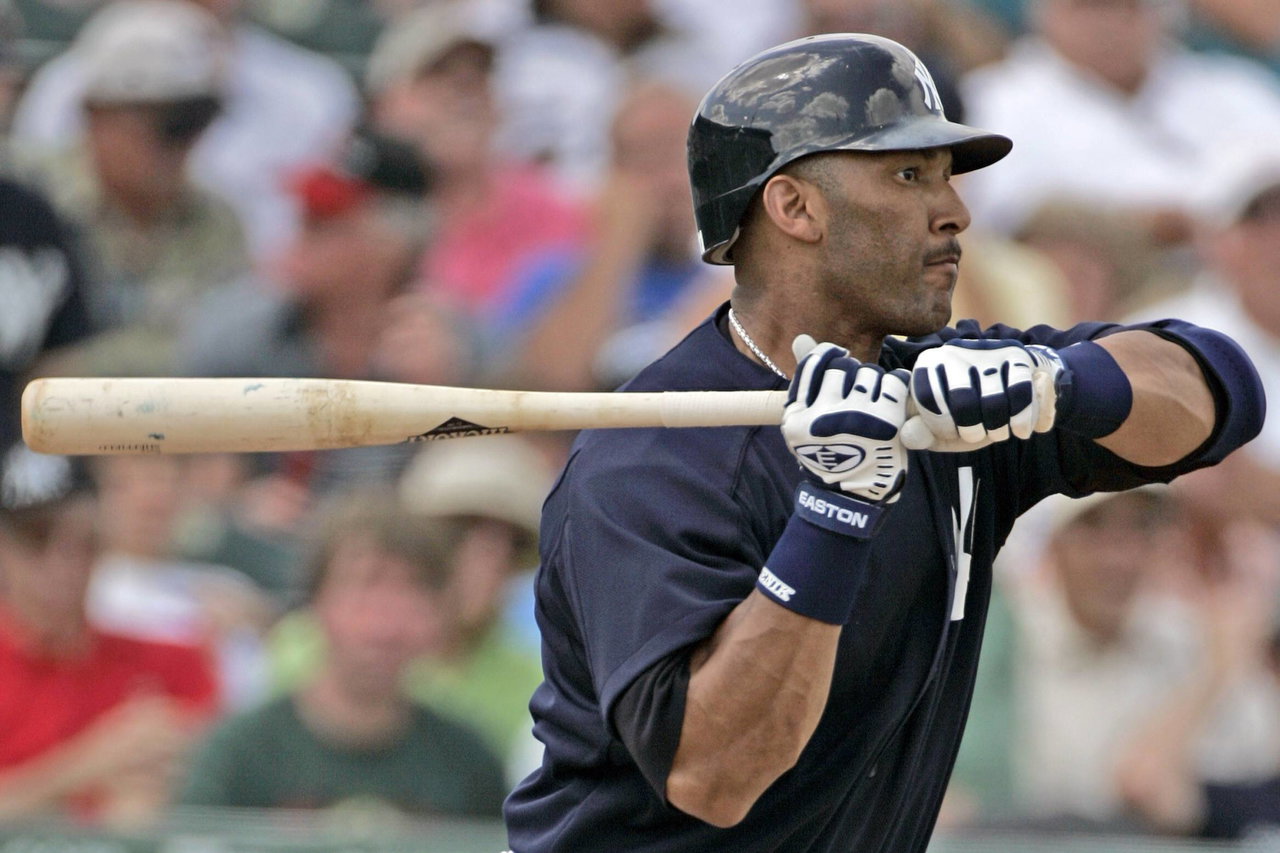
Life has a brutal way of making old problems look small. One day, you are a kid convinced one game means everything. Decades later, you are back in the same place carrying an entire career behind you. That was Gary Sheffield on Sunday. Long before his violent bat waggle became one of baseball’s most recognizable sights, he was just another kid trying to make it out of Tampa. The MLB legend returned to Williamsport for the Little League World Series, and one ceremonial first pitch was enough to drag him straight back to where it all began.
Watch What’s Trending Now!
“When I went out there and put that baseball in my hand and had to throw the first pitch, I had the jitterbugs a little bit. I was like, oh boy, everything hit me at once. I became that 11-year-old kid again,” said Gary Sheffield, per Adam McCalvy on X. “It was like being back in Williamsport. Man, my life came back in full circle in one moment”
Forty-six years ago, Sheffield was not an MLB star or a 500-home-run slugger. He was just an 11-year-old kid in Williamsport, trying to beat Taiwan in the 1980 Little League World Series. He represented Belmont Heights alongside future big-leaguer Derek Bell, long before either of them knew how far baseball would actually take them.
“Every time I played games in the big leagues, and I was going through rough times, the first thing I would think about was the Little League World Series”.
Growing up in Tampa, Sheffield did not exactly see a clear road ahead. He later admitted, “I didn’t see a way out,” which says plenty about how limited life felt at the time. Then baseball changed the map. At 11 years old, the game put him on an airplane for the first time and carried him all the way to Williamsport, Pennsylvania, for the Little League World Series.
Williamsport felt bigger than anything Sheffield had known. The 1980 Little League World Series had only eight teams, but to an 11-year-old, Lamade Stadium, the dorms, the practice fields, and the crowds made it feel enormous.
Sheffield remembered walking down the hill from the dorms and watching teams from completely different parts of the world prepare to play. Taiwan, in particular, left an impression.
He later said Belmont Heights was “petrified” watching them take batting practice because of how dominant they looked. Sheffield’s team had already cruised past Rhode Island 20-3 and Washington 16-0, but Taiwan proved to be a different challenge and won the championship game, 4-3.
However, Sheffield’s temper created problems the following year. After skipping practice and then being benched, he chased his coach with a bat and was suspended for the entire season.
Sheffield expressed similar emotions when he returned to Williamsport and threw a ceremonial first pitch during the LLWS on August 26, 2015.
“[Being here] took me back to when I was 11 years old, and what I was thinking at that time and how my life got to this point. It started here. When I look back at that, all of it comes full circle; you kind of see how your life played out in a picture frame. Now, when I see these kids, I’m more appreciative,” he said at the time, per MLB.com.
After the first pitch, Sheffield watched two of his former teams, the Brewers and Braves, meet in the Little League Classic. Milwaukee gave him his first MLB shot at 19. Decades later, he was back in Williamsport watching where his pro career began collide with where baseball first changed his life.
“I was just wishing we could have had something like this when we were playing. To be able to play in the World Series, the Little League World Series, and then come out here and play here. It was amazing, remarked Sheffield.
“And then when I saw that it was the Atlanta Braves and the Milwaukee Brewers, I’d say this is really a full-circle moment for me.”
Sheffield played for the Braves for two seasons, in 2002 and 2003. Acquired from the Los Angeles Dodgers, he batted .319 with 64 home runs, 216 RBIs, and 208 runs scored across 290 games. He also helped Atlanta reach the playoffs in both seasons.
While Sheffield played the first four seasons of his 22-year-long career for the Brewers. But it was not a cakewalk.
Gary Sheffield and his relationship with the Brewers
When Brewers vice president Al Goldis scouted him, he called Sheffield the best hitter he had ever scouted. Sheffield was 17 years old at the time and went to Helena to join their rookie-level team. It took him two years in the system to grow into a major leaguer.
The hype around Sheffield was enormous, and Milwaukee expected him to look like a star almost immediately.
After hitting nine homers with 54 RBIs in just 57 games at Triple-A Denver in 1988, the Brewers called him up and started him at shortstop for the final 23 games.
By 1989, he was being billed as the American League’s best prospect in 15 years and a Rookie of the Year favorite.
Then reality hit. Sheffield struggled badly in the field, led the Brewers in errors, and Milwaukee sent its supposed future star right back to Denver.
Things got uglier from there.
In Denver, Sheffield learned that the foot pain Milwaukee had initially dismissed as a bone bruise was actually a fracture, and that misdiagnosis appears to have cracked his trust in the organization.
When he returned in September, Bill Spiers had taken over at shortstop, and Sheffield was pushed to third base. He did not hide how he felt about it. By then, Sheffield believed the Brewers were mishandling him, and the resentment was starting to boil over.
He had reportedly said, “There was a lot of pressure put on me last season (1989). I felt some of it was because of racism. Racism is everywhere. Some guys just hide it better than others.”
By 1991, the relationship was basically poisoned. Sheffield hated Milwaukee’s decision to trade Dave Parker and openly accused the front office of ruining the team. His own season was a mess too. He hit just .194 with a .597 OPS while dealing with shoulder and wrist problems that eventually required surgery. At that point, the Brewers were not just losing games. They were losing Sheffield.
Gary Sheffield said that about Milwaukee Brewers general manager Harry Dalton in 1991. “Harry knows how I feel. Harry knows I don’t like him. I don’t care for him and never will. Like I told him before, my respect is done for him. I don’t really care what he does or says to me.”
After the 1991 season, the Brewers traded him to the San Diego Padres on March 26, 1992.
San Diego Bet on Sheffield and Milwaukee Paid the Price
Sheffield arrived with shoulder surgery behind him, controversy everywhere, and four ugly years in Milwaukee. The Padres did not care.
GM Joe McIlvaine had chased him for five years and reportedly made 24 calls to finally get the deal done. After 23 years of instability at third base, San Diego was convinced Sheffield was worth the headache.
“That’s why it was a tough trade for us to make,” McIlvaine said. “We’re giving up three young players, but we’re getting a third baseman that will make us one of the best infields in the National League. I’ll match up our infield with anyone’s.”
Sheffield was even happier to be there. He made no attempt to hide how badly he had wanted out of Milwaukee.
“I’ve done a lot of things out of anger, just so they would trade me,” Sheffield admitted. “After my rookie year, I knew I would never feel comfortable in Milwaukee. That’s why I can’t stop smiling now. It’s over. I can start fresh again.” He then added, “This is the best thing that could happen to me. Believe me, man, it’s been a long four years.”
Even after the ugly Milwaukee breakup, Brewers scouting director Al Goldis still called Sheffield one of the best hitters he had ever seen. “Will he ever live up to his potential? That’s up to him,” Goldis said. The problem was whether Sheffield could finally get out of his own way. Goldis believed the tools were there for him to become the best third baseman in baseball.
The Padres were willing to adjust the lineup around him, and even established stars like Tony Gwynn were part of that conversation. Fred McGriff also believed the noise around Sheffield was overblown and that the simplest solution was to let him play.
Then Sheffield made Milwaukee look even worse. In 1992, he hit .330 with 33 home runs and 100 RBIs, won the National League batting title, made the All-Star team, earned a Silver Slugger and finished third in MVP voting. One year after hitting .194 for the Brewers, he was suddenly one of the best hitters in baseball. San Diego did not fix Sheffield. It gave him room, and he exploded.