
Less than two weeks before the CBA expires, the MLBPA still calls a salary cap a nonstarter. The Los Angeles Dodgers’ $523 million tax-adjusted payroll dwarfs the Cleveland Guardians’ $74 million, a gap that MLB Commissioner Rob Manfred now treats as the core of the labor fight.
Watch What’s Trending Now!
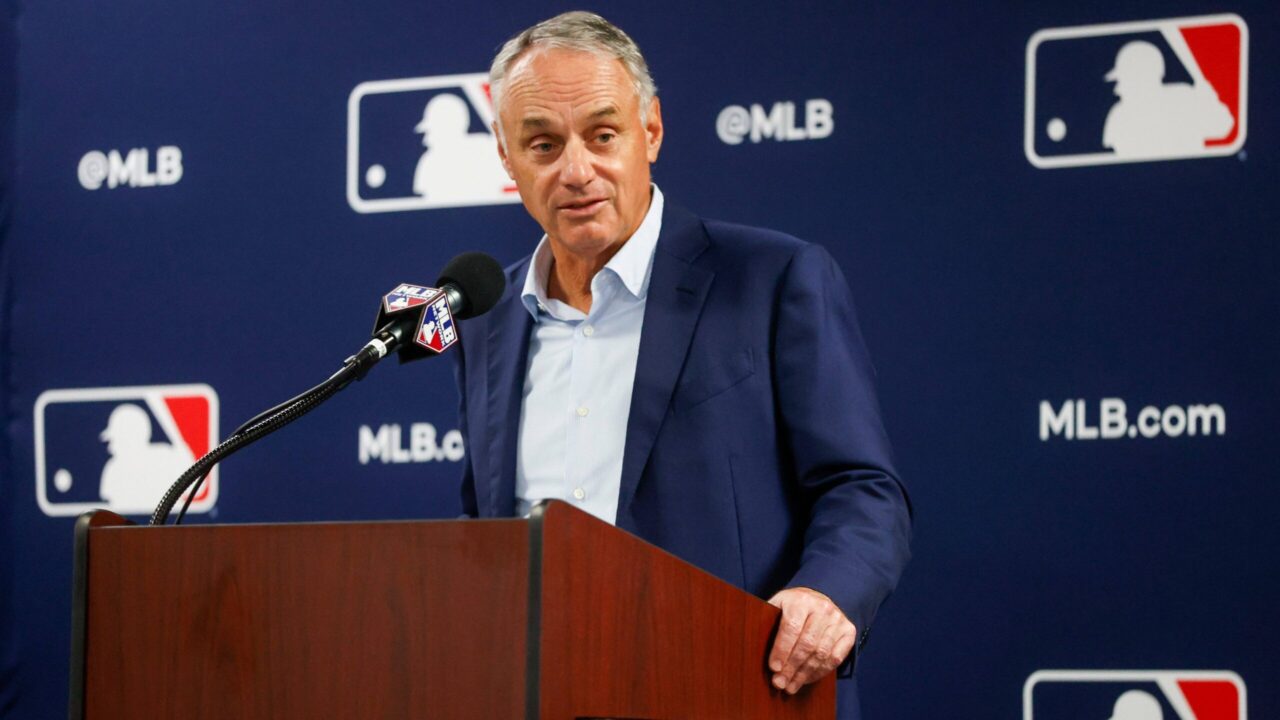
“There’s plenty of room for compromise, but there’s one thing that I will not compromise, and that’s the issue that we’re hearing from the vast majority of our fans. They want a salary cap and floor, and on that, we will not compromise,” Manfred said on Nov. 18, the second day of the owners’ meetings.
Manfred claimed 70 percent of fans back a cap, and the payroll gap across the league explains why owners are pushing. Using 2026 payrolls, MLB projects 12 clubs would add $636 million to reach the floor, while eight, including the New York Yankees, would cut $528 million. That pressure was aimed squarely at the players.
“We made the proposal way back in May. Another word for ‘nonstarter’ over months is a refusal to bargain,” Manfred said at the same news conference, responding to the Major League Baseball Players Association’s stance on the cap.
The union, led by interim executive director Bruce Meyer, rejected the cap outright. Its counter included a competitive integrity tax on clubs below the floor, a higher luxury tax threshold and expanded arbitration rights, yet Manfred said nothing significant followed its opening proposal.
Manfred put the players on notice, but the stance works as a negotiating position built to pressure the union toward compromise, not a final ultimatum on every term. He does not need the MLBPA to accept the plan outright, yet the cap and floor are the one piece he will not trade. Meyer answered soon after.
“There should be no illusions about the owners’ true motivation in pushing for this system. They want to make more money in profits and franchise values by artificially suppressing player salaries,” Meyer wrote in a statement issued shortly after Manfred finished his media session.
That claim rests on accounting. The league pitches an even revenue split with players. The union countered that total pay would shrink since close to $400 million in amateur signing bonuses is left out of the calculation. The MLBPA also took issue with the way clubs calculate what counts as revenue and what gets booked as expenses.
Management proposed a $258.2 million hard cap and a $180.2 million floor for 2028, with 2027 played under current rules. Clubs could dip to $162.18 million in 2028, but must reach the full $180.2 million in spending across a three-year window.
The proposal also reaches into contract terms. Individual contracts would be capped, and owners want a five-year limit on free-agent deals. Those items connect to Meyer’s complaint that the system strips away truly guaranteed contracts, while a $1 million minimum salary for players with two or more years of service favors the players.
Owners also tie the cap to local broadcasts. Morgan Sword, MLB’s executive vice president of baseball economics and operations, presented the system as the best route to equal sharing of local media revenue and an end to blackouts. According to the MLBPA, the league could resolve local blackouts on its own without tying the fix to a payroll ceiling. With neither side budging, the calendar becomes the bigger factor.
“A decision on a lockout is one that we’re going to make at the last possible moment,” Manfred told reporters in New York. He sat on ownership’s side of the table as a young attorney during the 1994 talks.
That moment arrives late on December 1, when the five-year CBA expires. Ownership is widely expected to shut the doors once the deal lapses, which would mark the league’s tenth stoppage over the last 54 years. All trades, signings, and contracts with 40-man roster players would freeze. Baseball has been here before.
The last formal cap proposal came in 1994, and players struck on August 12. That 232-day walkout erased the final weeks of the 1994 schedule and left October without a Fall Classic for the first time in 90 years.
A federal injunction ended that strike in April 1995, and owners dropped the cap. A luxury tax arrived in 1997, and the modern version now taxes overages at 20 percent in year one, 30 percent in year two, and 50 percent after three straight years. There is still no payroll floor.
The 2021-22 lockout lasted 99 days and ended with a fourth tax surcharge tier rather than a cap. This standoff could stretch similarly long, and no deal by mid-to-late February would put the March 24-25 Opening Day at risk.
Hockey shows how far a cap fight can go. The NHL lost the entire 2004-05 season before owners got the hard cap they wanted, the first time a major North American league lost a full year to labor.
That history is why the next two weeks matter so much for baseball. Players are paid only during the season, so lower-salaried players would feel a long freeze first, and the December 1 deadline will show whether either side moves toward the middle or the sport heads into another winter without trades or signings.