
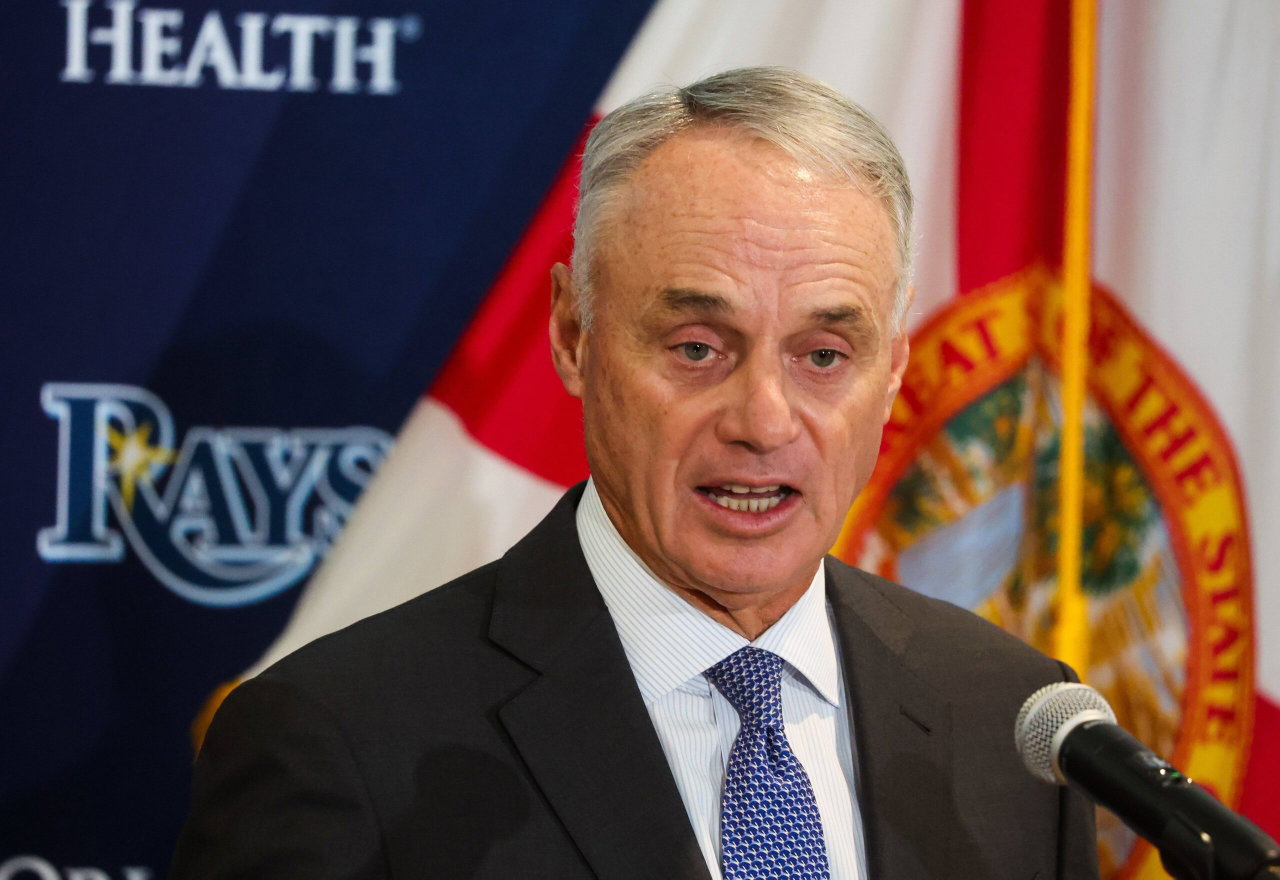
Rob Manfred’s leadership is facing another challenge, and a former MLB pro is making sure his concerns are heard. With baseball approaching a possible labor shutdown, Jeff Frye has questioned the commissioner’s priorities. His latest comments suggest the growing disagreement between players and owners extends far beyond the next collective bargaining agreement.
Watch What’s Trending Now!
“This guy disgusts me! Rob Manfred doesn’t care about our National Pastime folks,” said former player Jeff Frye.
Jeff Frye has taken another shot at Rob Manfred, questioning whose interests guide baseball’s commissioner. With another labor fight approaching, the former MLB infielder believes Manfred increasingly sides with owners. Frye’s November 19 message challenged the salary cap, rulemaking power, gambling partnerships, and leadership.
He added, “His sole purpose is to make his bosses money!” Frye also warned, “I am fearful that the 2027 MLB season is in jeopardy.”
That fear has grown after Manfred made the owners’ salary-cap demand impossible to miss.
“The owners want a deal with a salary cap and floor,” Manfred said.
The current agreement expires December 1, and a lockout could begin December 2. Such a stoppage would freeze signings, trades, and player-team contact during the offseason. Frye urged the union to hold strong.
“I hope that the MLBPA holds their ground and doesn’t cave.”
Players have repeatedly rejected a hard cap, calling it unacceptable for their future earnings.
The proposal feels harder to understand as MLB reports record revenue of $12.9 billion. Manfred still insists a cap is necessary, arguing spending gaps hurt competitive balance. The latest proposal sets a $258.2 million cap and $180.2 million floor for 2028. It also includes five-year contract limits and changes to how baseball revenue gets shared.
Frye also wrote, “The owners don’t need a salary cap; they just want one! If the game is thriving like everyone says, why do they need a salary cap?”
Revenue sharing adds another layer because receiving clubs already face rules governing that money. The current agreement requires those teams to direct funds toward improving on-field performance. Eligible spending includes player payroll, scouting, development, and other costs tied to competitiveness. The commissioner can demand plans or withhold funds when clubs fail those requirements.
Yet the current agreement leaves a gap. The agreement does not set a fixed payroll every receiving club must meet. That leaves fans asking whether owners turn shared revenue into better teams.
The proposed system could force major payroll changes across baseball, not simply raise spending. Based on 2026 payrolls, 12 clubs would need to add $636 million combined. Meanwhile, 8 other clubs would need to cut approximately $528 million combined. MLB says its plan would create balance and guarantee players half of defined revenue. The union disputes the league’s calculations and says restrictions would reduce player compensation. It also fears contract limits would weaken players’ ability to negotiate freely.
Frye’s criticism reaches beyond money, especially when considering players’ influence over rule changes. The Joint Competition Committee has 6 MLB-appointed representatives, four active players, and one umpire. That structure gives league-appointed representatives a majority when voting on playing-rule changes. The committee has handled decisions involving the pitch clock, larger bases, and defensive shifts.
Frye made his position clear.
“The Executive Committee on rule changes needs to have an equal number on both sides.”
He also questioned why owners hold more seats than players.
His concerns about Manfred also reach the league’s expanding relationships with gambling companies. Frye previously criticized those partnerships after a high-scoring Brewers-Athletics game this summer. The Brewers won 15-14 in 12 innings, with 11 home runs between the teams. Frye had earlier criticised Manfred’s gambling ties in a public post.
“Sadly Rob Manfred and his gambling buddies have turned the @MLB into the @WWE.” He described the league’s presentation as “flashing lights and all the glitz and glamour!” A survey by The Athletic from August 2026 found that 81 of 100 players had faced bettor confrontations.
The contrast has become difficult to ignore as MLB promotes betting while players face consequences. The league has explored prediction-market partnerships, while restricting players from betting on baseball. After the 2018 Supreme Court ruling, states could legalize sports betting. The union has pushed back against player props because of bettor harassment.
Frye demanded “an unbiased commissioner” focused on “growing the game and restoring its integrity.” “Bye bye to the gambling partnerships!” His latest attack connects labor, rulemaking, and betting before negotiations reach their deadline.