
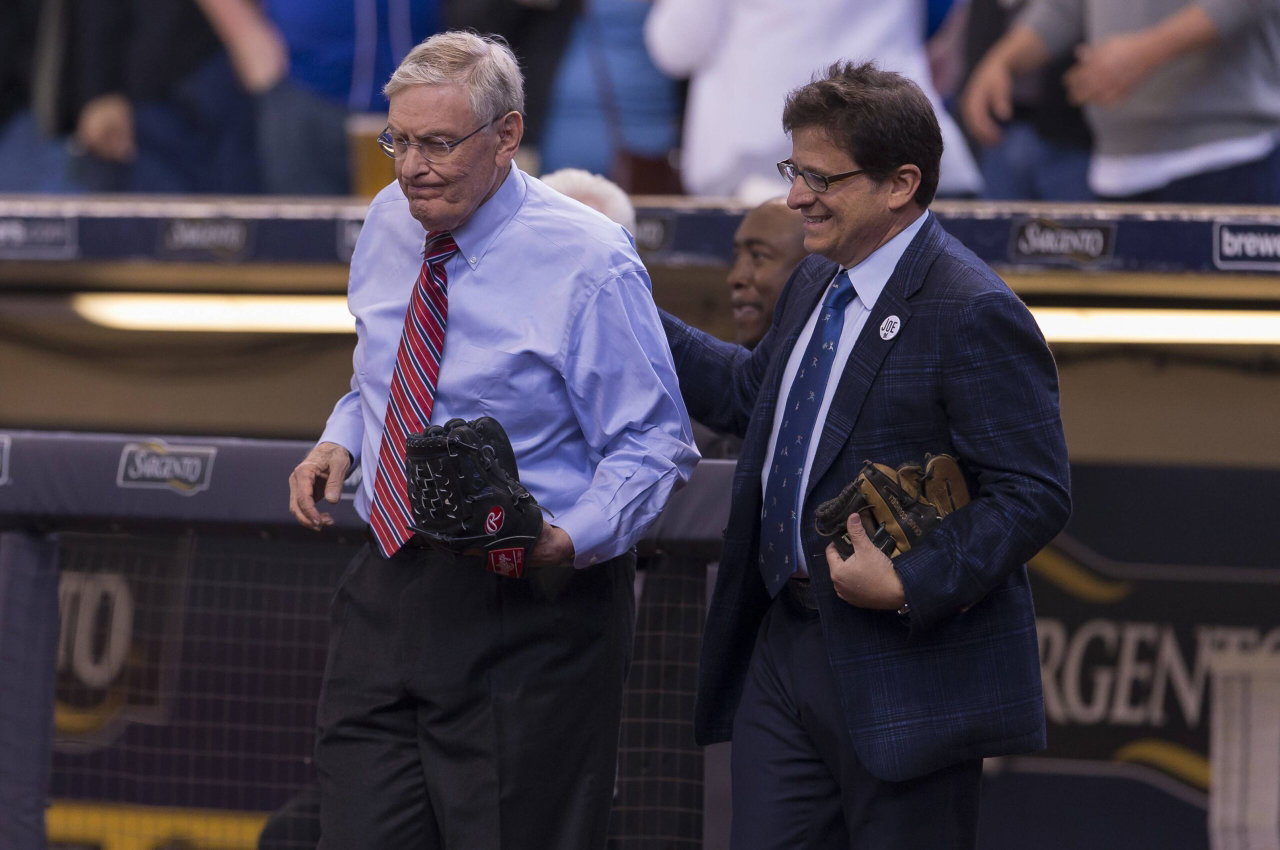
For years, the Los Angeles Dodgers have faced accusations that their financial dominance has ruined baseball. But the Milwaukee Brewers’ 2026 World Series triumph just gave MLB a powerful counterargument, proving that a smaller-market franchise with one of the league’s lowest payrolls can reach the sport’s ultimate summit. Yet, the celebration of Milwaukee’s historic breakthrough comes with an uncomfortable reminder that former MLB commissioner and Brewers owner Bud Selig believes baseball cannot afford to ignore.
Watch What’s Trending Now!
While the Brewers needed 44 years to return to the World Series after their 1982 appearance, the Dodgers made six trips to the Fall Classic during the same period. For Selig, that contrast goes beyond the magic of an underdog story. It exposes the financial imbalance shaping MLB’s competitive landscape and reignites the debate over whether a salary cap is necessary to prevent baseball’s richest franchises from enjoying a lasting advantage.
“Would you really make that conclusion after (the) 44 years it took to win?” Selig said via Dodgersblue. “The Dodgers have spent money, like my favorite term: drunken sailor. I understand people can disagree, but I believe (a cap is) the right thing. But that’s for another day.”
While the Dodgers’ historic payroll collapsed in the 2026 postseason, their immense economic power is precisely what fueled their era of dominance, culminating in back-to-back World Series championships in 2024 and 2025 and a historic streak of 14 consecutive postseason appearances.
The most visible benefit of the Dodgers’ wealth is their ability to sign the sport’s most coveted, franchise-altering talents without compromising their ability to pursue other high-end free agents. Their financial muscle allowed them to sign global icon Shohei Ohtani to a historic $700 million contract, followed immediately by securing Japanese ace Yoshinobu Yamamoto for $325 million.
Combined with pre-existing mega-deals for Mookie Betts and Freddie Freeman, the Dodgers routinely fielded up to six players earning over $20 million per season simultaneously, a luxury smaller-market clubs like the Brewers cannot replicate.
The postseason is unpredictable, but financial dominance guarantees one thing: more chances to win. Top-five payroll teams made the playoffs 52.5% of the time between 2010 and 2026, compared to 27.1% for bottom-half teams.
The Dodgers led that group of top-five teams.
However, it all boomeranged in 2026. Seeking a third consecutive title after championship runs in 2024 and 2025, the Dodgers doubled down ahead of the 2026 season by signing outfielder Kyle Tucker to a massive four-year, $240 million contract and closer Edwin Díaz for three years and $69 million.
Yet, they were shockingly swept in the NLCS by the Brewers. Tucker heavily underperformed, batting just .233 with 17 home runs, generating jeers from home fans and mid-season benching. Díaz battled first-half injuries and a string of blown saves in the second half.
The Dodgers’ “buy now, pay later” approach, deferring massive sums of money to lower their immediate luxury tax hit, made things worse. The deferred portions of contracts for Ohtani, Mookie Betts, Freddie Freeman, Blake Snell, and Kyle Tucker carry more than $1.06 billion in guaranteed salary obligations stretching through 2047.
Mark Walter’s sudden legal turmoil is steadily making this 2.1 billion a looming threat for the Dodgers.
Walter’s legal turmoil is posing a greater threat to the Dodgers
Mark Walter faces DOJ and SEC scrutiny over alleged undisclosed multi-billion-dollar related-party loans tied to life insurance companies. Still, the Dodgers front office has confirmed that it is “business as usual” as they prepare for the 2027 season.
Yet, Walter’s latest moves, including offloading his stakes from the LA Lakers and Chelsea FC, sparked concerns in MLB about his future with the Dodgers. It is also reported that he is exploring a sale of the WNBA’s Los Angeles Sparks.
So, the Dodgers may still stay dominant in this offseason, but a longstanding legal battle could prove heavy for Walter to manage the outstanding $2.1 billion payment.
Legal turmoil and an upset NLCS sweep were what it took to pose a threat to MLB’s one of the leading franchises. Per Selig, a salary cap would thus not only help the small-market team, but considering the Dodgers’ current situation, it could also help them to regulate their spending.