
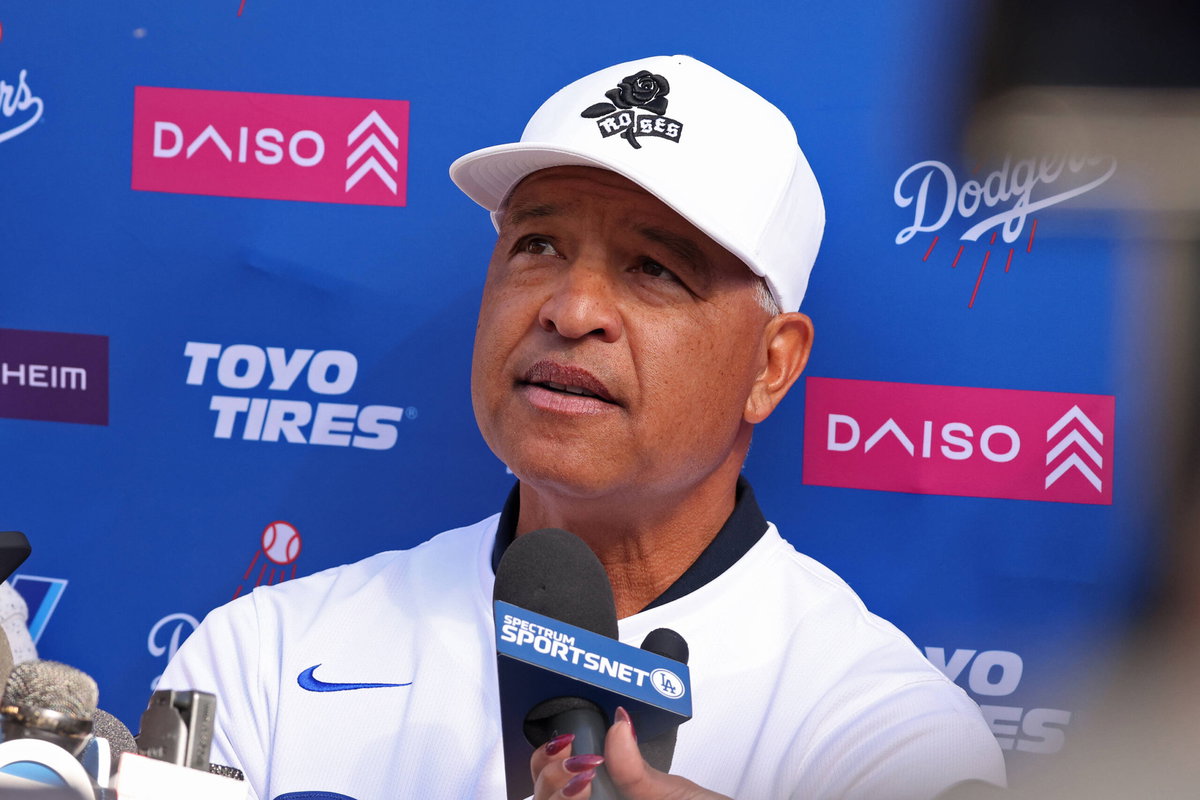
Dave Roberts has played alongside baseball’s greatest hitter. Now he’s saying he’s never seen a greater player. Barry Bonds may still be baseball’s ultimate hitting machine, but Shohei Ohtani brings something to the table that even the greatest sluggers cannot match. His .275 batting average and limited appearances on the mound this season may fall short of his usual standards. Yet Dave Roberts’ faith in the Japanese superstar remains unwavering. The Los Angeles Dodgers manager has once again been asked to choose between Bonds and Ohtani. And his answer reinforces what makes the two-way sensation so extraordinary.
Watch What’s Trending Now!
While Bonds’ legendary power and 162.8 career WAR as a position player speak for themselves, Roberts believes Ohtani’s ability to dominate both at the plate and on the mound gives him an edge that goes beyond hitting alone.
“I’m telling you, Barry is the greatest position player I ever played with. Barry Bonds. No one can do what he could do in the batter’s box, for me. But as far as the greatest player I’ve ever seen, it’s by far Shohei,” Josh Chambers quoted Roberts via the 6.1.1 podcast.
Bonds is still difficult to beat in terms of core hitting stats. Between 2001 and 2004, Bonds produced the four most dominant hitting seasons ever recorded. He set single-season records with 73 home runs, 232 walks, and a .609 on-base percentage.
Even before his historic power surge in his late 30s, Bonds was an elite all-around outfielder. He remains the only player in MLB history to join the 500-home-run, 500-stolen-base club, and he leads all position players in career WAR at 162.8. Moreover, he holds the all-time records for career home runs (762) and walks (2,558).
By contrast, Ohtani does what no modern player has ever done by performing as both an MVP-level slugger and a frontline starting pitcher. As Roberts, who played with Bonds, noted, Bonds is the greatest hitter ever, but Ohtani’s two-way ability makes him the greatest overall player.
In 2024, Ohtani became the first player in history to hit 50 home runs and steal 50 bases in a single season. In 2025, he returned to the mound while hitting 55 home runs, capturing his fourth unanimous MVP award, the most unanimous wins in baseball history.
Per Roberts, the biggest and most recent differential event for Ohtani was his performance against the Milwaukee Brewers during the 2025 postseason. “Case in point, that postseason game against the Brewers last year, that’s just something that’s never been. You could argue that that’s the greatest game of all time. But it’s interesting, there’s nobody that could move the needle in baseball, period, until Shohei came. He’s moved the needle in baseball.”
In the 2025 NLCS Game 4, Ohtani pitched 6.0 shutout innings on 100 pitches, allowing only two hits and three walks while striking out 10 batters. He touched 100 mph with his fastball early, striking out the side in the first inning after issuing a leadoff walk. Batting out of the leadoff spot, he went 3-for-3 with a walk, three solo home runs, three RBIs, and three runs scored.
Shohei Ohtani became the first player in MLB history to strike out 10 or more batters and hit 3 home runs in a single game.
“The pitching and hitting have been outstanding … he’s a complete player,” Bonds said about Ohtani last year. “There’s no doubt about the type of player he is and what he’s accomplished in his career; the game has just changed.” So, when the greatest hitter of all time is acknowledging Ohtani, the debate got its answer.
However, Shohei Ohtani’s heavy two-way workload may be taking over him. It triggered a chain reaction of non-structural injuries that shut down his pitching in July and severely derailed his hitting down the stretch. Ohtani opened the year on a Cy Young-caliber pace, posting a 0.74 ERA across his first 10 starts while simultaneously anchoring the Dodgers’ lineup.
But pitching and hitting on a compromised lead leg altered his mechanics and spiked his ERA to 4.38 over his next four outings. Playing through pain ruined Ohtani’s timing at the plate.
Over his final 18 regular-season games, he batted just .157 with zero home runs. His full-season offensive numbers dipped to 30 home runs and an .889 OPS, well below his MVP standards. Two-way dominance is what made Ohtani unique in baseball, but it shouldn’t be the reason for his premature exit.