
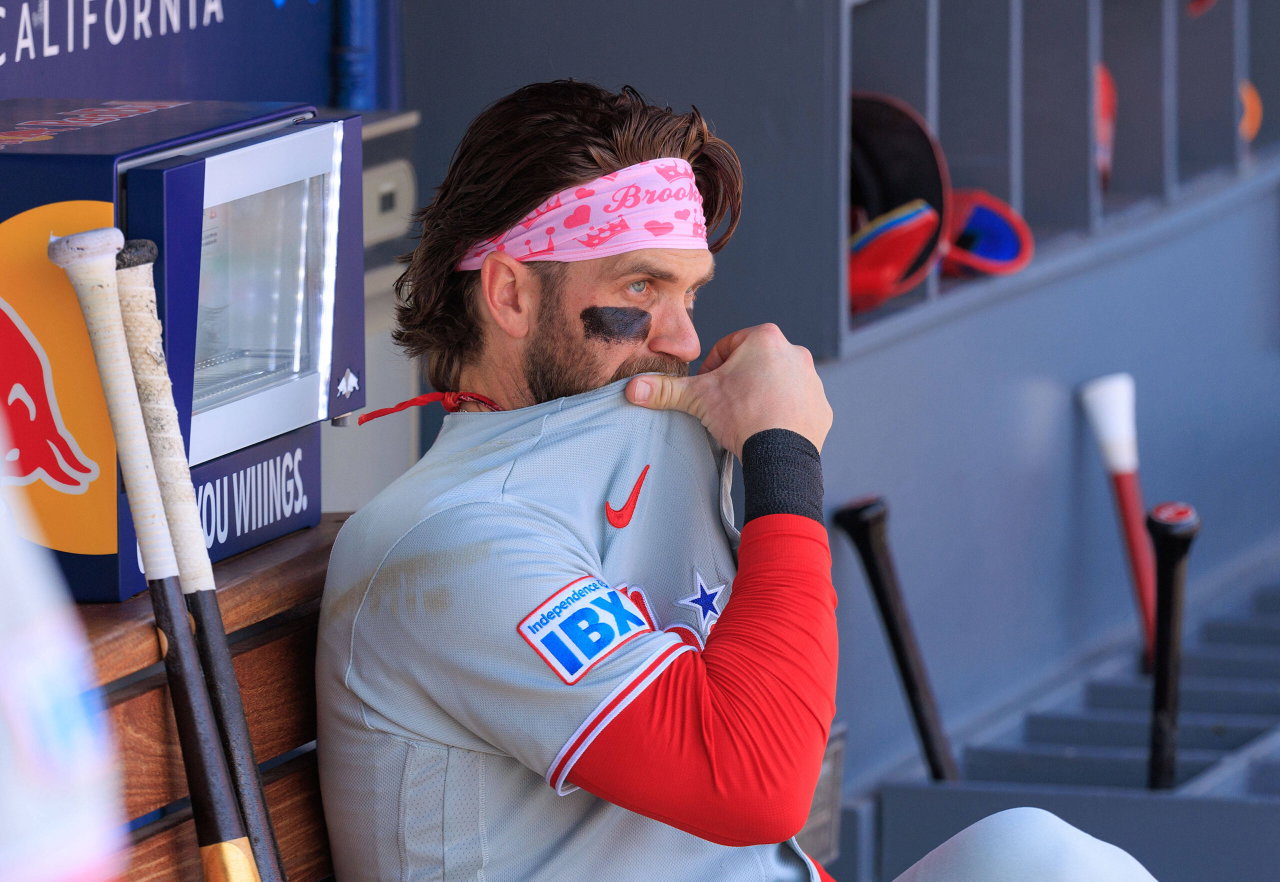
In November 2024, Terry Thompson’s phone brought him a Thanksgiving message from someone he had never known personally. It was Bryce Harper, looking into the camera, addressing Thompson by name and even sending a hello to his young son.
Watch What’s Trending Now!
Now, the Phillies star wasn’t personally acquainted with Thompson. Harper had recorded the roughly 20-second message through Cameo, a platform where celebrities make personalized videos for fans. But Thompson wasn’t simply another baseball fan who had paid for a greeting. By then, he had wagered millions through FanDuel, earned VIP status and received perks ranging from champagne to Super Bowl tickets. The Harper video was another reward. There was a much darker reason the video would later attract attention.
Thompson had developed a gambling addiction, and by the time Harper’s message reached him, his betting had already cost him heavily. He would eventually say that FanDuel’s VIP treatment kept him gambling as his losses mounted, with his total wagers on the platform eventually reaching $18.5 million. Nearly two years later, that Thanksgiving message has become part of a much larger fight:
“Three Congress members sent a letter to Major League Baseball and its players’ association Monday to prohibit promotional deals with betting operators after Phillies star Bryce Harper was featured in a video for a FanDuel VIP reward customer,” reported CBS Philadelphia on X.
Why this is such a big problem that led Congressmen, U.S. Sen. Richard Bluementhal and U.S. Reps. Paul Tonko and Valerie Foushee, can be understood by looking at the path that led Thompson to that VIP treatment in the first place.
In 2020, he placed his first FanDuel wager on his favorite team, the Philadelphia Eagles. He soon moved into microbetting, rapid in-game wagers on things as small as whether the next play would be a pass or a run. The speed of the bets made it possible to keep wagering throughout a game, quarter and even individual play, and Thompson’s gambling escalated from there.
By 2021, court records say, FanDuel had assigned him a VIP manager, Bryttanni Morgan. Their conversations weren’t limited to betting. Morgan texted Thompson about the Eagles, his family, travel plans and restaurants, while also encouraging him to keep wagering, according to his lawsuit. The relationship became part of the VIP experience Thompson says made him feel valued even as his finances deteriorated.
The perks became increasingly elaborate. In January 2023, Morgan offered Thompson two tickets to Super Bowl LVII in Arizona, along with transportation and access to FanDuel and Sports Illustrated events. FanDuel had also flown Thompson and his son to Super Bowl LVI in California, where they received pregame field access and encountered celebrities including Chris Rock. Other perks included tickets to Eagles, Flyers and Sixers games.
That history makes the Harper video stand out even more. The Philadelphia Inquirer, which obtained the 21-second recording, reported that the message was sent by Thompson’s FanDuel VIP host and carried FanDuel’s logo. Harper told Thompson that he was reaching out at the request of “your host Bryttanni at FanDuel,” who wanted to make his Thanksgiving “extra special.” Harper was not wearing FanDuel merchandise, and there is no evidence that he had an official FanDuel partnership or knew about Thompson’s gambling problems.
The Inquirer also found no other reported example of an active MLB player, let alone a nine-time All-Star and two-time MVP like Harper, recording a personal message for a sportsbook’s VIP customer. Danny Funt, who researched sportsbook VIP programs for his 2026 book Everybody Loses: The Tumultuous Rise of American Sports Gambling, described that distinction as significant. “I’ve never heard of an active player, let alone a former MVP, doing something like this,” Funt said.
That unusual crossover between a baseball superstar and a sportsbook’s highest-value customers is what has now drawn the attention of Congress.
MLB strictly prohibits players from placing bets or encouraging others to do the same, while it allows players to endorse those brands under the current CBA as long as they do not encourage betting. With the current CBA expiring on December 1, the MLBPA had proposed banning player prop bets in the upcoming agreement. And now their proposal from June received extra backing with the letter from the Congressmen.
The distinction is important, however. The MLBPA’s June proposal did not simply seek to ban player prop bets. The union also asked MLB to clarify that players could pursue endorsements and sponsorships from legal sportsbooks, including prediction-market operators. At the same time, it proposed a joint effort with MLB to restrict or eliminate individual-player prop betting, citing concerns over harassment and abuse from disgruntled bettors.
“This incident, however, raises broader concerns that players are not prohibited from such endorsements and highlights a systemic failure rooted in the deep enmeshment between leagues, teams, and sportsbooks. In fact, MLB rules currently allow players to enter endorsement deals with sportsbooks so long as they do not encourage betting on baseball,” read the letter, per CBS.
“Partnerships that do not violate this rule can even use personalized content from players to drive vulnerable fans into debt and addiction. This is a failure that Major League Baseball (MLB) and the Major League Baseball Players Association (MLBPA) must confront directly, especially as both are in the midst of renegotiating their collective bargaining agreement.”
The lawmakers are now pushing the issue beyond player props. Sen. Richard Blumenthal and Reps. Paul Tonko and Valerie Foushee asked MLB and the MLBPA five questions about their policies, including whether the current rules adequately protect fans from predatory VIP programs, whether players should be educated about the consequences of participating in sportsbook promotions and whether the league and union will prohibit players from appearing in personalized sportsbook marketing. They gave both sides until August 24 to respond.
The three lawmakers also sent a separate letter to FanDuel CEO Christian Genetski, calling for the company’s VIP program to be shut down and seeking answers about how it operates. FanDuel, for its part, has said its employees are trained to identify and flag signs of problem gambling and that it continues to strengthen its consumer-protection measures.
The controversy also lands against a much larger change in baseball’s relationship with gambling. Before legalized sports betting expanded across the country, MLB went to court to oppose the repeal of federal restrictions. In a 2012 deposition, then-commissioner Bud Selig described gambling as potentially “the end of your sport” and said he was “appalled” by the prospect of widespread legalization.
That position changed dramatically after the Supreme Court’s 2018 decision struck down the federal law that had largely restricted sports betting to Nevada. MLB entered its first partnership with FanDuel in 2019, and the 2022 CBA subsequently opened the door for MLB players to perform certain promotional work for sportsbooks, provided they did not promote betting on baseball.
The shift has created a strange tension inside the sport. MLB and its players now have commercial relationships with an industry whose products depend heavily on player performances, while the league continues to police gambling because of the threat it poses to the integrity of games. That tension became particularly visible after umpire Pat Hoberg was fired in 2024 for sharing a sportsbook account with a professional poker player who bet on baseball. MLB said there was no evidence Hoberg himself had bet on baseball, but determined that the arrangement created an “appearance of impropriety.”
The issue became even more serious in 2025, when Cleveland Guardians pitchers Emmanuel Clase and Luis L. Ortiz were indicted in an alleged scheme involving bets on specific pitches. Both have pleaded not guilty. MLB and its sportsbook partners subsequently placed a $200 limit on pitch-level markets and removed those wagers from parlays, citing the heightened integrity risks of bets tied to individual, one-off actions.
For Thompson, though, the concern was never only about the bets themselves. His lawsuit alleges that he took out second and third mortgages on his home to fund his gambling before the property eventually went into foreclosure. He also sold shares in an investment company he had operated for two decades. By late February, he says he had wagered his final $10,000 on a DraftKings parlay. His lawsuit puts his total losses at nearly $2 million, while the $18.5 million figure refers to the amount he wagered through FanDuel.
The situation eventually became so severe that Thompson, fearing he could not tell his family about the extent of his financial losses, texted his therapist. His therapist contacted police, who went to his home and intervened when he was at risk of harming himself. Thompson later entered treatment for gambling addiction.
That is also why the Harper video has become more than an unusual celebrity cameo. The question now being asked is not whether Harper personally encouraged Thompson to place a bet, there is no evidence that he did, and Harper has said he did not know the video’s purpose. It is whether a player’s image and personal connection can become part of a sportsbook’s VIP retention strategy without crossing a line that MLB’s current rules do not clearly address. After Thompson mentioned his name in the lawsuit, Harper clarified his stance.
“Had I known FanDuel’s true intent, I would not have made the video,” Harper reportedly stated. “The same is true had I known anything about Terry or his situation, or about any alleged ‘partnership’ between Cameo and FanDuel.”
Harper’s explanation adds another wrinkle to the controversy. He has said the Cameo request came with a short script and that he read it in good faith, believing he was recording a personalized message. He later said he would not have participated had he known FanDuel’s “true intent” or anything about Thompson’s circumstances.
That leaves MLB and the MLBPA facing a question that did not exist in quite this form when the league first began embracing sportsbook partnerships: how much distance is enough between a player and a bettor? A traditional advertisement is easy to identify. A personalized Thanksgiving message sent directly to a sportsbook’s VIP customer is harder to fit into the same box.
And that is where the Harper video has become significant. It did not involve a player telling fans to bet on a Phillies game. It did not involve Harper knowingly endorsing FanDuel. Instead, it exposed a gap between the way baseball’s gambling rules are written and the increasingly personal ways sportsbooks can use the sport’s stars to cultivate their most valuable customers.
With the MLB-MLBPA CBA set to expire on December 1, the issue is arriving at a particularly consequential moment. The union wants stronger restrictions on player prop bets while also seeking clarity over players’ ability to work with legal betting operators. Now Congress wants both sides to explain where they draw the line, and whether that line is enough to protect fans like Thompson.