
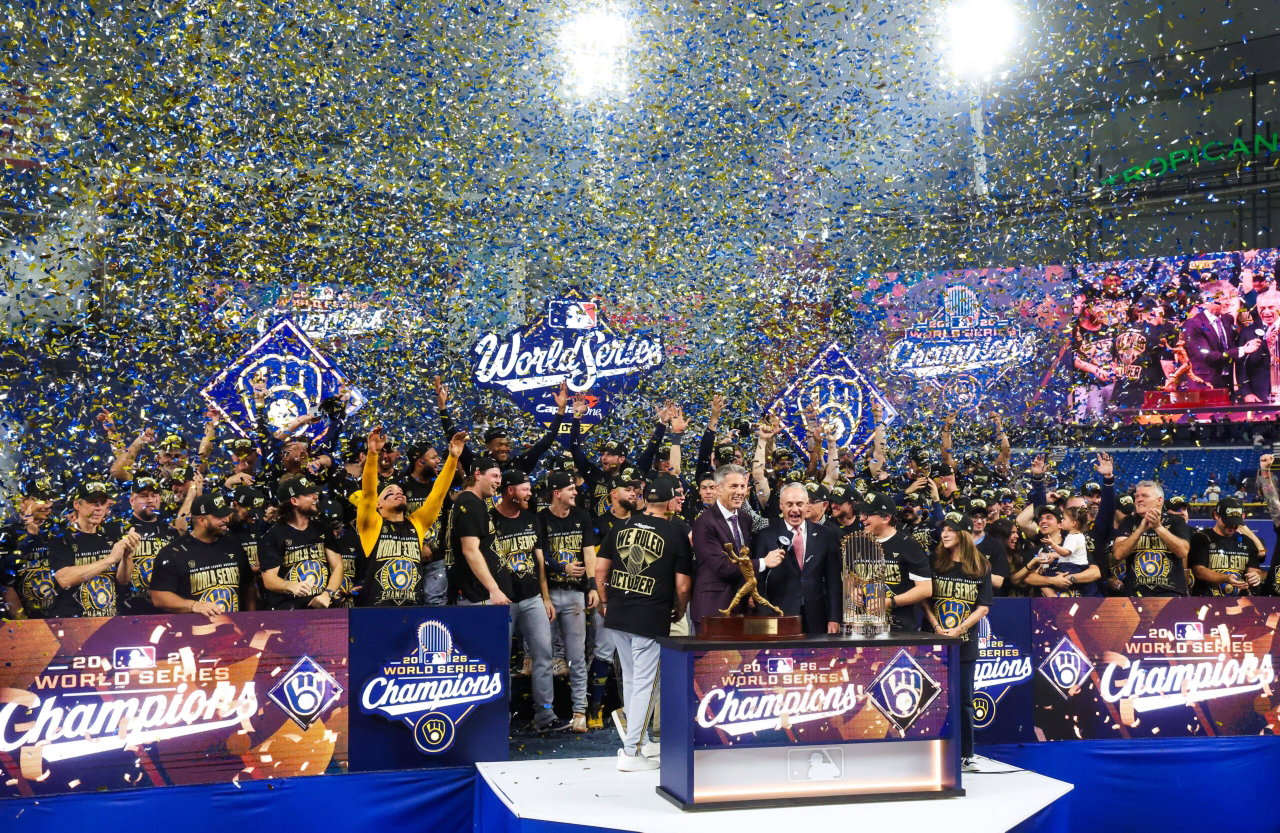
The Milwaukee Brewers won the 2026 World Series without the pitcher who had anchored their rotation for years. The Brewers traded Peralta before 2026. Then lost Bauers and May after winning the championship in 2026, but even with key contributors leaving, Milwaukee’s ability to sustain success has become a talking point across baseball.
Watch What’s Trending Now!
“They’ve lost these dudes… you’re able to sustain losing these dudes and move on and find guys to fill the void… Their philosophy about how they go about their game doesn’t allow them to dwell on the past,” said Cliff Floyd, the host of the MLB Network.
Milwaukee’s pitching depth (3.51 ERA, 2nd-best) anchored the championship. Offensively, they led baseball in hits and were second in walks, not homers, yet scored 832 runs, 2nd-most overall. Despite these departures, the Brewers’ championship victory proved their model could withstand roster turnover.
Peralta’s departure loomed large because he had anchored Milwaukee’s rotation for years. The Brewers traded him to the Mets before 2026, creating another important opening once again. Rather than panic after losing Burnes, Williams, and Adames, the Brewers spread responsibility across young players and new arrivals.
Milwaukee had traded Burnes and Williams and lost Adames in free agency. Rather than find one replacement, the club spread responsibility across young players and new arrivals. Winning the World Series without Peralta showed how well that shared responsibility worked for Milwaukee.
That depth begins with finding players who can improve, rather than buying established reputations. Young hitters stepped up: Chourio emerged as a key bat, Turang drove in 100 runs, and Contreras added 18 homers. No single star carried the load. The Brewers also used 56 players during the regular season, adjusting roles for different matchups. Pat Murphy embraced those changes, sometimes resting veteran Christian Yelich against tough left-handed starters.
After Bauers left for Boston, Murphy said, “I’m excited for Jake, and we move on.” That response reflected a clubhouse willing to accept changing roles while keeping team goals first.
Milwaukee’s offense also shows why home runs are not its only path to scoring. The Brewers ranked 28th with 154 homers, but led baseball with 1,422 total hits. They drew 668 walks, the second-most, and stole 162 bases, creating pressure in different ways. That mix helped Milwaukee score the second-most runs in baseball. Their postseason pitching showed the same collective strength when every October inning mattered most.
Relievers handled 65 of Milwaukee’s 118 postseason innings, posting an excellent 1.38 ERA overall. The Brewers never allowed more than 4 runs in any of their 13 postseason games. Bauers’ departure tests the system: he hit .266 with 26 homers and 3.3 WAR in 2026, up from -0.3 in 2024. Murphy called Bauers “a huge part of that room for the last three years.” Replacing him will be difficult, but Milwaukee’s approach is clear: develop talent and share responsibility.
Players important for the 2027 season for the Brewers
The Milwaukee Brewers enter 2027 with nearly all their championship-winning roster still together today. Jake Bauers signed a four-year deal, while Dustin May agreed to Chicago’s three-year contract. Those departures leave gaps, but Milwaukee still has proven stars and emerging young contributors. Milwaukee won 103 games before beating Tampa Bay 4-1 in the 2026 World Series. Repeating will be difficult, and five returning players could shape Milwaukee’s entire title defense.
Christian Yelich remains important because Milwaukee needs his bat and steady clubhouse leadership daily. He hit .235 with 12 home runs, 59 RBIs in 118 games during 2026. Those numbers leave room for improvement, but his influence reaches beyond the batting line. As captain, Yelich can help younger teammates handle pressure that follows a championship season. His role becomes especially important when losing stretches test the clubhouse’s confidence during 2027.
Cooper Pratt faces a major step, with his first full major-league season now approaching. The 21-year-old hit .281 with 3 home runs and 34 RBIs across 74 games. He stole 19 bases, giving Milwaukee another way to create pressure on opposing defenses. His postseason contribution included 2 RBIs in the title-clinching Game 5 against Tampa Bay. At shortstop, steady defense and continued growth could make Pratt more valuable in 2027.
William Contreras gives Milwaukee another proven contributor after winning 2026 World Series MVP honors. He hit .373 with 3 home runs and 9 RBIs across 13 postseason games. His work behind the plate disrupted Tampa Bay’s running game during the championship series. Jacob Misiorowski offers an advantage, giving the Brewers an ace at the rotation’s front. He went 16-5 with a 1.80 ERA and 252 strikeouts across 174⅔ innings overall.
Misiorowski gave Milwaukee 5.2 scoreless innings in its title-clinching Game 5 against Tampa Bay. Brice Turang praised him, saying, “He’s been a great teammate,” after his remarkable season. Jackson Chourio gives Milwaukee another major weapon after hitting .291 with 25 home runs. He added 75 RBIs and 23 stolen bases across 127 games, proving his value. At 22, Chourio’s continued growth could help Milwaukee challenge again and defend its championship.