
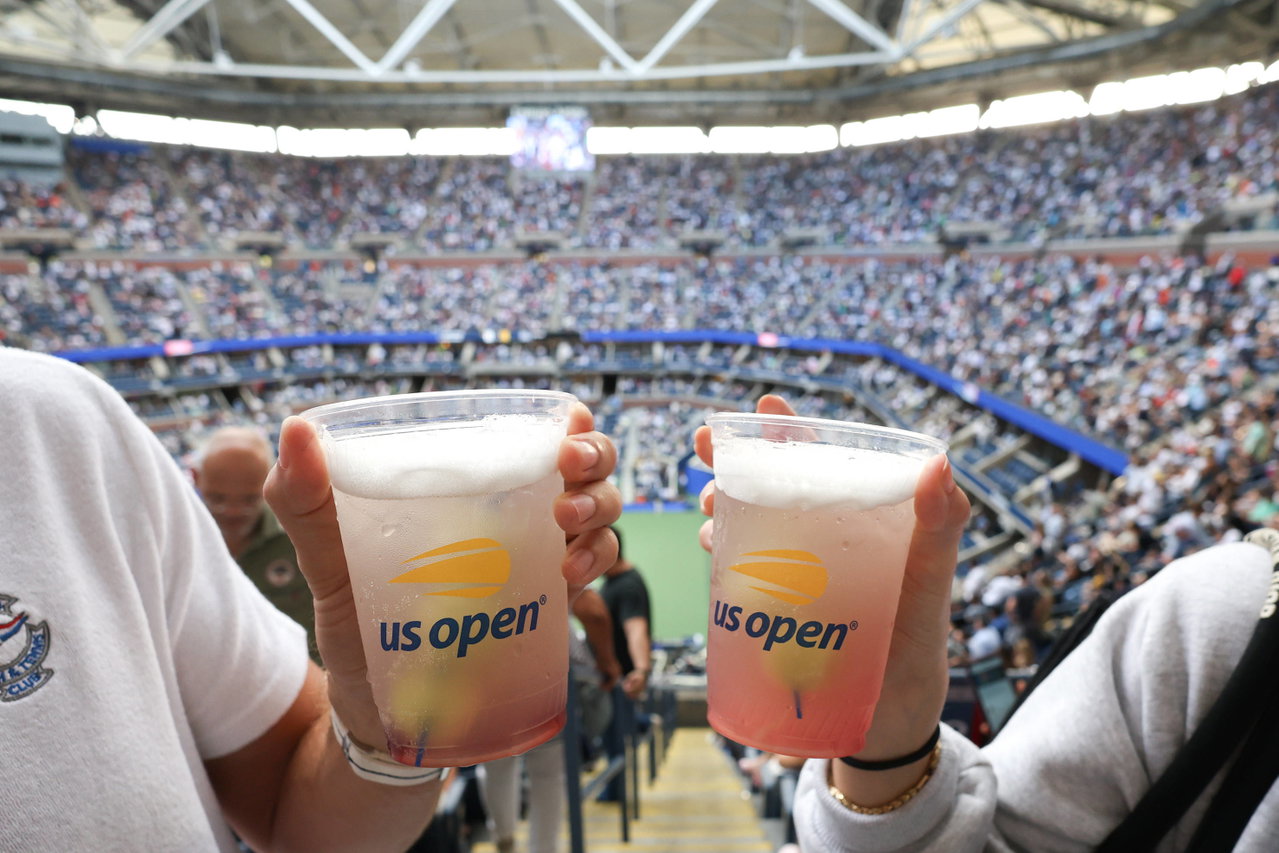
The US Tennis Association (USTA) took a simple 3-ingredient drink and turned it into one of the most profitable concession items in the sports world. The US Open’s 2025 financial numbers reveal a staggering $637.9 million in total event revenue and $313.3 million in operating profit. But the real showstopper wasn’t on the court. The $23 Honey Deuce cocktail stole the spotlight, raking in a whopping $20 million in sales alone. That’s double the $10 million combined prize money earned by the men’s and women’s singles champions!
Watch What’s Trending Now!
From its 2007 debut of 24,000 units sold at $12 each, sales surged to 738,459 cocktails in 2025—and projected toward 900,000 for 2026. Indeed, a perfect example of how product design, pricing power, and organic social media virality can turn a stadium concession into a real profit center.
Engineering a High-Margin, High-Speed Concession
The economics of Honey Deuce are all about efficiency and low ingredient costs. In 2006, US Open official spirit sponsor Grey Goose asked Nick Mautone, creator of the drink, to come up with a signature drink that would be quite eye-catching and still be quick enough to serve to the hundreds of thousands of people in the stadium. Mautone’s solution was a fairly simple one: 1.25oz of Grey Goose vodka, 3oz of fresh lemonade, 0.5oz of Chambord, poured over crushed ice and finished with three skewered frozen honeydew melon balls (the skewers themselves were designed to look like little tennis balls). “We knew we were going to sell a lot, so we had to simplify the recipe and make it something that could work for everybody,” said Mautone
From a unit economics perspective, the recipe wins on gross profit margin. You don’t have to muddle, you don’t have to shake, you don’t have to use any of the more perishable ingredients. The Honey Deuce is constructed directly in the glass in seconds. The USTA and its hospitality partners also benefit from the sponsorship economics. Grey Goose extended its US Open sponsorship for a further five years in 2023, and as part of that deal it pays a significant rights fee to be the exclusive vodka partner. That rights fee effectively subsidises the cost of the spirit and provides Grey Goose with enormous brand exposure.
Further to that, the USTA sorted out the distribution bottlenecks across Flushing Meadows. What began with a single dedicated concession stand in 2007 had evolved into a network of dozens of satellite carts, bars and roving vendors across Arthur Ashe, Louis Armstrong and the outer courts. They’d placed high-margin, pre-batched cocktail stations at every major pedestrian crossing so they could capture the impulse buys during the change of games without having to have fans walk away from the action on the court.
Turning a Drink into Portable Status and Free Advertising
While the operational speed allows for volume, the Honey Deuce’s explosive revenue growth is down to behavioural economics and visual branding. Over the past 10 years, the USTA has raised the price six times (from $14 in 2012, $15 in 2015 to $23 in 2024), which is well and truly outstripping standard consumer inflation. CNBC worked out that if you just adjusted the 2012 price for inflation, it would have been $20.33, so fans were effectively paying a $2.67 premium on top of the standard stadium mark-up.
That price elasticity exists because the USTA packages the cocktail in a collectible plastic souvenir cup, which is printed with the tournament year and the names of all the past US Open singles champions. In 2022, when the supply chain issues temporarily caused a shortage of the commemorative cups, the USTA immediately reduced the price of the drink by $3, which proved the cup itself has retail value to the fans. The fans take the empty cups home with them, and it’s a rare piece of merchandise. “The Open has evolved into as much an entertainment spectacle as a sports spectacle. People come for the tradition …part of the US Open experience is getting that Honey Deuce cup,” said Daniel Zausner, COO of the USTA Billie Jean King National Tennis Center, to Front Office Sports.
The bright pink drink and green melon garnish are so instantly recognizable in the frame that every person holding a cup effectively becomes a walking billboard. The Honey Deuce launched in September 2007 and has evolved in parallel with Instagram and TikTok. To have a Honey Deuce is now in itself a form of proof of attendance – people will take a photo of the drink in the context of Arthur Ashe Stadium, and that’s it. That organic form of marketing reached its zenith during the 2024 men’s singles final when the cameras and photographers at the event were all capturing Taylor Swift and NFL tight end Travis Kelce drinking Honey Deuces in their suite. The US Open social media accounts simply shared the image with no footage of the tennis at all, calling it “the full U.S. Open experience”.
Expanding the Ecosystem Beyond the Stadium Gates
The USTA and Grey Goose took full advantage of that cultural capital and really pushed the Honey Deuce brand out past the two weeks of main draw tennis in Queens. Prior to the recent tournaments, they ran “Honey Deuce season” campaigns across NYC with the official recipe featured on the menus of over 140 bars in Manhattan and Brooklyn and with mini versions of the drink available at a pop-up bar in Grand Central Terminal. Luxury hospitality partners also incorporated the drink into their premium packages; for the 2026 tournament, The Ritz-Carlton New York, NoMad was offering a private Honey Deuce mixology masterclass as part of a $15k per night VIP package.
Inside the grounds, the USTA has been able to cash in on the intellectual property of the cocktail through a range of merchandise. Honey Deuce hats, T-shirts, and lapel pins have also inspired other tournament sponsors to come up with their own premium signature drinks. Moët & Chandon’s $39 Watermelon Slice in a neon green tennis ball goblet is the prime example. The volume of the cocktail is now far and away the largest of any of the major sporting events, easily surpassing the 300,000 Pimm’s Cups consumed at Wimbledon each year and the 125,000 Mint Juleps consumed over the course of Kentucky Derby weekend.
For the USTA, those concession margins are the engine of the wider business. In 2025 total food and beverage revenue across the tournament went up 19% with a 9% increase in attendance, which helped the organization’s operating surplus to go from $277.4 million in 2024 to $313.3 million. The USTA has committed $800 m to the renovation of Arthur Ashe Stadium and the expansion of the luxury hospitality suites.
Honey Deuce’s success proves that modern-day sports teams don’t need to be entirely dependent on broadcast and ticket sales to generate record margins. It’s a three-ingredient cocktail, with the ingredients being sponsored spirits, a price point that beats inflation at $23, and a collectible cup that doubles as organic social media. The result is a $20 million concession business that is in fact more profitable than the prize money paid out to the singles champions. As the USTA funnels those huge operating surpluses into an $800 million renovation of Arthur Ashe Stadium, the pink cocktail is the textbook example of how to take a fairly mundane stadium hospitality product and turn it into a self-sustaining cultural asset.