
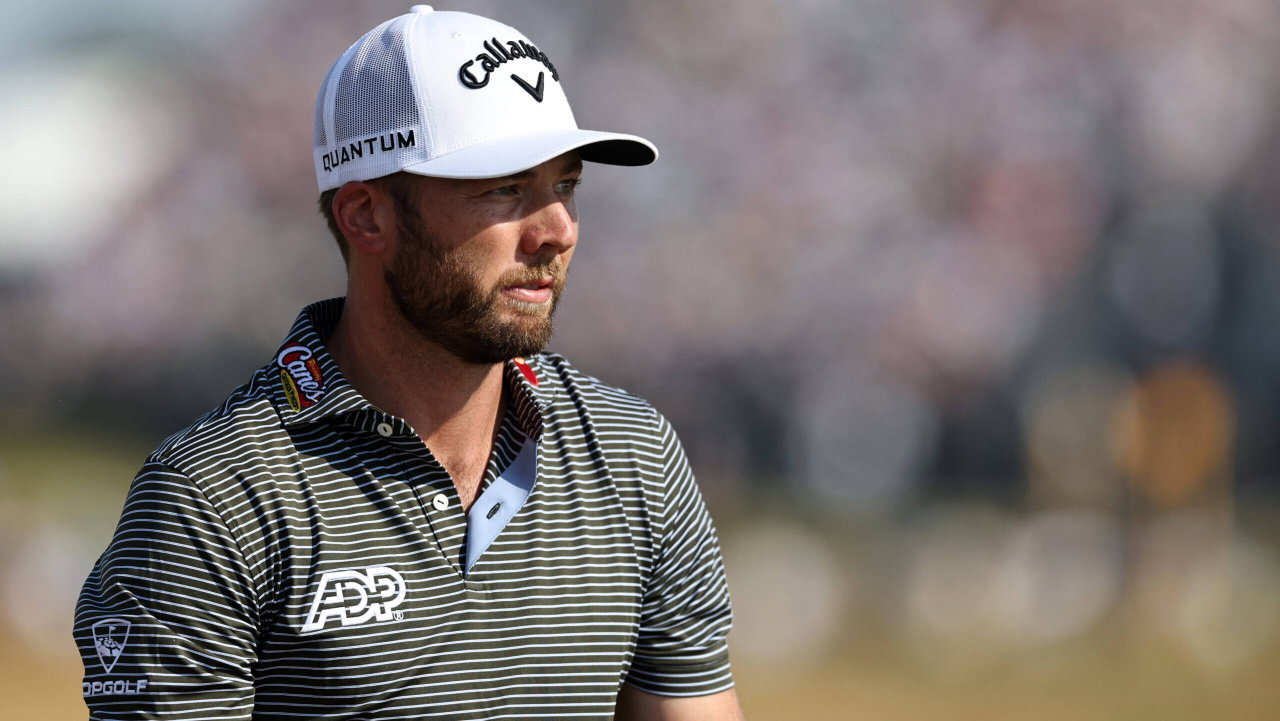
When Sam Burns joined the PGA Tour’s Pace of Play Committee, he wanted to bring in real change. Change that will have a long-lasting effect and improve the fan experience. Barely a few months into his role, Burns grew frustrated. Then he got punished for mistakes that were not his own. Burns eventually walked away from the PGA Tour’s pace-of-play committee, and he explained the reason in blunt terms during a recent sit-down on the Fore Play Podcast, calling the tour’s Pace of Policy pointless and flawed.
Watch What’s Trending Now!
“When slow guys play with me, they are just like, ‘This is the greatest thing ever, because I can be slower and he can make up for it.’ And then we’d have rules officials coming up to our group and put our group on the clock. I was like, “Dude, no! Don’t lump me into this.’ It happened like two or three times, and I finally told them, ‘Take me off the committee. I’m out. This is a waste of time.'”
Sam Burns joined the “Speed of Play Working Group” when the PGA Tour formed it in April 2025, along with Adam Schenk and Jhonattan Vegas. The goal was ambitous: to curb slow play and reward the pros who were actually playing quicker. But a year later, what does Burns’s rant show us?
Hardly any of that materialized. Burns bemoaned that officials would put the entire group on the clock instead of isolating whoever was actually slow, and Burns grew tired of absorbing blame for a fault that wasn’t his. It’s not immediately clear when he left the committee. But the five-time PGA Tour winner explained his alternate solution that the committee refused to adopt.
Sam Burns’s solution can curb slow play for good
So how do you ensure that the guy who is actually playing slow gets punished and not the quick player who happened to be in the same group? It’s a big problem, and from Scottie Scheffler to Justin Thomas, everyone has voiced their frustration about getting unfairly put on the clock. Burns’s solution is simple: don’t put the group on clock.
“I keep telling you [PGA Tour officials], ‘Don’t put the group on the clock. Put the player on the clock, who is slow. They’re like, ‘Okay, yeah, yeah.’ And then it happened again; I said, ‘Alright, I’m out.'”
Kevin Kisner, a four-time PGA Tour winner and now an NBC broadcaster, agreed: “Individual timings would change a lot [in the PGA Tour]. If they were just old [mature] enough to yell at the slow players…”
Burns was also asked about what he does to keep himself focused when his playing partner takes an agonizingly long time. Burns’s response? Exactly what you would expect.
Sam Burns hits out at fellow slow players: “I don’t care. Hurry up.”
You’ve seen Charley Hull sitting with visible disgust around the tee box because players ahead of her were still not done. You’ve heard Brooks Koepka demanding golfers be penalized when they are slow. Now hear it from Burns:
“Just tell my caddie I can’t believe this guy is slow,” Burns quipped when asked what he does while waiting. “Like this sucks. What is this guy doing? Why has this guy not picked a club? He has been standing there for two minutes. Like it’s a 7-iron or 8-iron, just hit one of those clubs. I don’t care. Hurry up.”
No wonder his comment echoed what Ryan Fox said just a few weeks back. Fox said many golfers start discussing their next approach with their caddie after their playing partner has hit their shot. The Kiwi International said that’s the biggest problem that everyone overlooks, and Burns agreed too.
“What have you been doing for the last 45 seconds? It’s either one of two clubs, most likely. You are going to hit a good shot or a bad shot. At least do it quickly… Look, it’s 130 yards to the front. 140 yards to the pin. What do you use to hit 137 yards? Hit that club.”
Ryan Fox came up more than once in the conversation. Burns and Fox were paired together in the final round of this year’s Open Championship at Royal Birkdale, where Burns carried a two-shot lead into Sunday only to shoot 72 while Fox birdied four of his last six holes, including the 72nd, to steal the Claret Jug by one shot. Burns finished third.
The two are also frequent playing partners on tour, and it’s Fox, not some notoriously slow player, whom the hosts jokingly crowned the tour’s unofficial “czar of slow play,” with Burns cast as his “vice president.” The irony: they’re both fast. It’s the kind of mismatch between reputation and reality that fueled Burns’ complaint about the committee in the first place.
Burns also ran through his pre-shot routine on the show, timing himself live: read the number, pick a club, and hit the ball.
“That took about eight seconds,” Riggs said after Burns ran through the sequence live on the show.
The course itself came up too. Burns pointed to Hilton Head as a layout that keeps pace manageable in twosomes, compared to routings that force players to walk 120 yards in the opposite direction after finishing a hole. A stopwatch on the group doesn’t account for that kind of built-in delay. Burns isn’t the only one griping about slow play.
Pros are done with slow play
Lucas Glover called the tour’s field-size cuts an insult to players’ intelligence back in November 2024, telling Golfweek that officials “think we’re stupid” for using pace of play as cover.
Matt Fitzpatrick piled on over social media that same week, calling it “pathetic” that pace of play gets discussed every year with nothing changing.
Back in the 2023 Masters, Brooks Koepka said, “Honestly, I would start stroking guys. If you are going to take that long, you have to get stroked. There are certain circumstances where the wind switches, something like that; it’s understandable, but taking a while is, I just think, unnecessary.”
Bryson DeChambeau, after his prolonged read at the Northern Trust years earlier, suggested timing entire rounds instead of individual shots. On the other hand, Sam Burns just wants officials tracking whoever’s actually causing the delay so his playing partners stop eating the penalty for it.
So what is PGA Tour’s new plan? A data-driven approach.
Group timing exists because the tour can’t track every shot for every player. With 156-man fields and cameras covering only a handful of holes, individual tracking was never realistic. Fans kept complaining anyway. The PGA Tour’s Fan Forward Initiative has flagged pace of play as one of the top issues fans raise, and slow rounds keep drawing criticism for dragging out broadcasts and testing viewers’ patience.
Officials started collecting those numbers in 2026, tournament by tournament and as season averages. Korn Ferry Tour players will see a speed-of-play ranking first, and the PGA Tour could adopt it down the line. It’s essentially what Burns wanted the whole time: track the player who’s slow, not everyone stuck playing with him.
Whether that data ever reaches the PGA Tour is still an open question. But if it does, Burns finally gets the tool he says was missing from the committee, a number that names the actual slow player instead of dragging his group down with him.