
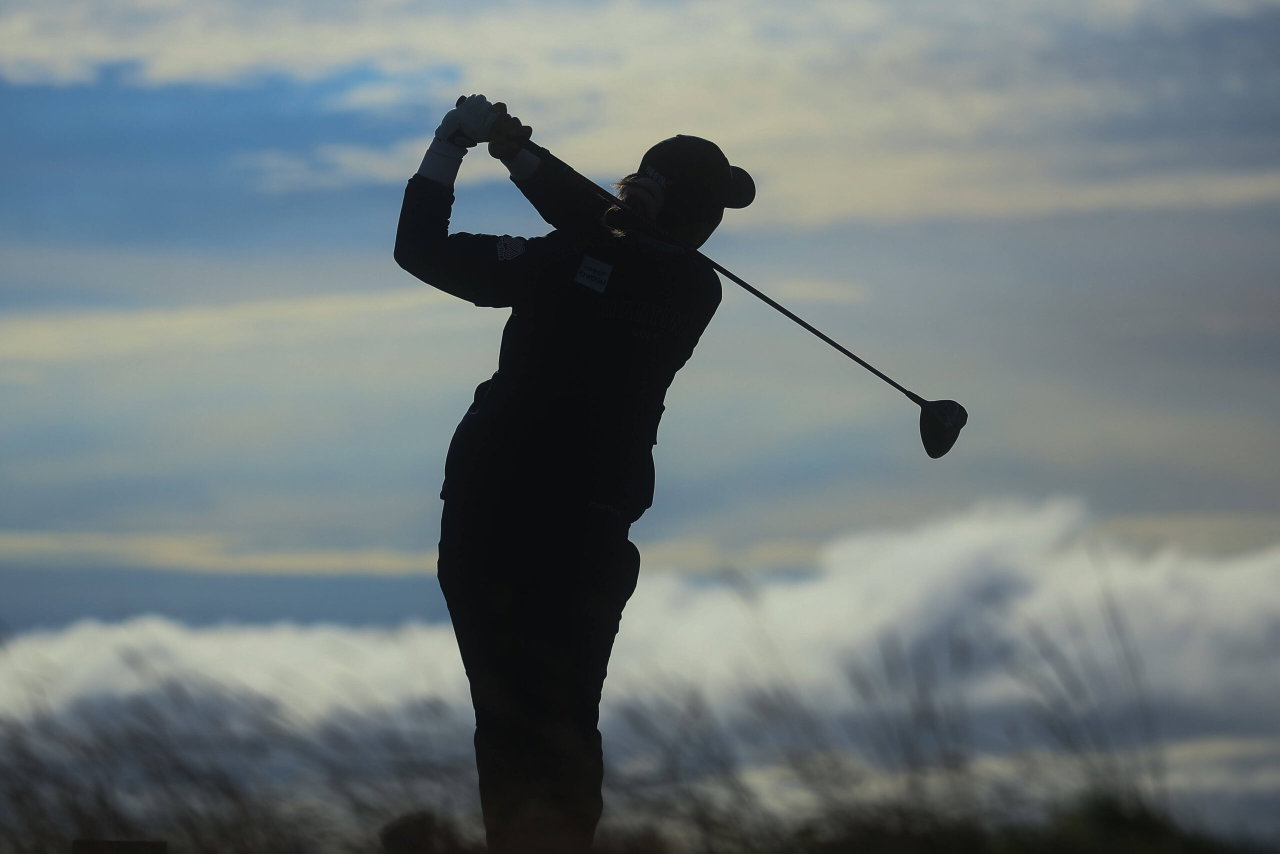
Two days in at the Solheim Cup, and we already have the second TIO ruling in place. A day after Celine Boutier’s partner’s ball ended up on the right side of a creek, thus granting her relief, a fellow team member’s (Esther Henseleit) ball landed near a grandstand, triggering a fresh debate on the ruling.
Watch What’s Trending Now!
The problem, as the debate goes on, is the way the ruling was applied. In a post on X, No Laying Up raised the issue: “Just when I thought I was starting to understand the rules, Esther gets ‘more than one club length but less than two’ relief from TIO on 16. That’s what the rules official told us. Isn’t it just one club length?” Here’s what happened on the 16th.
Henseleit was playing with Leona Maguire against Team USA’s Rose Zhang and Jennifer Kupcho. On the 16th, on the same hole where Boutier received relief yesterday, her ball ended up near a grandstand, which came into line of sight. She received relief. But the question remained: how far can a player actually move when temporary infrastructure gets in the way?
The confusion stems from how line-of-sight relief works. Under Model Local Rule for Temporary Immovable Obstructions (TIOs), which cannot be found in the Rules of Golf, a TIO is a “structure that is temporarily added on or next to the course, usually for a particular competition, and is fixed or not readily movable.” Grandstands, television towers, and scoreboards are some examples. Since they are usually not on the course, they are not considered part of the hazard.
Consequently, golfers get free relief when the TIO interferes with stance, swing, or line of play. The relief area is usually one club‑length from the nearest point of complete relief. So, what about Henseleit’s case?
In this situation, there’s a corridor that can extend it to more than one club-length distance. The line-of-sight (LOS) measurement uses an equidistant arc from the hole. The golfer and the officials decide on a spot from which the TIO is no longer in direct line. Once that exact reference point is established outside of the corridor, you apply the one‑club‑length relief area around that reference point. So collectively, it may go over one club length. Henseleit received relief.
The ruling turned out to be useful for the Europeans. After TIO relief, the European professionals won that hole to tie the scores through 16. On the final hole, Henseleit sank a clutch par putt to secure a 1up win.
Of course, it probably reminds you of Rule 16 about immovable obstruction. There’s one difference between these two, however. You cannot have free relief for line of sight under Rule 16, but that is possible under TIO. That means if there’s an obstruction on the straight line between the ball and the hole, the TIO ruling can come into use.
What made the latest ruling dramatic was Boutier’s relief on day one. She got a controversial TIO relief on the same hole yesterday. Her playing partner, Nanna Koerstz Madsen, hit her tee shot on the par‑5 16th into the right‑side penalty area. Her partner, Boutier, had a spectator bridge in her line of play.
After a lengthy on‑site discussion, Boutier got free TIO relief even though the ball was in a penalty area. In fact, when her first two drops rolled back into the creek, she even got to simply place the ball. Many fans and golfers, including US captain Angela Stanford, questioned the decision.
“There is just no scenario where a player should get relief from a HAZARD. Obviously she is just using the rule to her advantage, as she should; I’m just saying the rule is insane,” Monday Q Info wrote in an X post about yesterday’s controversial TIO ruling.
While the TIO decision keeps the drama going, the round was exciting and competitive.
Saturday foursomes match: Jennifer Kupcho & Rose Zhang Vs. Leona Maguire & Esther Henseleit
Leona Maguire and Esther Henseleit defeated Jennifer Kupcho and Rose Zhang 1 up in Saturday morning’s foursomes. The European team took the lead late by winning two of the final three holes.
Maguire immediately put Europe ahead with a roughly 10-foot birdie putt on the par-4 first. But that lead didn’t hold long, as their American counterparts were quick to tie and then take a lead in the front nine. Rose Zhang made a 20-foot birdie on the par-4 third for a birdie to level the match. The duo then won the fourth and sixth holes, each with par. That sequence moved the Americans 2 up.
But on the back nine, the Europeans won five holes, while the Americans won only two. The comeback began on the par-5 10th. Zhang missed a five-foot par putt, which allowed Europe to reduce the deficit to 1 down. Then, at the par-4 12th, Maguire hit the shot of the match from a fairway bunker, leaving Europe only about three feet for birdie. Esther Henseleit converted to tie the score.
Team Europe then won holes 13, 16, and 18, while Team USA claimed holes 14 and 15. This turned a match that appeared headed for a tie into a decisive point and helped Europe move from 4-4 overnight to a 7-5 overall lead after the morning sessions.
However, after the afternoon session, both teams are tied at 8-8. Tomorrow, on Sunday, singles matches will take place. That, in the end, will prove to be decisive. Let’s hope we don’t have to see another TIO relief on the 16th.