
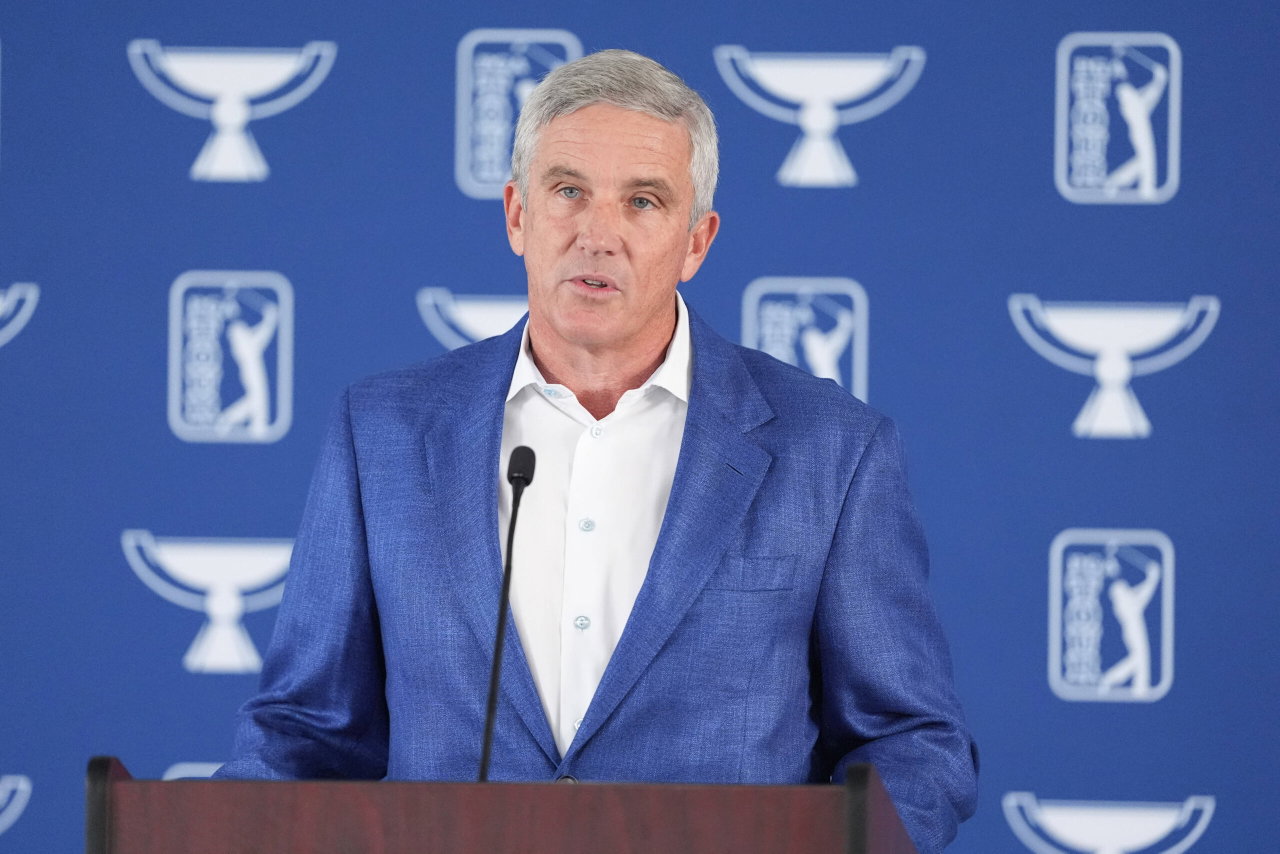
Jay Monahan rarely accepted blame during the PGA Tour’s four-year battle with LIV Golf. But as he prepares to leave office, the commissioner has acknowledged his responsibility for one of the most damaging episodes of that fight: the decision to announce a Saudi partnership without first informing his own players.
Watch What’s Trending Now!
“Anything as it relates to the way that was handled, or the way people were surprised by that, that’s on me,” Monahan said.
The remarks concern June 6, 2023, when the Tour announced on CNBC’s Squawk on the Street that it would partner with Saudi Arabia’s Public Investment Fund, minutes before players learned of the agreement. The announcement blindsided the membership and became one of the defining controversies of Monahan’s tenure.
His willingness to accept responsibility is particularly striking given his previous stance. He invoked the families of 9/11 victims when discussing LIV, told players they would have to choose sides, and once asked on national television whether any player who left had ever apologized for being a member of the PGA Tour.
Monahan made the remarks at his home in Ponte Vedra Beach, Florida, during a conversation with Golfweek columnist Eamon Lynch for the premiere episode of Eamon Lynch Has Questions, which aired Thursday night. With Brian Rolapp set to succeed him on Jan. 1, 2027, the interview offered a final opportunity to revisit the controversy. However, he limited his concession to how they announced the agreement.
What he takes responsibility for
Monahan was specific about where he believes he failed.
“Because I mishandled the communication, because the rollout was a failure, that ended up prolonging all of that,” he said.
“All of that” refers to the fallout from an agreement intended to end the dispute. The announcement instead intensified tensions, bringing litigation, congressional scrutiny, stalled negotiations, and further divisions within the membership.
Monahan attributed those consequences to the failed communication and suggested that other circumstances might have led to a different reception of the agreement. He did not question the decision to pursue it.
Where his defense stops
Asked whether he should have reached an agreement with the Saudis before LIV launched, a criticism he has faced since 2021, Monahan rejected the premise. He argued that LIV initially viewed the PGA Tour as a “feeder tour” from which it could recruit players individually rather than an organization with which it wanted to negotiate.
He described the appeal of the 2023 agreement as an effort “to take a competitor off the board, to have them exist as a partner, not an owner.”
That rationale required players to accept a dramatic reversal. After spending more than a year being told LIV posed an existential threat, they were suddenly being asked to welcome its financial backer as a partner. The absence of prior consultation made the transition even harder to absorb.
LIV’s subsequent collapse has changed the competitive landscape. Its funders pulled out, the proposed relaunch financing didn’t succeed, and the league notified a bankruptcy court this week that it planned to wind down and liquidate. But its fate does not resolve the questions surrounding the Tour’s decision to partner with the PIF.
The timing
Monahan’s willingness to revisit the controversy comes at the end of his tenure rather than during the dispute itself. He retires at the end of the year, with Rolapp taking over on Jan. 1, 2027.
Asked about his legacy, Monahan left the final assessment to others.
“History will determine what my impact or what my legacy was,” he said, “and I’m very comfortable with that, because I gave everything I could to try and help the PGA Tour.”
He also discussed the personal toll of the period, including the leave of absence he took in 2023. A White House meeting with President Trump and PIF governor Yasir Al-Rumayyan in February 2025 also failed to produce the agreement his board had expected.
Assessing his tenure
Monahan’s record extends beyond the Saudi agreement. After the framework deadline passed at the end of 2023, the Tour secured a $1.5 billion investment from Strategic Sports Group through PGA Tour Enterprises, signed new media agreements and deepened its alignment with the DP World Tour.
Those developments helped stabilize the organization, but they do not settle whether the original partnership was the right decision. The organisation later asked players who turned down LIV offers, trusting Monahan’s assurances, to accept the PIF as a partner. That wider breach of trust remains beyond the scope of his latest explanation.
Nor does LIV’s collapse provide a definitive answer. The league is winding down after BC Partners Credit withdrew from a proposed $300 million relaunch financing, while Jon Rahm, Tyrrell Hatton and Sergio García are among the players who have said they will not join its successor competition.
Those developments now form part of Rolapp’s inheritance. He takes over a Tour that survived its biggest competitive threat but still faces unresolved divisions within its membership and decisions about how former players might return.
Monahan believes history will determine his legacy. His interview establishes where he accepts responsibility, but leaves the larger judgment untouched. He has conceded the failure of the announcement, not the decision itself. That distinction could eventually determine the legacy of his leadership.