
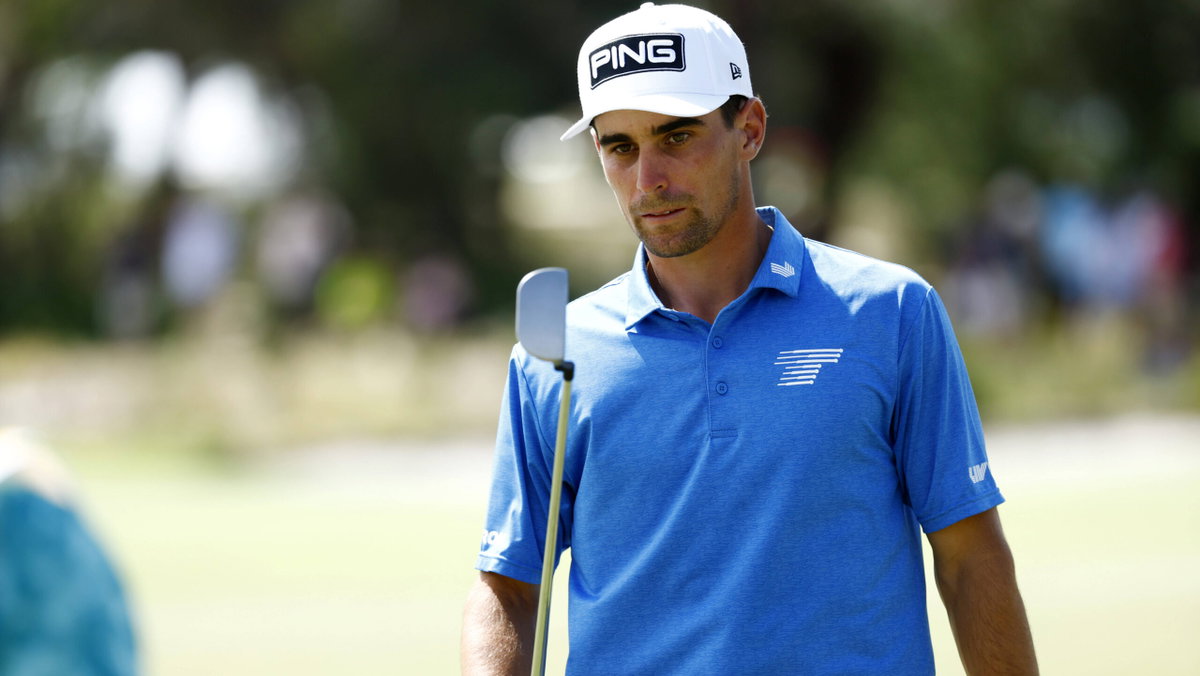
As Joaquin Niemann sat down to explain the two-stroke penalty that cast a shadow over his U.S. Open, another dispute was already unfolding away from the spotlight. New details suggest that Niemann’s caddie, Diego Salinas, pushed back against the reporting that first brought the incident to light. His response is now adding another layer to a controversy that was already drawing attention because of the championship’s newly introduced code of conduct.
Watch What’s Trending Now!
Gabby Herzig of The Athletic was among the first to report details of the incident after speaking with a volunteer who witnessed it. While gathering additional information, Herzig also sought comment from Niemann’s team and his caddie, Diego Salinas. The response she received contrasted sharply with Niemann’s own remarks.
While Niemann was inside the interview room addressing the penalty, a separate confrontation was unfolding outside it. Earlier that morning, after the USGA announced the ruling, Herzig had tracked down the volunteer who witnessed the incident on the sixth hole and obtained additional details about what transpired. When she later approached Niemann’s team for comment, Salinas reportedly pulled up her report on his phone, called her a “clown,” and argued that it was irresponsible to report details of an incident she had not personally witnessed.
Herzig clarified that her reporting was based on a firsthand account from a volunteer who identified himself by name and invited Salinas to share his version of events. According to Herzig, Salinas responded that providing his side was not worth his time. When asked repeatedly which aspects of the report were inaccurate, neither Salinas nor any member of Niemann’s team identified any specific errors or disputed the eyewitness account.

I'm more bothered by the way Niemann's caddie treated @GabbyHerzig than by Niemann throwing a club tbh.


.@JosephLaMagna on an eventful 24 hours for Joaquin Niemann (and his team) 👇 thefriedegg.com/articles/2026-…
According to Herzig, members of Niemann’s camp also argued that similar behavior from other players had gone unpunished and suggested his affiliation with LIV Golf influenced both the ruling and the public reaction.
Meanwhile, Niemann suggested the officials’ rebuke may have been excessive, but he didn’t refuse his actions. He said, “I wouldn’t be happy seeing players throwing clubs and behaving in that way; I mean, I agree.”
By now, the incident is well known across the golf world. Niemann arrived at the U.S. Open following a strong LIV Golf season and was still searching for his first major championship victory. Due to weather delays, Niemann was unable to complete his opening round until Friday morning. He started on the back nine on Thursday, but the situation escalated on the par-4 sixth hole, his final hole before play was suspended for darkness.
After hitting two tee shots out of bounds, Niemann’s third tee shot came to rest in the native area. Facing a difficult lie roughly 131 yards from the pin, he requested free relief under Rule 16.2a, citing the presence of fire ants near his ball. Tournament officials denied the request.
The LIV Golf star’s frustration boiled over at that point. According to the eyewitness account later shared with The Athletic, Niemann kicked the marker flag a volunteer had used to identify his ball, kicked sand near the area, and then threw his sand wedge approximately 50 yards toward the edge of the native area. A police officer later retrieved the club and returned it to him.
On Friday morning, the USGA reviewed the incident and determined Niemann’s actions violated the championship’s code of conduct. Although the policy follows an escalating structure of warning, two-stroke penalty, and disqualification, the USGA determined Niemann’s actions constituted serious misconduct and bypassed the warning stage.
“Joaquin Niemann was assessed two penalty strokes for throwing a club on the 6th hole during Round 1. This act was determined to be serious misconduct under Rule 1.2b,” the USGA said in a statement.
The USGA further clarified its ruling.
“If a player’s or caddie’s behavior is so far removed from what is expected in the spirit of the game of golf, in accordance with Rule 1.2b, the Chief Referee, in consultation with the Championship Directorate, may apply a penalty of two strokes or disqualification, taking account of frequency, impact, intent, and severity of misconduct.”
Niemann was informed of the penalty after signing his first-round scorecard and just 37 minutes before the start of his second round. The ruling turned his quintuple-bogey 9 on the sixth hole into an 11.
By his own account, the news left him devastated, and his coach, Pete Cowen, later revealed that Niemann broke down in tears on the driving range after learning of the penalty.
Despite the setback, Niemann regrouped quickly, birdieing five of his first six holes and carding a 5-under 65 in the second round, matching the lowest score of the day.
“Took me probably 30 minutes to get over it, then two minutes to hit some tee shots, two putts, and then go out,” Niemann said. “I mean, nice birdie on the first and the second, so yeah, it was a good start.”
With that in mind, all four major governing bodies and the PGA Tour collaborated on a new code of conduct policy aimed at holding players and their teams to a higher standard of behavior on the course.
The policy will apply across all four men’s major championships. In April, R&A chief executive Mark Darbon confirmed that similar conduct standards would be enforced at The Open Championship.
Despite carding an 11 on the sixth hole, Niemann made the cut and will continue into the weekend. He entered the third round at 3 over par and was paired with Jordan Spieth.