
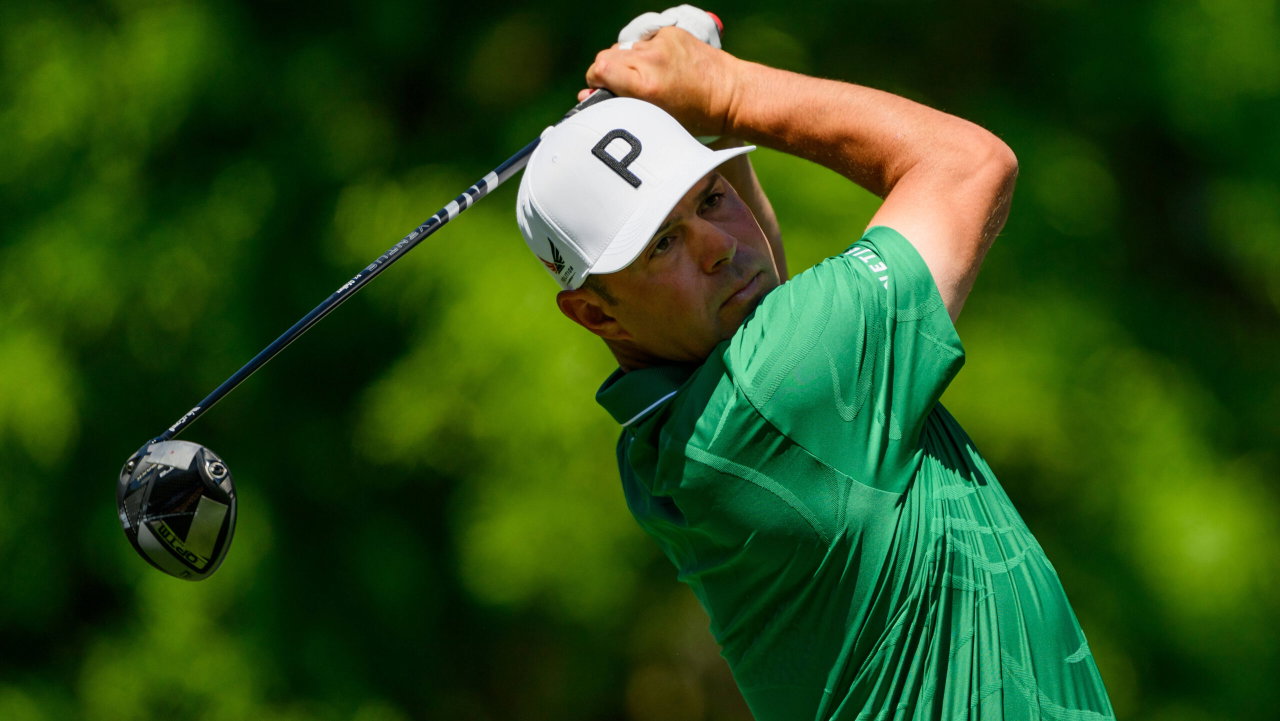
U.S. Open champion Gary Woodland still struggles to be out on the golf course nearly three years after brain surgery. In 2023, doctors removed a lesion from his brain that had triggered seizures and crippling anxiety. He has recovered a lot but still battles PTSD. Through it, he has leaned on a steady, positive mindset to keep competing at the highest level.
Watch What’s Trending Now!
“When I’ve gone through some treatment and when I’m doing, when I’m struggling, I put my hand on my heart just to remind myself that I’m alive,” Woodland explained at the BMW Championship on Thursday during the press conference. “And if I can feel my heartbeat, I know I’m breathing. And when I have done that this year, just to try to slow my heart down, I tell myself I’m safe and all will be right.”
While the positive outlook has helped Woodland through his battles, he shared an incident that put his own struggles into perspective. He referenced an 11-year-old boy from New Zealand who followed him at last week’s FedEx St. Jude Championship in Memphis.
Unfortunately, the child is living with an inoperable brain tumor. Knowing that, Woodland said that showing the boy he could keep competing despite his own struggles meant far more to him than simply showing up on a leaderboard. It’s the bigger picture that matters to him – to show up while struggling in hopes that others facing illnesses might see it and do the same.
Woodland’s health crisis began in early 2023. Months after the Masters, Gary started experiencing tremors, chills, and crushing anxiety. Doctors initially tested for Parkinson’s disease, but an MRI instead revealed a lesion pressing on the part of his brain that controls fear and anxiety. As a result, it triggered partial seizures that jolted him awake at night. Speaking about it a few months ago, he described it as a stretch of four to five months where he genuinely feared he was dying, regardless of what the doctors told him.
Medication helped him keep playing that summer, but symptoms kept worsening.
Woodland continued to play through the summer of 2023, hoping medication could keep the symptoms under control. But after the Wyndham Championship in early August, he and his caddie recognized that pushing through was no longer a sustainable option. It proved to be his final start before stepping away from competition to focus on surgery and recovery.
Later that month, Woodland publicly disclosed that doctors had found a lesion on his brain and that he would undergo surgery. Noting that he had consulted multiple specialists and discussed the decision with his family before determining that surgery was the best option after medication had failed to adequately manage his symptoms.
The days before the procedure underscored how frightening the experience had become. Woodland wrote goodbye letters to his wife, Gabby, and their three children because he feared he might not survive the operation. The letters, intended to be read only if he did not come home, reflected the worst-case scenarios that had consumed him in the months leading up to surgery.
On September 18, 2023, he had to undergo a craniotomy to remove the lesion. In the months that followed, Gary Woodland received encouraging medical news. Follow-up MRI scans showed the remaining lesion was stable, and he said he had not experienced another seizure after surgery. The results reassured him that the procedure had worked in the most urgent sense, even as doctors continued to monitor him with regular imaging.
Woodland returned to PGA Tour competition at the Sony Open in Hawaii in January 2024, just 115 days after the surgery. It was his first Tour start since the 2023 Wyndham Championship, and the return carried far more weight than the 1-over 71 he posted in the opening round. Although he missed the cut, simply stepping onto the first tee marked a major step in his physical recovery.
On the other hand, the physical progress did not erase the trauma of what had happened. Woodland later revealed that he had continued to deal with PTSD, including moments of panic and hypervigilance during tournaments.
Gary has recalled terrifying moments of panic during rounds, such as being startled by a walking scorer or a cart movement, that reduced him to tears in the middle of a fairway and led him to hide in restrooms.
Woodland now seems determined that he doesn’t want to keep “living a lie,” as he further shared, “I have more energy, and that’s the big deal. I was wasting energy, hiding that, and I’m not wasting the energy anymore.”
His progress has also been reflected in his results. In March, he won the Texas Children’s Houston Open for his first PGA Tour victory since the 2019 U.S. Open and the fifth title of his career. He closed with a 3-under 67 at Memorial Park to finish at 21-under 259, five shots ahead of Denmark’s Nicolai Højgaard. The win came just weeks after Woodland publicly discussed his PTSD, offering clear proof that his return has become more than a symbolic comeback.
Gary Woodland entered the BMW Championship 31st in the FedEx Cup standings, just outside the cutoff line for East Lake. But a 6-under 64 in round 1 has vaulted him into projected position No. 12. Maybe the Tour Championship will finally be firmly within reach for Woodland for the first time since 2019.