
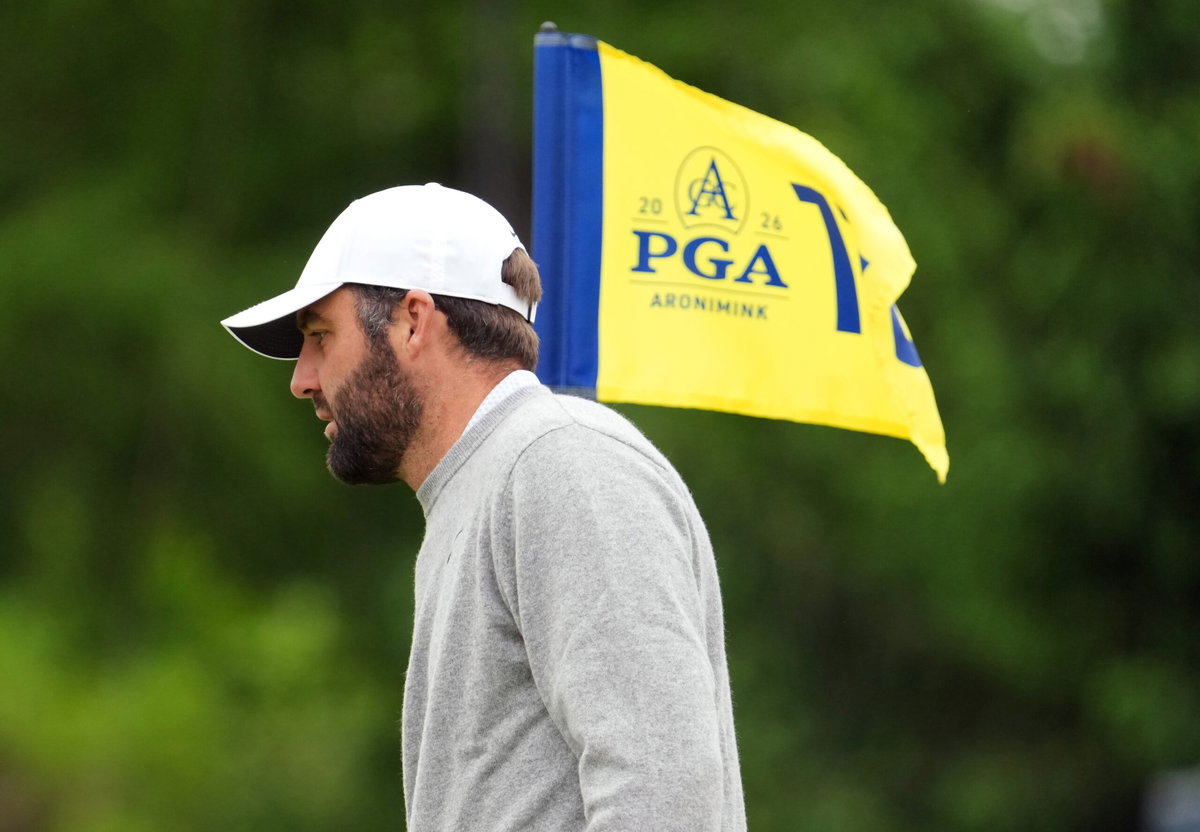
The PGA Championship is in its 108th edition this year, and it is still fighting to prove it belongs at golf’s top table. That tension was on full display Wednesday at Aronimink Golf Club, where PGA of America CEO Terry Clark and chief championship officer Kerry Haigh addressed what has now become one of golf’s most persistent debates.
Watch What’s Trending Now!
Clark was direct when asked whether the championship has lost its identity by moving away from August. “I really think we’ve got a strong position in May,” he said. “I like that we don’t have to think about changes for the Olympic years. I think we can stand out in a window… there’s a unique spot that we sit.” On the question of moving back to August, he was unambiguous: “I don’t see that as one. I’m really pushing on a change right now.”
The PGA Championship moved from August to May in 2019 after the PGA Tour reshaped its calendar around the FedEx Cup Playoffs and The Players Championship, with part of the motivation being to avoid competing with the NFL later in the summer. The move also compressed the men’s major season from a five-month stretch into a far tighter April-to-July window.
The pushback from players, however, has been difficult to ignore. Rory McIlroy said the move to May has directly hurt his results. “Since the tournament has moved to May, my results haven’t been that great here at the PGA,” the golfer said at Aronimink. “I feel like it’s a very tight window between the Masters and this tournament.”
His numbers support that. Before 2019, McIlroy won the PGA Championship twice, in 2012 and 2014. Since the move to May, he has managed just three top-10 finishes and finished T-47th last year.
McIlroy has repeatedly tied the issue to the tournament losing part of what once made it distinct. “I think glory’s last shot. I think it needs to go back to August,” he said earlier this year, referencing the old tagline that framed the PGA Championship as the final major chance of the season. “The Masters was The Masters, the US Open was the hardest, The Open was links golf and the PGA was your final chance.”
Haigh offered an agronomic defence of the May slot, pointing out that August brought its own problems, including 100-degree heat, repeated lightning delays in 8 of 11 years, and Olympic year disruptions. “I think this week speaks for itself,” he said, pointing to Aronimink’s condition.
But the course scheduling debate is only one layer of a deeper problem. The PGA Championship sits in a calendar window now shared by three PGA Tour Signature Events, each carrying $20 million purses and the majority of the tour’s best players. The RBC Heritage, Cadillac Championship, and Truist Championship all fall between the Masters and the PGA, making it harder for the major to stand out.
That congestion has increasingly blurred the line between elite PGA Tour stops and the year’s second major. While the Masters, US Open, and Open Championship all retain instantly recognizable identities tied to venue style, course setup, or history, the PGA Championship has struggled to define what separates it from the modern tour schedule.
McIlroy put it more bluntly earlier this year: “It’s The Players. Like it doesn’t need to be anything else. I would say it’s got more of an identity than the PGA Championship does at the minute.”
The comparison stung because The Players Championship is not officially a major, yet many inside the sport now view it as more culturally distinct than the PGA Championship itself.
Clark also addressed 2027, when the championship heads to PGA Frisco in Texas, a venue that has already drawn skepticism. He pushed back confidently, noting it will be the first men’s major in the Dallas/Fort Worth area in over 60 years and pointing to strong early ticket and hospitality sales. Haigh added that changes have been made to the course based on feedback from two prior events there, including the addition of shade trees.
Course identity has quietly become part of the criticism too. The PGA Championship has often rotated through high-end parkland venues that, while impressive, can feel visually similar to regular PGA Tour stops. In contrast, Augusta National, Pinehurst, Pebble Beach, and traditional Open rota links courses tend to carry instantly recognizable visual and historical weight.
The bigger identity question, though, sits beyond dates and venues. Clark has already made one quiet but pointed statement, limiting PGA of America attendees at the past champions’ dinner to just himself and vice-president Nathan Charnes, a significant shift from a guest list that previously swelled to around 50 people who had never won the championship.
The move was viewed internally as an effort to restore exclusivity to one of the championship’s most traditional spaces and reduce the corporate feel that critics believe has increasingly surrounded the event.
It is a small move, but a deliberate one from a leader who appears to understand that fixing the PGA Championship’s identity starts with fixing the culture around it.
Beyond the course, a new rule is now monitoring every player.
Players’ code of conduct comes to the PGA Championship 2026
The PGA Championship has adopted a formal player code of conduct this week, developed collaboratively across all four majors and the major tours. Haigh confirmed it mirrors a pace-of-play style framework: the first offence draws a warning, and the second costs two shots.
The timing connects directly to Augusta in April. Garcia destroyed his driver on the second tee during the Masters final round, snapping the clubhead clean off after slamming it into a cooler. Competition committee chairman Geoff Yang issued golf’s first formal conduct warning at a major on the fourth tee.
Garcia’s pattern made the policy difficult to ignore. He had broken his driver in virtually identical circumstances at Royal Portrush during the 2025 Open Championship, same hole, same outcome; no policy existed then to respond formally. Augusta changed that, and the other majors followed quickly.
MacIntyre also received a warning at Augusta after he made a middle-finger gesture following a quadruple bogey at the 15th hole. Both incidents went viral within minutes.
The majors’ concern extends beyond isolated incidents. With player reactions now circulating instantly across social media, officials have become increasingly conscious of how the sport presents itself publicly, particularly during its biggest events.
Max Homa captured the broader concern plainly: breaking clubs makes players look spoiled, and the next generation deserves better role models. The policy now has teeth.